
Why Content Publishers Price Newsletter Ads the Way They Do

Updated: Jun 5
Looking to monetize your newsletter? Learn how Media Intercept helps publishers grow newsletter revenue without requiring exclusivity.
Newsletter ad pricing often looks arbitrary to advertisers encountering it for the first time. Why does one newsletter with 50,000 subscribers charge $500 per placement while another with the same list size charges $5,000? Understanding why content publishers price newsletter ads the way they do is not just an academic exercise. It directly affects how you allocate budget, select partners, and measure return on your spend. This article breaks down every major pricing driver, explains the models publishers use, and gives you the frameworks to negotiate and plan campaigns with confidence.
Table of Contents
Key takeaways
Point | Details |
Engagement beats list size | Open rates and niche specificity determine “engaged reach,” which drives pricing more than raw subscriber count. |
Model choice shapes ROI | Flat fee, CPM, CPC, and hybrid structures each affect how you calculate and predict campaign returns. |
Direct deals cost more for a reason | Direct sponsorships command rates 20 to 50 times higher than programmatic, justified by audience exclusivity. |
Bundles improve unit economics | Frequency packs reduce your cost per placement and build brand recognition through repeated audience exposure. |
Publisher trust carries a price premium | Creator-led newsletters with verified performance metrics justify higher rates and deliver measurably better engagement. |
Why content publishers price newsletter ads based on audience value
Raw subscriber count is the least reliable pricing signal in newsletter advertising. A general marketing newsletter with 200,000 subscribers and a 15% open rate has roughly 30,000 engaged readers per send. A cybersecurity newsletter with 20,000 subscribers and a 45% open rate reaches 9,000 readers, but those readers are CISOs, security architects, and IT directors with budget authority. The second list commands a higher price, and it should.
Audience quality and engagement are the primary pricing variables, far more than subscriber count. Publishers who understand their readers know exactly what that access is worth to an advertiser selling into that niche. That knowledge gets priced in.
A few specific factors drive the premium:
Open rate as engaged reach. A publisher with a 45% open rate is selling you access to nearly half their list every send. One with a 12% open rate is delivering far fewer actual impressions regardless of the headline subscriber number.
Niche demand. Reaching a general business audience is relatively easy across many channels. Reaching, say, a confirmed list of procurement managers in manufacturing is genuinely hard to replicate elsewhere. Scarcity drives pricing up.
Ad slot limits. Publishers who cap placements at one or two sponsors per issue create artificial scarcity, which keeps CPMs high and protects advertiser share of voice. This is a deliberate pricing tactic, not a capacity limitation.
Generalist vs. specialist pricing. Pricing tiers stratify far more by audience intent and niche scarcity than by sheer list size. A specialist newsletter can price at 3 to 5 times the CPM of a generalist newsletter at the same subscriber count.
Pro Tip: When evaluating a newsletter for potential sponsorship, ask for the last 90 days of average open rates, not just a claimed subscriber number. An engaged list of 10,000 is often more valuable than an unengaged list of 100,000.
Pricing models every advertiser should understand
Publishers use several distinct pricing structures, and each one carries different implications for your budget planning and ROI measurement.
Model | How it works | Best for |
Flat fee | Fixed price per placement regardless of performance | Predictable budgeting, brand awareness |
CPM | Cost per 1,000 impressions delivered | Scale-focused campaigns with clear impression goals |
CPC | Cost per click tracked to your destination | Performance campaigns focused on traffic or conversions |
CPA | Cost per acquired customer or lead | Lower-funnel campaigns with trackable conversion events |
Hybrid | Base flat rate plus per-click or performance bonuses | Aligning publisher and advertiser incentives |
Flat fee pricing anchored on CPC benchmarks of $2.00 to $2.50 per click is the most common structure for small to mid-size newsletters. Publishers use their historical click data to justify the flat price, which simplifies the sale for them and gives you a predictable cost. You are essentially buying a guaranteed placement with an implied performance floor.
Hybrid pricing models that combine a base rate with per-click bonuses are growing in popularity because they align both parties toward the same outcome. A publisher has more incentive to give your creative prime placement when their payout increases with better performance. For you, the base rate caps your downside while the bonus structure keeps your cost tied to results.
CPA deals are less common in newsletters because tracking attribution across email clients is technically challenging, but they do exist in performance-focused niches. The CPC vs flat-fee comparison matters most when you are deciding whether to prioritize predictable spend or performance accountability.
Programmatic vs. direct deals in newsletter pricing
This is where advertiser confusion runs deepest. Many marketers assume newsletter CPMs should mirror what they see in programmatic display networks, and that assumption leads to real budget misjudgments.

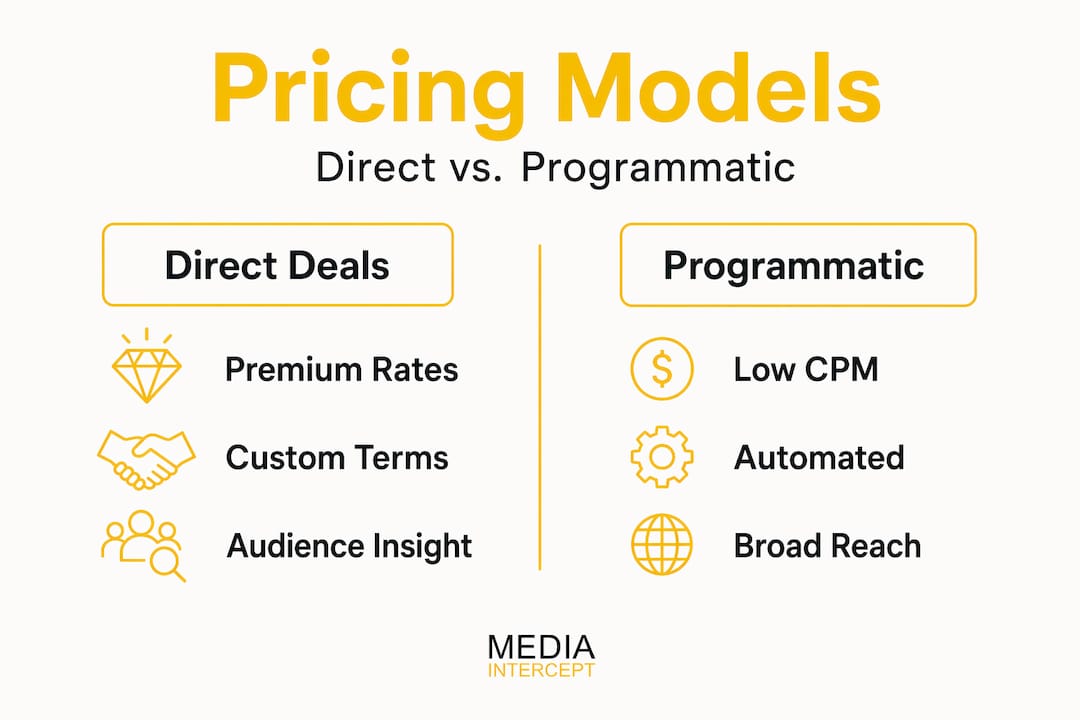
Programmatic networks often commoditize newsletter inventory, pushing CPMs below $5. Publishers who accept those rates are essentially selling ad space at clearance prices to fill unsold inventory. Savvy publishers do not let those figures anchor their direct sponsorship rates, and they should not. Programmatic is inventory filler. Direct deals are a different product entirely.
Here is what justifies the premium in direct newsletter sponsorships:
Audience knowledge. A direct publisher can tell you exactly who reads their newsletter, what they care about, and what they have clicked on previously. No programmatic network offers that level of detail.
Exclusivity. When you buy a direct sponsorship, you are often the only advertiser in that category in that issue. That share of voice is not available at scale through ad networks.
Context and creative control. Direct deals let you place native-style ads that match the editorial voice of the newsletter, significantly improving engagement compared to banner-style programmatic units.
Verified performance history. A publisher selling a direct deal can show you actual click and open data from previous sponsors, which lets you model expected performance before you commit.
Direct-negotiated sponsorships command rates 20 to 50 times higher than programmatic CPMs. That premium reflects real, quantifiable advantages in targeting precision, context, and creative integration. For advertisers using programmatic advertising as a baseline, newsletter direct deals represent a fundamentally different value proposition rather than an inflated version of the same thing.
Why bundle pricing is gaining ground
Single placements work for testing a new publisher, but publishers increasingly structure their most attractive pricing around commitment packages. This benefits both sides of the transaction in measurable ways.
Publishers sell bundles and frequency packs structured as pilot or sustained quarter packages, with pilot bundles starting around $14,000 and sustained quarter packages exceeding $28,000. These bundles typically include multiple primary ad placements plus secondary formats like spotlight callouts or advertorial sections.
From your perspective as an advertiser, bundle pricing offers several concrete advantages:
Lower cost per placement. The unit economics of a bundle almost always beat single-placement rates.
Frequency effect. Repeated exposure in the same newsletter builds brand recognition with an audience over time, and research consistently shows that conversion rates improve with multiple impressions before the click.
Predictable spend. A quarter-long bundle lets you lock in your newsletter advertising spend and plan the rest of your budget around it.
Prioritized placement. Publishers managing capacity prefer committed advertisers and often reward bundle buyers with better creative positioning.
Frequency packs offer better CPC pricing per placement than single ads, which directly improves your return on ad spend when you track clicks or conversions across the campaign period.
Pro Tip: If you are testing a new newsletter publisher, negotiate a pilot bundle rather than a single placement. You get better unit pricing, more data points to evaluate performance, and a stronger starting relationship with the publisher for future negotiations.
Nuanced factors that influence newsletter ad costs
Beyond the foundational variables, several less obvious factors shape the final price you pay for a newsletter placement.
Creator reputation and audience trust. Creator-led newsletters command premiums due to higher trust and engagement. When a recognized expert writes a newsletter, their endorsement of a sponsor carries implicit credibility. Readers are more likely to act on a recommendation from a trusted voice than on a standard ad unit. That trust premium is real and gets priced accordingly.
Exclusivity and limited ad slots. A publisher who sells only one sponsorship per issue delivers 100% share of voice. That exclusivity justifies prices well above what you would pay to appear alongside three or four competing brands in the same email.
Verified performance data. Publishers with clean, documented performance histories can price with confidence. When a publisher shows you three months of click data from comparable advertisers, they are not just building your confidence. They are demonstrating that their pricing is backed by evidence rather than wishful thinking.
Publisher monetization strategy. Publishers are shifting from volume-based models to loyalty-based relationships to protect revenue. That shift changes how they price. A publisher focused on long-term relationships prices differently from one trying to maximize short-term fill rate. The loyalty-focused publisher invests in audience quality, which justifies higher sustained pricing.
“Advertisers should prioritize publishers who demonstrate deep knowledge of their audience over focusing solely on list size vanity metrics.” Jane Friedman
My take on what these pricing signals actually tell you
I’ve spent years working inside newsletter advertising, and the single biggest mistake I see advertisers make is treating a high price as a red flag. When a publisher charges $4,000 for a placement in a newsletter with 30,000 subscribers, the instinct is to balk. But in my experience, that price is usually a signal, not a barrier.
What I’ve learned is that publishers who know their audience well enough to price confidently are the ones whose readers actually convert. The publishers who discount aggressively often do so because they cannot defend the value of their list. When I’ve compared campaign results across price points, the higher-priced direct placements in niche newsletters have almost always delivered stronger CPC outcomes than cheaper, higher-volume alternatives.
The hidden value in direct newsletter sponsorships goes far beyond the click. When a trusted publisher writes about your brand in their editorial voice, you get association with their credibility. That lift in brand perception does not show up in your click report, but it affects how subsequent ads perform across your entire funnel. I’ve watched brands see improved conversion rates on their paid search campaigns in the weeks following a newsletter sponsorship push, and that connection is easy to miss if you only track last-click attribution.
My advice: when negotiating, focus the conversation on the publisher’s open rate trends, their audience composition, and what similar advertisers have achieved. A publisher who can answer those questions specifically is worth paying a premium for. One who deflects to subscriber count is not.
— Media Intercept
Plan your next newsletter campaign with Media Intercept
Understanding newsletter ad pricing is the first step. Executing a campaign efficiently across the right publishers is where results happen.
Media Intercept connects advertisers and marketers with premium newsletter publishers across high-value niches, offering both CPC and flat-fee placement options so you can match the pricing model to your campaign goals. The platform handles targeting, reporting, and execution in one place, so your team spends time on strategy rather than logistics. Whether you are running a pilot test or a sustained quarter campaign, Media Intercept’s newsletter sponsorship platform gives you the tools to plan, execute, and measure every placement. You can also explore Media Intercept’s publisher guides for deeper guidance on pricing benchmarks and audience targeting strategies.
FAQ
Why do newsletter ad prices vary so much between publishers?
Prices vary primarily because of audience quality, open rates, and niche specificity rather than subscriber count. A smaller, highly engaged list in a specialized industry commands higher rates than a large, low-engagement general list.
What is a typical CPM for a direct newsletter sponsorship?
Direct newsletter CPMs are significantly higher than programmatic rates, which sit below $5. Primary placements in mid-size B2B newsletters typically range from $1,500 to $5,000 per placement in 2026.
Is flat-fee or CPC pricing better for advertisers?
Flat-fee pricing offers predictable spend while CPC ties your cost directly to performance. Many publishers use flat fees anchored to CPC benchmarks around $2.00 to $2.50 to give advertisers both predictability and implied performance accountability. Your choice depends on whether you prioritize budget certainty or performance accountability.
Why are newsletter bundle packages worth considering?
Bundles deliver a lower cost per placement, improve audience familiarity with your brand through repeated exposure, and lock in predictable spend for the quarter. Frequency packs improve advertiser ROAS by spreading fixed costs across multiple placements while building cumulative audience recognition.
How do I know if a publisher’s pricing is justified?
Ask for verified open rate data, historical click performance from comparable advertisers, and a breakdown of their audience composition. Publishers who can provide specific, documented answers to those questions have earned their pricing. Those who cannot are selling on hope rather than evidence.
Recommended
Related Publisher Resources
Explore Media Intercept’s newsletter monetization platform for publishers.
Download our newsletter advertising guides for more publisher monetization and sponsorship planning resources.
Review our newsletter advertising glossary for common terms around CPC, CPM, publisher payouts, tracking links, and campaign reporting.