
What is a Premium Media Publisher for Brands?

Updated: Jun 5
Looking to monetize your newsletter? Learn how Media Intercept helps publishers grow newsletter revenue without requiring exclusivity.
Most marketers can identify a premium publisher when they see one. Far fewer can articulate what actually makes it premium, or why that distinction should shape their ad spend. Understanding what is a premium media publisher goes well beyond recognizing a big logo. It defines the quality of the environment where your brand appears, the trust your audience extends to that context, and the measurable lift your campaigns earn as a result. This article breaks down the definition, the data behind the advantages, and the strategic moves worth making.
Table of Contents
Key takeaways
Point | Details |
Premium goes beyond reach | A premium media publisher earns its status through editorial credibility and user experience, not audience size alone. |
Brand trust lifts significantly | Ads in premium environments increase brand trust by 85% compared to non-premium placements. |
PMPs unlock premium inventory | Private marketplaces give advertisers access to curated, brand-safe inventory at higher CPMs with greater transparency. |
Engagement beats volume | Premium publishers deliver higher CTR (0.19%) than non-premium (0.07%) despite fewer total impressions. |
Strategy over savings | Choosing premium publishers is a long-term brand equity decision, not just a placement cost comparison. |
What is a premium media publisher?
The definition of media publisher, at its most basic, is any entity that produces and distributes content to an audience. But the premium distinction requires meeting two separate standards simultaneously: brand credibility and environmental quality. Strip away either one and you no longer have a premium publisher.
Brand credibility is what a publisher has built before a single user clicks an article. It is the editorial reputation, the authority in a subject area, the consistency of tone, and the history of trustworthy reporting or content creation. Think of publications with years of institutional credibility in finance, health, or technology. Their audiences arrive with a pre-existing level of trust. That trust transfers, at least partially, to any brand that appears alongside their content.
Environmental quality is what users experience once they arrive. This covers site design, content relevance, page load speed, and the density and placement of ads. A publisher running interstitial pop-ups every thirty seconds fails this test regardless of their editorial reputation.
What separates premium from non-premium boils down to these core qualities:
Editorial standards enforced consistently across all content
Controlled ad loads that do not overwhelm the reading experience
Audience engagement driven by content quality rather than clickbait
Consistent visual identity and navigational clarity
Transparent data practices and brand-safe content categories
Publishers with premium experience are 86% more likely to drive longer site visits, and 67% of consumers find premium environments more enjoyable. Those numbers reflect the compound effect of getting both layers right simultaneously.
Pro Tip: When evaluating a potential publisher partner, request their editorial guidelines alongside their media kit. A premium publisher will have written standards for content quality, ad placement limits, and audience data use. A publisher without documented editorial standards is not premium, regardless of traffic volume.
Quantifiable advantages of premium ad placements
The case for premium publishing is not theoretical. The data is direct and the performance gaps are significant enough to shape budget decisions.
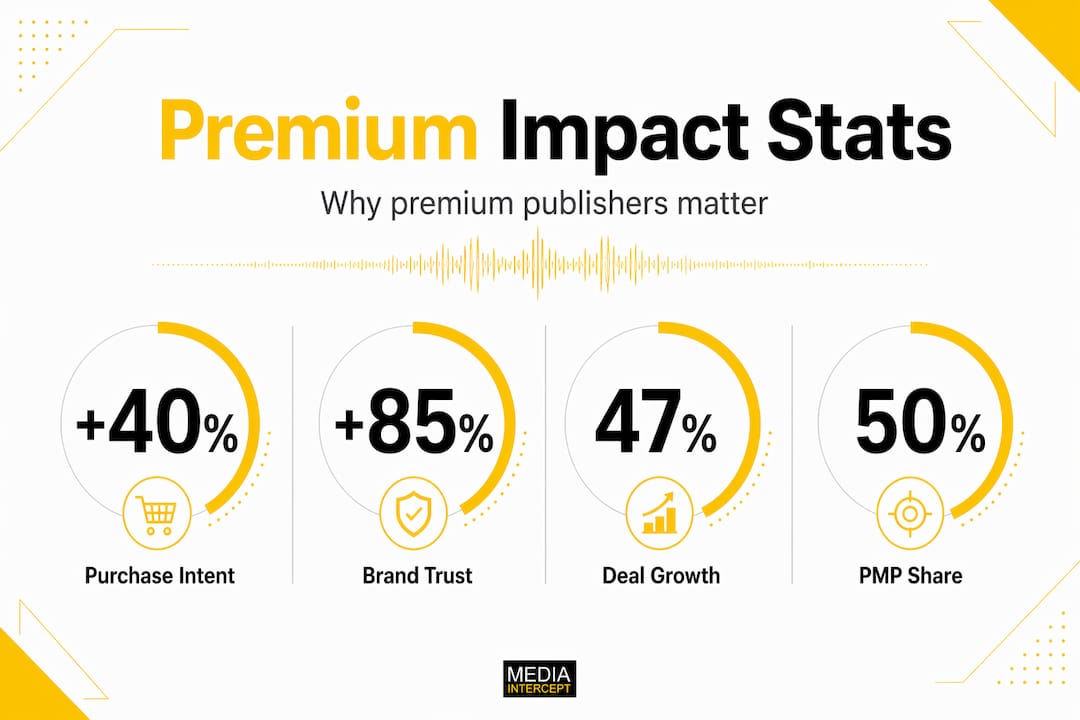
Ads in premium environments increase purchase intent by 40% and brand trust by 85% compared to non-premium placements. For a brand running awareness campaigns, those numbers represent the difference between spend that moves the needle and spend that generates impressions with no lasting effect.

Metric | Premium environments | Non-premium environments |
Purchase intent lift | +40% | Baseline |
Brand trust lift | +85% | Baseline |
Click-through rate | 0.19% | 0.07% |
CPM range | $10 to $40+ | $2 to $8 |
Consumer enjoyment | 67% find it more enjoyable | Below average |
Consumer sentiment reinforces the performance data. 57% of advertisers now prioritize placement quality and integration over raw audience targeting. That shift reflects a hard-learned lesson: reaching the right person in the wrong context produces weak results. And 77% of consumers say ads that feel high quality and interesting are what they associate with premium environments.
“Advertisers face a strategic choice balancing lower-cost impressions against the superior brand lift premium media delivers.” — CFOTECH
The context effect extends into connected TV and video formats as well. Ads in premium CTV contexts are viewed as 3.2x more innovative and 2.6x more successful than ads in lower-quality environments. That perception halo applies to newsletter advertising too, where editorial context and audience trust are equally strong.
The CPM gap is real. You will pay more for premium placements. But the advantages of premium publishing compound over time in ways that lower-cost inventory rarely does. Brand equity built in trusted editorial environments persists beyond the campaign window. Cheap impressions in low-quality environments often leave no measurable trace.
For marketers calculating newsletter ad ROI, the comparison between premium and standard inventory is not simply about cost per impression. It is about cost per outcome.
Private marketplaces and premium publishing
Private marketplaces (PMPs) are where premium publishing and programmatic advertising intersect most clearly. Understanding what is a premium publisher network often requires understanding how PMPs work, because the two concepts are deeply connected.
A PMP is an invitation-only programmatic auction where a publisher offers their inventory to a selected group of advertisers. Unlike open auctions, where any buyer can bid on available impressions, PMPs give publishers direct control over who can access their inventory, at what price floor, and under what brand safety conditions.
Feature | Open auction | Private marketplace |
Buyer access | Anyone | Invited advertisers only |
CPM floor | $2 to $8 | $10 to $40+ |
Brand safety control | Limited | Publisher-enforced |
Transparency | Low | High |
Inventory quality | Variable | Curated and guaranteed |
For publishers, PMPs solve one of the most frustrating structural problems in programmatic advertising. Open auctions reward volume and low floor prices, which punishes premium publishers who run fewer ads and charge more for them. PMPs let premium publishers reclaim pricing control and protect their inventory from appearing alongside brands that do not align with their editorial positioning.
For advertisers, PMPs provide something open auctions cannot: certainty. You know exactly where your ad will appear, in what context, and alongside what content. Many premium publishers see 30 to 50% higher CPMs through PMP deals compared to open markets, and the premium is largely justified by placement predictability and brand safety alone.
Premium programmatic deals grew by 47% year-over-year in 2024, and PMP share of programmatic spend was approaching 50% by the end of that year. The market is moving toward curated inventory. Brands that build PMP relationships now with premium publishers are positioning ahead of that shift.
Pro Tip: When negotiating PMP access with a premium publisher, ask specifically about their floor pricing logic and how they segment inventory tiers. Publishers who can explain their pricing rationale with audience engagement data are the ones worth building a long-term partnership with.
Challenges premium publishers face and what that means for you
Understanding the full picture of what is a media publisher in the premium tier requires acknowledging a structural tension. Premium publishers often get disadvantaged in open programmatic markets despite delivering measurably better outcomes.
Here is the core problem: programmatic open auctions are built to reward volume. The more impressions a publisher can deliver, the more competitive they appear on paper. Premium publishers deliberately limit ad loads to protect user experience. That means fewer impressions per session, which makes them look less attractive to demand-side platforms optimizing purely for scale.
The result is that premium publishers often earn lower overall revenue per session in open auctions despite commanding higher CPMs, because they run fewer ads. It is a mismatch between how their value is measured and how it is actually delivered.
For you as a marketer, this has direct implications:
Impression volume comparisons between premium and non-premium publishers will always favor non-premium. That comparison is misleading.
Premium publishers who have fewer impressions but a CTR of 0.19% versus 0.07% on non-premium sites are delivering more actual clicks per ad served.
Editorial trust and engagement signals passed into the bidstream are more reliable indicators of inventory value than raw impression counts.
Programmatic premium is a trade-off where you pay for placement certainty and signal quality, not scale.
Marketers who evaluate publishers on CPM alone systematically undervalue premium inventory and overpay for the cumulative effect of low-engagement placements.
The strategic move is to build a portfolio view of your media placements. Measure brand lift, engagement quality, and conversion attribution separately for premium versus standard inventory. The difference will likely justify the higher CPMs many times over.
To build online trust through advertising, the context in which your brand appears matters as much as the creative itself. Premium publishers provide that context by default.
My take on what marketers consistently get wrong
I’ve worked with enough brand teams to recognize a recurring mistake: they treat media buying as a cost optimization problem when it is actually a brand positioning decision. The pressure to hit impression targets at the lowest possible CPM is real. But I’ve seen firsthand how the “lowest cost” mentality quietly erodes brand perception over time, not through any single bad placement, but through years of appearing in environments that signal nothing about your brand’s quality.
What I’ve found is that premium publishers do something that media plans rarely credit them for. They create a context that makes your audience more receptive before they’ve even processed your message. That receptivity is not captured in a standard CTR report. It shows up in brand recall surveys, in net promoter scores, in the way customers describe how they first encountered a brand they trust.
The shift toward private marketplaces and curated newsletter inventory tells me the industry is finally internalizing this. Brands that previously optimized for open auction scale are now building direct relationships with premium publishers because the performance evidence is no longer deniable.
My advice: stop treating premium placement cost as a line item to reduce. Treat it as an investment in the conditions your brand needs to be taken seriously. Balance your short-term performance KPIs with at least one brand equity metric that captures what premium environments actually deliver. Authentic brand presence in the right context is a compounding asset. Cheap impressions in forgettable environments are not.
— Media Intercept
How Media Intercept connects you to premium publishers
Understanding what is a premium media publisher is the first step. Accessing them at scale with full transparency is where most brands get stuck.
Media Intercept specializes in newsletter sponsorships across curated premium publisher networks, giving your brand direct access to highly engaged, trust-driven audiences without the complexity of negotiating individual publisher deals. The platform offers CPC and flat-fee CPM placements, standardized reporting, and efficient workflows so you can execute campaigns quickly and scale what works. For publishers, Media Intercept’s monetization platform handles demand, execution, and payouts without requiring exclusivity. Whether you are a marketer building brand equity in premium editorial environments or a publisher ready to monetize your newsletter audience, Media Intercept makes the process direct and measurable. Start planning your next campaign at mediaintercept.com.
FAQ
What makes a publisher “premium”?
A premium media publisher combines editorial credibility with a high-quality user experience, including controlled ad loads, relevant content, and consistent visual standards. Premium environments are 85% more likely to increase advertiser trust and drive deeper site engagement.
What is a premium publisher network?
A premium publisher network is a curated group of publishers that meet defined standards for content quality, audience engagement, and brand safety, often accessed through private marketplaces or specialized platforms like Media Intercept’s newsletter marketplace.
How do premium publishers differ in performance from standard ones?
Premium publishers deliver a CTR of 0.19% compared to 0.07% on non-premium sites, and ads placed in their environments increase purchase intent by 40%. The trade-off is a higher CPM, typically $10 to $40+ versus $2 to $8 in open auctions.
What is a private marketplace and why does it matter?
A private marketplace (PMP) is an invitation-only programmatic auction where premium publishers offer curated inventory to selected advertisers. PMPs give publishers pricing and brand safety control while giving advertisers transparency and placement certainty that open auctions cannot guarantee.
How should marketers evaluate premium publishers?
Look at engagement metrics like CTR, time on site, and editorial trust signals rather than raw impression volume. Premium publishers prove value through content quality and audience engagement data, not just audience size.
Recommended
