
Cost Per Click Email: Guide to Optimizing Newsletter Ads

Updated: Jun 5
New to CPC newsletter buying? Start with our guide to what CPC newsletter buying is before comparing pricing models or optimizing campaign performance.
Open rates feel reassuring, but they tell you very little about whether your newsletter ad actually worked. The metric that reveals true campaign performance is cost per click (CPC), and yet many digital marketers still treat it as a secondary concern. If you’re allocating budget to newsletter sponsorships without a firm grasp of CPC email strategy, you’re likely leaving performance gains on the table. This guide breaks down how CPC works in newsletter advertising, how to calculate and benchmark it accurately, and what steps you can take right now to optimize your spend and drive measurable outcomes.
Table of Contents
Key Takeaways
Point | Details |
CPC is crucial for email ads | Cost per click email metrics reveal true performance and enable smarter ad spend in newsletters. |
Actual CPC differs from bid | Auction mechanics often mean advertisers pay less than their maximum CPC bid for newsletter placements. |
Track post-click outcomes | Always use UTM parameters and conversion goals to measure campaign results beyond the initial click. |
Benchmarks guide optimization | Compare your CPC, CTR, and conversion rates to industry benchmarks for continuous improvement. |
Go beyond clicks for ROI | Focus not just on getting clicks, but on driving meaningful engagement and conversions from email ads. |
Defining cost per click (CPC) in email marketing
CPC in newsletter advertising refers to the cost an advertiser pays each time a reader clicks on a sponsored link or ad placement within an email newsletter. It’s a performance-based pricing model, which means you pay for engagement, not just exposure. That distinction matters enormously when you’re trying to tie ad spend to real business results.
Understanding how CPC compares to other pricing models helps you make smarter budget decisions:
CPC (cost per click): You pay only when someone clicks. Good for performance-focused campaigns where traffic is the goal.
CPM (cost per thousand impressions): You pay for every 1,000 times your ad is displayed, regardless of interaction. Better for broad awareness campaigns.
CPA (cost per acquisition): You pay only when a user completes a specific action, such as a purchase or form fill. The most outcome-focused model, but typically the most expensive per unit.
Flat fee: A fixed price for a dedicated newsletter placement, regardless of clicks or impressions. Common for solo/dedicated email sends.
Each model serves a different strategic purpose. CPC sits in the middle ground, balancing accountability with accessibility. For campaigns where driving traffic to a landing page is the primary goal, it’s often the right choice.
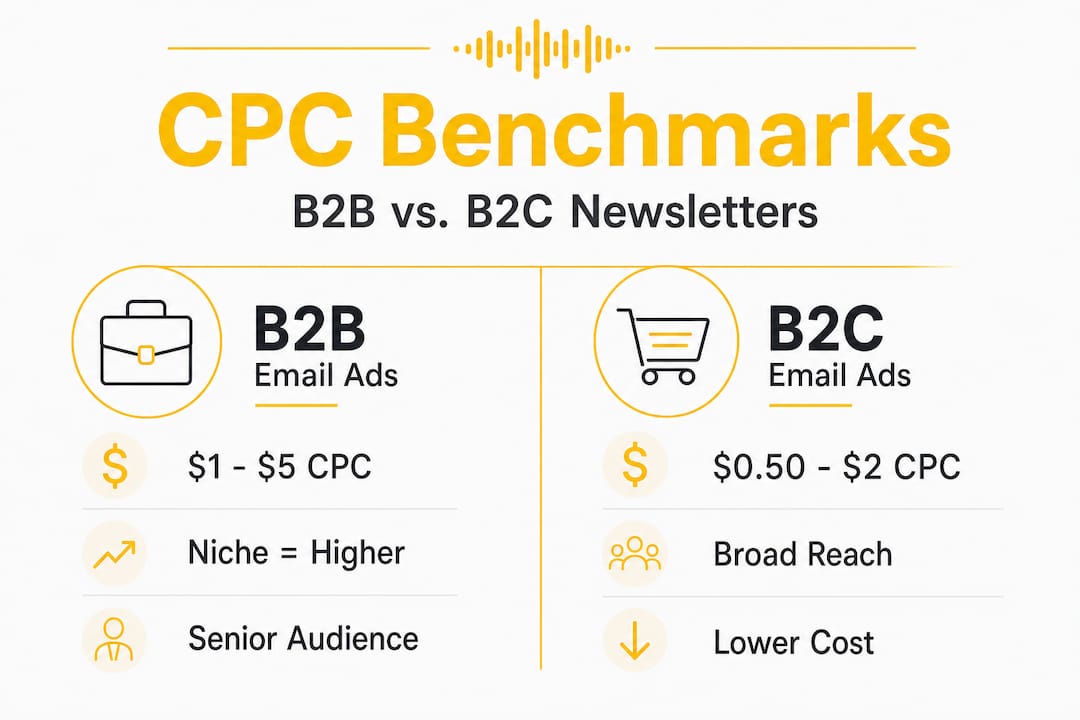
When it comes to benchmarks, B2B newsletter CPC for sponsored placements in 2026 typically ranges from about $1 to $5 per click, depending on audience quality, niche, and publisher reach. A highly targeted B2B fintech newsletter with a senior executive readership will command a higher CPC than a general small business newsletter. That’s expected and reflects audience value.
Key factors that influence CPC in newsletter advertising:
Factor | Impact on CPC |
Audience niche and seniority | Higher niche specificity = higher CPC |
Newsletter list size | Larger lists may offer lower CPCs at scale |
Publisher reputation | Premium publishers charge premium rates |
Ad placement (primary vs. secondary) | Top-of-email placements cost more |
Campaign targeting options | More granular targeting = higher CPC |
Understanding performance marketing basics gives you the foundation to evaluate whether CPC is the right model for a given campaign or whether CPM or flat-fee placements serve your goals better.
Pro Tip: Always ask publishers exactly how they track and count a “click” before signing any agreement. Some platforms count unique clicks, others count total clicks. The difference can significantly change your reported CPC and distort performance comparisons across campaigns.
With this clear definition of CPC email, let’s examine how it’s calculated and the nuances that digital marketers need to watch for.
How cost per click is calculated and measured
Calculating CPC is straightforward at the formula level, but the mechanics behind it carry important nuances. Here’s the basic formula:
CPC = Total Ad Spend / Total Clicks
So if you spend $500 on a newsletter placement and receive 200 clicks, your CPC is $2.50. Simple. But what happens when you’re working within a bidding or auction model? That’s where the distinction between actual CPC and maximum bid becomes critical.
Step-by-step breakdown of CPC calculation in newsletter ad campaigns:
Set your campaign budget. Determine the total amount you’re willing to spend on a given newsletter placement or campaign period.
Define your maximum bid. In auction-based platforms, this is the highest amount you’re willing to pay per click.
Understand actual CPC. The amount you’re actually charged per click is often lower than your maximum bid, depending on competition and publisher pricing logic.
Collect click data. After the campaign runs, pull total clicks from the publisher’s reporting dashboard or your UTM tracking data.
Divide total spend by total clicks. This gives you the actual CPC for that placement.
Compare against benchmarks. Use industry data to evaluate whether your CPC is competitive for the audience you reached.
“The actual CPC you pay is often less than your maximum CPC bid, because with the Google Ads auction, you’re only charged enough to beat the competitor directly below you.” — Google Ads, actual CPC explained
Newsletter publishers increasingly use similar pricing logic. When multiple advertisers compete for a premium placement in the same newsletter, the winning advertiser doesn’t necessarily pay their full maximum bid. They pay just enough to secure the spot. This makes bidding strategy just as important as budget size.
Comparison of CPC pricing models:
Pricing model | How you’re charged | Best for | Risk level |
Actual CPC | Per click, often below max bid | Performance campaigns | Low to medium |
Max bid CPC | Your ceiling, rarely charged in full | Auction-based placements | Medium |
Flat fee | Fixed price regardless of clicks | Predictable spend, brand awareness | Low |
Using a CPC calculator tool helps you model scenarios before committing budget, so you can compare flat-fee versus CPC options and estimate which delivers better expected value for your campaign goals.
If you’re working with a newsletter sponsorship platform that offers both CPC and flat-fee options, you gain flexibility. CPC works when you want accountability. Flat fee works when you want visibility at a locked cost. Knowing which to choose at the right time is a skill that separates average campaigns from strong ones.
Once you know how CPC is calculated, optimizing and tracking post-click outcomes is the next crucial step for campaign improvement.
Beyond CPC: Tracking post-click outcomes
Here’s a problem many marketers run into: they optimize hard for a low CPC, celebrate hitting their target cost, and then realize they have no idea what those clicks actually did. Did visitors convert? Did they bounce immediately? Did they sign up, purchase, or request a demo? CPC tells you what you paid to get someone to your page. It tells you nothing about what happened next.

Post-click outcomes in newsletter ads are what ultimately determine whether your campaign succeeded. Practitioners in the newsletter advertising space consistently emphasize the importance of tracking cost per acquisition (CPA) and conversion rates alongside CPC, not instead of it.
The tools and practices to track this properly include:
UTM parameters: Add UTM tags to every link in your newsletter ad. These codes (utm_source, utm_medium, utm_campaign) pass data into Google Analytics or your preferred analytics platform, letting you see exactly which newsletter placement drove which conversions.
Dedicated landing pages: Send newsletter clicks to a page built specifically for that campaign. This removes ambiguity from your attribution and makes conversion tracking cleaner.
Conversion events: Define what a conversion means before your campaign launches. A form submission, a product purchase, a demo booking — set it up as a tracked goal in your analytics platform.
CPA tracking: Divide your total campaign spend by the number of conversions to calculate cost per acquisition. This is the number that tells you whether your campaign was profitable.
Return on ad spend (ROAS): For e-commerce campaigns especially, calculate the revenue generated per dollar spent on newsletter ads.
Best practices for email campaign measurement:
Set up UTM tracking before the campaign goes live, not after.
Create unique links for each newsletter placement so you can compare performance across publishers.
Monitor bounce rate on the landing page. A low CPC with a high bounce rate signals a targeting or creative mismatch.
Review conversion rates by newsletter source, not just overall totals.
Build a consistent reporting cadence so trends become visible across multiple sends.
Connecting CPC data to a full-funnel campaign strategy is how you shift from measuring activity to measuring impact. Every click is an entry point into your funnel. What happens next is what builds or erodes your return on investment.
Pro Tip: Set your conversion goals before you launch. Campaigns that define success upfront are easier to optimize mid-flight and far easier to evaluate honestly after the fact. Without predefined goals, every campaign becomes a guessing game.
Benchmarks, optimization, and maximizing your CPC strategy
Knowing your CPC number is useful. Knowing how it compares to industry benchmarks is powerful. Without a reference point, a $3 CPC might look great in one newsletter category and be wildly overpriced in another.
Email marketing effectiveness benchmarks increasingly focus on click-to-open rate (CTOR) and CTR rather than open rate alone. CTOR measures the percentage of people who clicked after opening, which is a much stronger signal of ad creative and offer relevance than raw open rate.
2026 newsletter ad benchmark reference table:
Metric | B2B newsletters | B2C newsletters | Notes |
Average CPC | $1.50 to $5.00 | $0.50 to $2.00 | Varies by niche and targeting |
Click-through rate (CTR) | 1% to 3% | 2% to 5% | Based on total sends |
Click-to-open rate (CTOR) | 10% to 20% | 15% to 25% | Measures engaged openers |
Cost per acquisition (CPA) | $20 to $150+ | $5 to $50 | Highly dependent on offer |
For 2026 sponsored B2B newsletter ads, a CPC in the $1 to $5 range is the expected norm, but the real question is always whether the quality of clicks justifies that cost. A $5 CPC that converts at 10% is far more valuable than a $1 CPC that converts at 0.5%.
Actionable ways to lower CPC and increase conversions:
Tighten your targeting. Work with publishers who serve your exact buyer persona. Broad targeting inflates your click volume but reduces conversion quality.
Test your ad creative. Run A/B tests on subject lines, call-to-action copy, and visual elements. Small changes in headline copy can shift CTR significantly.
Improve landing page relevance. The message on your landing page should directly match the promise in your newsletter ad. Disconnects between ad and landing page are the single biggest driver of wasted CPC spend.
Negotiate placement position. Primary placements (top of newsletter) typically drive higher CTR, which can lower your effective CPC when buying on a flat-fee basis.
Review your audience fit. If your CPC is high but conversions are low, the audience may not be the right fit for your offer. Shift to a more aligned publisher.
You can get deeper guidance on boosting marketing impact through newsletter sponsorships by exploring how top-performing brands structure their placements and creative for maximum efficiency.
The uncomfortable truth about CPC email most marketers miss
Here’s something worth saying plainly: CPC is a proxy metric, not a success metric. The number of clicks you buy tells you almost nothing about the value you created. And yet, campaign reports frequently stop right there. The CPC looks good, the click volume is healthy, and everyone moves on.
This is where most campaigns quietly fail.
The uncomfortable truth is that many brands optimize obsessively for lower CPC and then lose sight of what those clicks are supposed to accomplish. We’ve seen campaigns where a $1.20 CPC generated hundreds of clicks and almost zero conversions, while a $4.50 CPC campaign to a tighter audience drove a meaningful pipeline. The lower-cost campaign looked better on paper. The higher-cost one built actual business results.
Clicks are not engagement. A click means someone was curious enough to leave the newsletter. It does not mean they were ready to buy, interested in your offer, or even the right person for your product. Mistaking click volume for audience interest is one of the most common and costly errors in newsletter advertising.
The lesson is this: always track CPC and conversion data simultaneously. If your reporting infrastructure only captures clicks, you’re flying blind. Every click should trace a path to a business outcome, whether that’s a lead, a sale, a download, or a demo request. Reviewing common mistakes in sponsored content campaigns reveals that missing post-click attribution is consistently among the top errors brands make.
Build your reporting so that every campaign tells a complete story: how much you paid, how many people clicked, and what percentage of those clicks became something meaningful to your business. That’s the standard worth holding yourself to.
Pro Tip: If a publisher can’t give you click-level data or UTM-compatible tracking links, treat that as a red flag. Accountability in newsletter advertising starts with measurement. No data, no optimization.
Unlock advanced newsletter advertising strategies with Media Intercept
Understanding CPC email strategy is the first step. The next is having the right platform to put it into practice efficiently and at scale.
Media Intercept is built specifically for marketers and brands who want to run newsletter advertising with precision. You can plan and execute campaigns across premium publisher networks, access standardized reporting that connects clicks to conversions, and use flexible pricing options including CPC and flat-fee placements. Our newsletter advertising solutions give you the tools to target the right audiences, track what matters, and scale what works. Use our CPC and CPM calculator to model your next campaign before you spend a dollar. When you’re ready to move from strategy to execution, our platform is ready to support you. Let’s plan your next campaign together.
Frequently asked questions
What is cost per click (CPC) in email advertising?
CPC is the cost paid by an advertiser each time a reader clicks on an ad inside an email newsletter. For B2B newsletter sponsorships, CPC typically ranges from $1 to $5 per click in 2026.
How does CPC email pricing compare to CPM and CPA?
CPC charges you per click, CPM charges per thousand impressions, and CPA charges per completed action. CPC is more performance-oriented than CPM, though tracking post-click outcomes like CPA gives you a fuller picture of campaign ROI.
What is the typical CPC range for B2B newsletter placements in 2026?
For B2B audiences, sponsored newsletter CPC benchmarks in 2026 sit between $1 and $5 per click, with premium niche publishers commanding rates toward the higher end of that range.
How can marketers track conversions from newsletter ads?
UTM-tagged links are the most reliable method, as they connect each click to downstream actions in your analytics platform. Tracking post-click conversions through UTM parameters is considered a baseline best practice in newsletter campaign management.
What email campaign benchmarks should brands monitor beyond CPC?
Beyond CPC, brands should track click-to-open rate, overall CTR, and cost per acquisition. Email performance benchmarks consistently show that CTOR is a stronger signal of creative effectiveness than open rate alone.
Recommended
Related Newsletter Advertising Resources
Use our CPC and CPM calculator for newsletter advertising to compare clicks, impressions, CTR, CPC, CPM, and flat-fee campaign costs.
Learn more about newsletter sponsorships and how brands can use CPC, CPM, or flat-fee buying models across premium publisher newsletters.
Review our newsletter advertising glossary for definitions of CPC, CPM, CTR, attribution, tracking links, conversions, and other campaign terms.
Explore newsletter advertising for brands to see how Media Intercept helps advertisers plan, manage, and measure newsletter campaigns across publishers.
