
How to Monetize Your Nonprofit Newsletter With Sponsorships

Updated: Jun 5
Looking to monetize your newsletter? Learn how Media Intercept helps publishers grow newsletter revenue without requiring exclusivity.
Traditional fundraising channels are under pressure. Grant competition is fierce, direct mail costs are rising, and donor fatigue is real. Yet many nonprofits are sitting on an underutilized asset: a loyal, engaged newsletter audience that local businesses and mission-aligned brands genuinely want to reach. Newsletter sponsorships offer a sustainable, repeatable revenue stream that doesn’t require a gala, a grant cycle, or a major donor ask. This guide walks you through everything you need to start, structure, pitch, and manage nonprofit newsletter sponsorships responsibly and profitably.
Table of Contents
Key Takeaways
Point | Details |
Clarify value first | Before pitching sponsors, define your audience and gather proof of your newsletter’s engagement. |
Design tiered packages | Offering different sponsorship levels makes it easy for sponsors to choose the right amount of exposure. |
Disclose and comply | Clear, visible disclosure keeps your nonprofit on the right side of the law and maintains trust. |
Measure and report | Track opens, clicks, and sponsor results so you can improve and renew deals. |
Quality beats quantity | A few well-aligned sponsors who value your audience outperform a long list of one-off partners. |
What you need before starting with newsletter sponsorships
Now that you know what nonprofit newsletter sponsorships can mean for your revenue goals, let’s pinpoint exactly what needs to be in place before you approach sponsors.
Before you pitch a single sponsor, you need a clear picture of what you’re selling. Sponsors don’t just buy ad space. They buy access to a specific audience. Your first job is to understand and document that audience in concrete terms.
Know your audience inside and out. Collect data on your subscribers: age range, location, professional background, and how they engage with your content. Open rates, click-through rates, and list growth trends are the numbers sponsors care about most. If you don’t have this data yet, most email platforms provide it automatically. Pull a 90-day snapshot and build from there.
Gather your proof points. Sponsors want evidence, not promises. Compile your best-performing issues, highlight any prior sponsor outcomes (even informal ones), and collect reader testimonials if you have them. A sample newsletter goes a long way in a pitch. As a starting framework, define a clear value proposition that tells sponsors who your readers are, why they matter, and what outcomes you can credibly deliver.
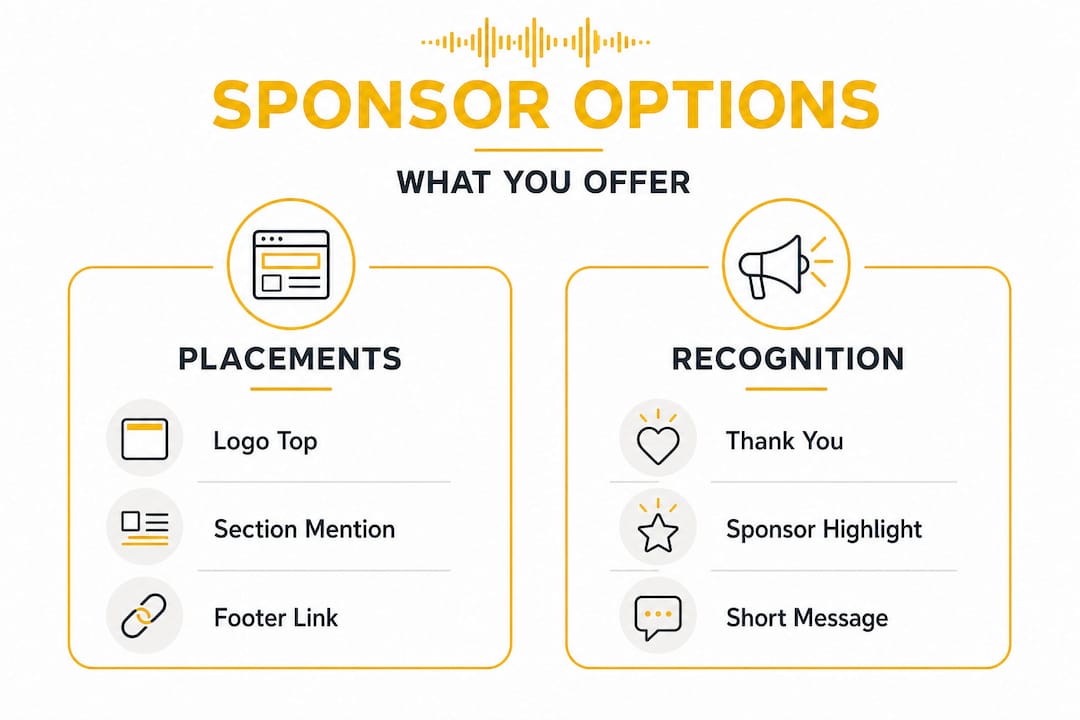
Map your sponsorship inventory. Inventory means the placement options you can offer: a logo mention at the top, a sponsored content block mid-issue, a dedicated send, or a footer callout. Be realistic about frequency. If you publish weekly, you might offer four placements per month. If monthly, one or two. Clarity here prevents overpromising.
Here’s a quick comparison of what sponsors typically expect versus what nonprofits commonly offer:
Sponsor expectation | What nonprofits often provide |
Audience demographics | General mission statement |
Engagement metrics | Subscriber count only |
Defined placement options | Vague “mention in newsletter” |
Measurable outcomes | No tracking or reporting |
Clear pricing tiers | Ad hoc pricing per ask |
Understand the compliance picture before you start. This is where many nonprofits get tripped up. There is a meaningful legal difference between a sponsorship and advertising. Sponsorship versus advertising can have tax implications for your organization. If your arrangement creates a “substantial return benefit” for the sponsor or functions like a promotion with a call-to-action, the IRS may treat it as advertising and trigger Unrelated Business Income Tax (UBIT). UBIT is a federal tax on income that isn’t directly related to your nonprofit’s mission. Knowing this distinction early protects you. Review email marketing compliance basics to make sure your overall newsletter practices are sound before layering in sponsorships.
Strategies for growing newsletter audiences also matter here because a larger, more engaged list directly increases your sponsorship rates and appeal.
Key assets to have ready:
Subscriber count and 90-day growth trend
Average open rate and click-through rate
Audience demographics (even basic ones)
Sample newsletter issues (2 to 3 recent editions)
A description of available placements and frequency
Any prior sponsor results or reader feedback
Pro Tip: Start with smaller, clearly defined sponsor packages. A simple “logo + one-line recognition” tier at a low monthly rate is easy to sell and easy to deliver. It builds confidence on both sides before you pitch larger, more complex arrangements.
How to design compelling sponsorship opportunities
With your assets and proof points in hand, it’s time to turn those resources into sponsorship packages that will appeal to mission-aligned businesses and partners.
Good sponsorship packages are specific, priced clearly, and tied to measurable outcomes. Vague offerings confuse prospects and slow down decisions. Structure is your friend here.
Step-by-step package design:
Map your inventory. List every placement you can offer: header logo, sponsored content block, footer mention, dedicated email, social media cross-promotion. Be honest about what you can execute consistently.
Create three tiers. A three-tier structure (basic, featured, premium) gives sponsors a choice without overwhelming them. Each tier should have a name, a price, and a specific list of deliverables.
Build a proof deck. This is a short document (three to five slides or pages) that shows your audience data, engagement metrics, and any prior sponsor outcomes. Think of it as a mini media kit.
Set measurement expectations. Tell sponsors upfront how you’ll track and report results. Will you share open rates, click counts, or a post-campaign summary? Defining this in advance builds trust.
Price with confidence. Tiered options should be priced by visibility and your ability to measure ROI, such as using clickable links and tracking offers. Don’t underprice out of uncertainty.
Here’s a sample tier structure you can adapt:
Tier | Placements | Reporting | Suggested price range |
Recognition | Logo + name mention | Monthly summary | $150 to $300/month |
Featured | Sponsored content block | Click tracking + summary | $400 to $800/month |
Premium | Dedicated newsletter send | Full campaign report | $1,000 to $2,500/send |
The practical sponsor pitch workflow follows a clear sequence: package your audience and proof, pitch specific placements, negotiate deliverables, and run reporting and recap to enable rebooking. This cycle is what turns a one-time sponsor into a recurring partner.
Explore sponsorship design strategies and review available newsletter sponsorship formats to see what works across different publisher types. Understanding the broader landscape of sponsorship versus advertising also helps you frame your packages correctly from the start.
Pro Tip: Keep your proposal to one page or less. Sponsors are busy. A clear, concise offer with a defined price and deliverables converts better than a detailed document that requires a meeting to decode.
Pitching and closing your first nonprofit newsletter sponsors
Once your sponsorship packages are ready, it’s time to get them in front of the right partners and secure your first deals.

Choosing the right prospects matters as much as the pitch itself. A mission-aligned local business will convert faster and stay longer than a random brand with no connection to your cause.
How to research and select prospects:
Look for businesses that already support causes similar to yours
Check who advertises in peer nonprofit newsletters or local publications
Review your donor list for small business owners who might want more visibility
Search for companies whose customer base overlaps with your audience
Steps for your first outreach:
Personalize the subject line with the prospect’s name or business.
Open with a one-sentence connection to their mission or work.
State your newsletter’s audience and engagement in two to three numbers.
Describe the specific tier you’re recommending for them.
Include a link to your proof deck or media kit.
Close with a single, clear call to action: a 20-minute call or a direct reply.
What to include in your media kit:
Subscriber count and growth trend
Open and click rates (last 90 days)
Audience demographics
Placement options with pricing
Sample newsletter
Testimonials or prior sponsor results
“Actionable CTAs and specific placement details consistently outperform vague sponsorship pitches. Sponsors want to know exactly what they’re getting, when they’ll get it, and how you’ll prove it worked.”
The practical pitch workflow reinforces this: specificity closes deals. Vague pitches get ignored. When you follow up after no response, wait five to seven business days and send a brief, friendly note referencing your original email.
Handling objections:
“Our budget is limited” — Offer your entry-level recognition tier or a one-issue trial.
“We’re not sure about the ROI” — Share your tracking plan and offer a post-campaign report.
“We need to think about it” — Send a one-page summary and set a follow-up date.
Understanding the benefits of sponsoring a newsletter from the sponsor’s perspective helps you speak their language during negotiation. Review sponsorship email best practices for templates and tone guidance that work in real outreach.
Managing compliance and maximizing sponsor value
With your first sponsors in place, make sure your communications are legally compliant and risk-free for both your organization and your sponsors.
Let’s define three terms clearly. A sponsorship is when a business provides financial support and receives recognition in return, such as a logo and name mention. Advertising is when a business pays for promotional content that includes a call-to-action or product promotion. UBIT (Unrelated Business Income Tax) is the tax the IRS can apply to nonprofit income that isn’t related to your exempt purpose. If your newsletter sponsorship looks like advertising, UBIT may apply.
Disclosure checklist:
Place a clear sponsorship statement near the sponsored content, not buried in the footer.
Use plain language: “This newsletter is sponsored by [Business Name]” works well.
If the entire issue is sponsored, disclose it at the top.
Avoid language that sounds like a product endorsement or promotional tagline.
Keep records of all sponsorship agreements and disclosures.
Disclosure must be clear, prominent, and proximate to the sponsored content. A plain-language statement near the relevant links or at the top of a fully sponsored message meets the standard.
Compliance mistakes to avoid:
Using subtle CTAs like “Visit their store today” inside a recognition-only sponsorship
Hiding disclosures in small print or at the bottom of a long email
Writing sponsor copy that reads like an ad rather than a recognition statement
Failing to document the terms of your sponsorship agreement
To reduce risk, design packages that favor recognition and limited CTAs and keep sponsored content clearly labeled. This approach keeps you on the right side of the IRS and builds credibility with your audience.
Pro Tip: When in doubt, over-disclose. Transparency is always better than an IRS audit. A simple, visible “Sponsored by” label costs you nothing and protects everything.
Measuring results and scaling sponsorship revenue
You’re not just done when the newsletter is sent. Smart tracking and reporting set up your next, larger sponsorships.
Measurement is what separates a one-time sponsor from a long-term partner. Sponsors who see results rebook. Sponsors who receive no follow-up don’t.
Core metrics to track:
Open rate for sponsored issues versus your baseline
Click-through rate on sponsor links
Conversions or redemptions if the sponsor offered a code or link
Sponsor feedback after each campaign
List growth during the sponsorship period
Post-campaign report structure:
Metric | Benchmark | Sponsored issue result |
Open rate | Your 90-day average | Actual result |
Click-through rate | Your 90-day average | Sponsor link CTR |
List growth | Baseline trend | Growth during campaign |
Sponsor link clicks | N/A | Total clicks |
Steps to convert one sponsor into a recurring partner:
Collect all campaign data within 48 hours of sending.
Build a one-page post-campaign report using the table above.
Email the report with a brief summary of what performed well.
Include a renewal offer with a small incentive for early rebooking.
Schedule a 15-minute debrief call if the sponsor is interested in a larger package.
A simple measurement loop, tracking clicks and CTR, providing a post-campaign mini report, and using that data to rebook, is consistently the key to converting one-off sponsors into recurring partnerships. The Montclair Local case demonstrates this clearly. By combining disciplined audience segmentation and stewardship with consistent tracking, they achieved over 90% revenue growth and meaningful subscriber increases. Measurement wasn’t an afterthought. It was the engine.
Use sponsorship outcome reporting resources and a sponsor ROI calculator to build credible, data-backed reports that impress sponsors and justify rate increases. For broader context on measuring digital marketing outcomes, tracking the full funnel helps you make smarter decisions about which placements to prioritize.
Why most nonprofits underestimate sponsorships—and what actually works
Stepping back from the technical how-to, let’s unpack what really separates successful nonprofit newsletter sponsorships from the rest.
Many nonprofits hesitate around corporate sponsorships because they fear it signals a compromise of mission. That fear is understandable. But it’s also the wrong frame. The nonprofits that build strong sponsorship programs aren’t selling out. They’re building relationships with partners who share their values and want to reach their audience for legitimate, mission-aligned reasons.
The real mistake isn’t pursuing sponsorships. It’s pursuing too many of the wrong ones. Chasing volume, accepting any sponsor who will pay, or building packages that prioritize revenue over fit, creates noise, erodes reader trust, and burns out your team. Fewer, deeper partnerships consistently outperform a crowded sponsor roster.
Here’s the insight that most guides miss: measurement isn’t just for sponsors. When you track what your audience responds to, you learn what content drives engagement, what topics generate clicks, and what your readers actually care about. That data improves your editorial decisions, your fundraising appeals, and your impact reporting. Sponsorship measurement and mission measurement are the same activity.
Another underrated factor is accelerating audience growth before you pitch. A growing list signals momentum. Sponsors notice. A 500-subscriber list that grew 30% in six months is often more attractive than a 2,000-subscriber list that’s been flat for two years. Growth is proof of relevance.
The nonprofits that succeed with newsletter sponsorships treat them like partnerships, not transactions. They communicate regularly, share results proactively, and ask sponsors what would make the relationship more valuable. That mindset turns a one-issue deal into a multi-year partnership.
Unlock more nonprofit newsletter sponsorship opportunities
Ready to turn your newsletter into a nonprofit fundraising engine? Here’s how you can go further, faster.
Building a sponsorship program from scratch takes time, but you don’t have to do it alone. Media Intercept connects publishers like you with brands actively looking for engaged, niche audiences through newsletter placements. Our platform handles the logistics so you can focus on your mission.
Whether you’re just starting out or ready to scale, Media Intercept offers tools built for publishers who want to monetize without complexity. Explore monetization tools for publishers to see how our platform manages demand, reporting, and payouts without requiring exclusivity. If you’re looking to connect with brands as an advertiser or understand the full ecosystem, visit our newsletter advertising page. We’d love to help you build a sponsorship program that’s sustainable, compliant, and genuinely impactful.
Frequently asked questions
What is the difference between a newsletter sponsorship and advertising for nonprofits?
Newsletter sponsorships recognize sponsors for their support without promotional calls-to-action, while advertising promotes products or services and can trigger UBIT tax implications for your nonprofit.
How should a nonprofit disclose sponsored content or links in newsletters?
Use plain language near the sponsored content, such as “Sponsored by Name],” and if the entire message is sponsored, [disclose it at the top of the email.
What metrics should nonprofits track for newsletter sponsorships?
Track open rates, click-through rates, and conversions, then share a post-campaign summary with sponsors. This measurement loop is the most reliable way to convert one-time sponsors into recurring partners.
How can nonprofits negotiate sponsorship deals that deliver value to both sides?
Lead with your audience data and engagement metrics, then offer tiered packages with clear deliverables and a defined reporting process so sponsors know exactly what they’re getting.
What are common mistakes nonprofits make with newsletter sponsorships?
The most common mistakes include unclear value propositions, missing or buried disclosures, and failing to track and report sponsor outcomes after each campaign.
Recommended

