
Newsletter Content Performance: What Marketers Must Know

Most marketers assume a strong open rate means their newsletter is working. That assumption costs them real revenue. What is newsletter content performance? It’s the full picture of how your newsletter drives audience engagement, pipeline activity, and measurable business outcomes. Not just who opened it. Open rates have been inflated by 15–40% since Apple Mail Privacy Protection arrived, making them an unreliable signal on their own. The metrics that actually matter go deeper, and understanding them is how you turn a decent newsletter into a high-performing revenue asset.
Table of Contents
Key takeaways
Point | Details |
Open rates alone mislead | Apple Mail Privacy Protection inflates opens, making clicks and conversions far more reliable engagement signals. |
CTR and CTOR are better benchmarks | Click-through rate and click-to-open rate reflect genuine reader intent better than raw open numbers. |
Revenue per email reveals true ROI | Tracking revenue per email sent ties newsletter activity directly to business outcomes. |
Segmentation multiplies results | Segmented campaigns can more than double CTR compared to unsegmented broadcast sends. |
CRM integration completes the picture | Connecting newsletter data to your CRM shows pipeline impact, lead conversion, and customer lifetime value. |
What newsletter content performance really means
Newsletter content performance is the set of metrics and behaviors that tell you whether your newsletter content is achieving its intended goals. Those goals vary. Some newsletters exist to sell. Some exist to build brand authority. Some nurture leads through a long sales cycle. Performance means something different in each case, and that’s exactly why so many measurement efforts fall short.
The standard metrics most platforms report include open rate, click-through rate, conversion rate, and unsubscribe rate. Each one plays a role, but each one also has blind spots.
Metric | Definition | Pros | Cons |
Open rate | Percentage of recipients who open the email | Easy to track, widely benchmarked | Inflated by Apple MPP; not reliable post-2021 |
Click-through rate (CTR) | Percentage of recipients who click any link | Reflects genuine intent | Can be skewed by bot clicks without filtering |
Click-to-open rate (CTOR) | Clicks divided by opens | Measures content relevance among openers | Denominator still affected by MPP inflation |
Conversion rate | Percentage who complete a desired action | Directly tied to business outcomes | Requires proper attribution setup |
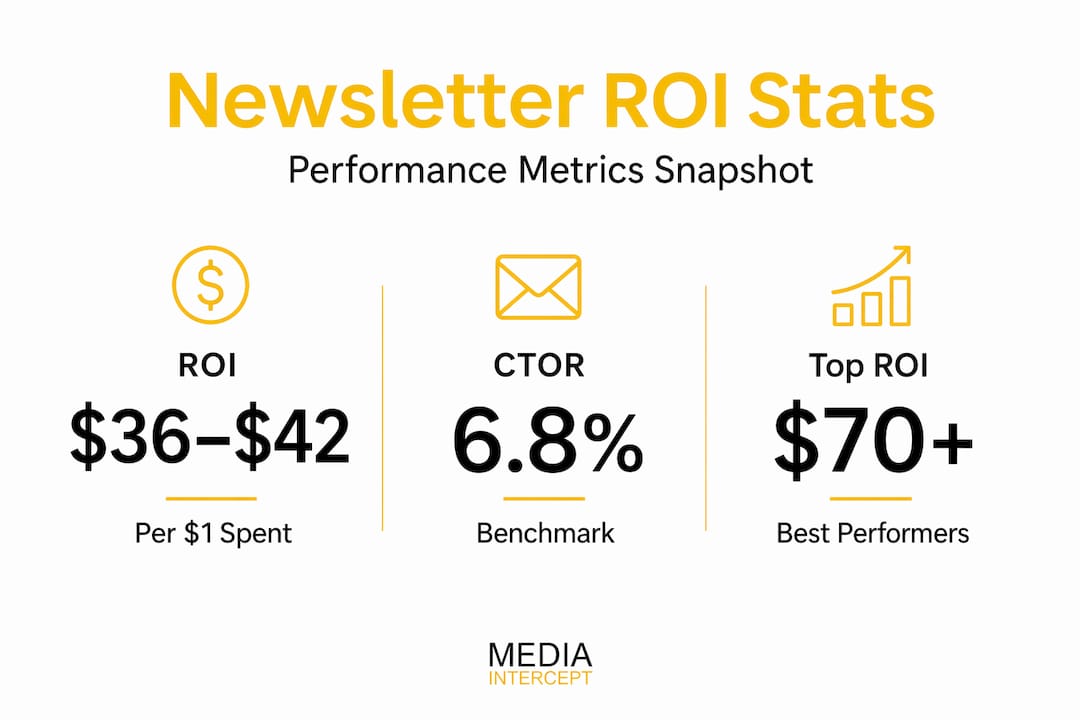
The CTOR benchmark sits around 6.81%, with anything above 10% considered excellent performance. If you’re tracking open rate as your primary KPI, you’re measuring something Apple’s servers may have already triggered before your subscriber ever touched their inbox. Shifting focus to CTR and CTOR gives you a far cleaner read on what actually resonated with real people.
Email marketing ROI averages $36 to $42 for every $1 spent, with top performers exceeding $70 per dollar. Those numbers don’t come from marketers who stop at opens. They come from teams measuring the full content performance chain.
Advanced metrics that reveal deeper engagement
Once you move past the basics, you start seeing the metrics that connect newsletter content to real business impact. These go beyond the inbox and into actual reader behavior and revenue outcomes.
Here’s what sophisticated teams track and what each metric reveals:
Revenue per email sent (RPE): The most direct business-impact number. Divide total revenue attributed to a send by the number of emails delivered. Top-quartile companies prioritize RPE as their north star metric.
Email-to-lead conversion rate: How many subscribers took a tracked action that entered them into your sales pipeline? This requires CRM integration but transforms newsletter analytics from vanity to velocity.
Campaign-to-opportunity rate: Measures how many newsletter touches are linked to open deals inside your CRM. Connecting emails to pipeline stages gives you leverage when justifying newsletter investment to leadership.
Read time and scroll depth: Only about 40% of recipients fully read the emails they open. Scroll depth and time-on-content tell you whether your writing is actually holding attention or losing people in paragraph two.
Heatmap click data: Shows exactly which sections of your newsletter drive action and which sections are invisible to readers in practice.
Unsubscribe and complaint rate trends: Leading indicators of content-audience mismatch or frequency fatigue. Watch these week over week, not just as isolated data points.
Tracking downstream behavior after clicks, such as pageviews per session and read time on landing pages, reveals true content quality and audience intent in ways that surface metrics simply cannot.
Pro Tip: Close the loop between your email platform and CRM. Map every tracked click back to a contact record, a deal stage, or a conversion event. Without that connection, you’re measuring activity. With it, you’re measuring impact.
Common mistakes when analyzing newsletter performance
Even experienced marketers make measurement errors that distort what they think is working. Here are the pitfalls that show up most often.
Treating open rate as a performance verdict. Since Mail Privacy Protection blocks tracking pixels and pre-fetches them on Apple devices, your open rate includes a large percentage of machine-triggered events. Optimizing your content based on this number is optimizing for noise.
Reading click rates without conversion context. A 5% CTR sounds strong until you check whether any of those clicks converted. Clicks without conversions reveal a content-offer mismatch, a weak landing page, or a targeting problem. Always pair CTR with the next step in the funnel.
Ignoring list health. A bloated list full of unengaged subscribers depresses your performance averages and can damage deliverability over time. Regular list hygiene, including re-engagement campaigns and sunset policies, is part of newsletter performance management.
Additional measurement pitfalls to watch for:
Misaligning newsletter goals with the metrics you track (a brand awareness newsletter should not be judged by direct sales conversion rate)
Using inconsistent attribution models across campaigns, making period-over-period comparison meaningless
Overlooking segmentation as a factor in performance differences between sends
Measuring aggregate performance without breaking it down by segment, send time, or content type
Pro Tip: Sending frequency matters more than most teams admit. High-frequency email campaigns push unsubscribe rates up faster than they push revenue up. For B2B audiences, 1 to 2 emails per week is the safe ceiling. Respect inbox space and your audience will stay engaged longer.
72% of marketers cannot prove email ROI because they focus on vanity metrics rather than revenue-linked ones. The fix is not more data. It’s better alignment between what you measure and what the newsletter is actually supposed to do.

Five steps to optimize newsletter performance based on metrics
Using data to improve your newsletter is not about chasing every metric simultaneously. It’s about establishing a clear feedback loop and acting on what you learn. Here’s how to do it systematically.
Audit your current metric stack. List every metric your platform currently reports. Then ask which ones connect to a business goal. Remove the ones that don’t and add tracking for the ones you’re missing, particularly RPE, CTOR, and CRM-linked conversion rates.
Segment your audience before your next send. Segmented campaigns produce 101% higher CTR than broadcast sends. Start with behavioral segmentation based on past clicks, purchase history, or content category preference. Demographic segmentation is a starting point, but behavior is what actually predicts engagement.
Test subject lines with statistical rigor. Subject line testing is one of the fastest levers for improving newsletter engagement. Run A/B tests with a clear hypothesis, a large enough sample size to reach significance, and a single variable changed at a time. Use CTOR as your success metric, not open rate.
Analyze heatmaps and scroll data for content decisions. If your heatmap shows readers consistently abandoning after the first section, your structure is the problem. Use this data to reorganize content so the most relevant material appears earlier. Content consumption quality is the leading indicator of downstream action.
Build a monthly performance review cycle. Set a recurring review of your core metrics compared against the previous period and your benchmark targets. Track trend direction, not just absolute numbers. A declining CTOR over three sends warrants a content review. A sudden unsubscribe spike warrants an immediate audit of your last send’s frequency, tone, or offer relevance.
For more on building an audience growth strategy that ties directly to these performance loops, the Media Intercept resource library is a practical starting point.
Using marketing technology to measure and improve performance
The metrics you can track depend heavily on the tools you have connected. Most email platforms report click and open data well. Very few teams fully exploit what becomes visible when those platforms connect to a CRM and a web analytics setup.
When you integrate your newsletter platform with your CRM, you gain the ability to track email-to-lead and conversion rates at the individual contact level. You can see which newsletter segments are entering deals, progressing through pipeline stages, and ultimately closing. That’s a level of visibility that fundamentally changes how you allocate content resources.
UTM parameters are non-negotiable for any newsletter that drives traffic to a website. Tagging every link with campaign, source, and content parameters lets your analytics platform attribute pageviews, session behavior, and conversions back to specific newsletter sends. Combined with CRM data, this creates a clear line from content to customer.
Here’s how common marketing technology features stack up for newsletter performance tracking:
Feature | Tool type | Performance insight it enables |
UTM link tracking | Analytics platform | Attribution of downstream web behavior to specific sends |
CRM contact syncing | CRM integration | Email-to-lead and campaign-to-opportunity rates |
Heatmap overlays | Email analytics add-on | Content section engagement and scroll behavior |
Send time optimization | Email platform (AI-assisted) | Improved open and click windows based on individual behavior |
Qualitative feedback forms | Survey tools | Subscriber sentiment and content preference signals |
Automated send time optimization, now available in most major email platforms, uses individual open and click history to deliver each email at the moment a specific subscriber is most likely to engage. Pair that with the newsletter strategy fundamentals that connect content planning to ROI, and you have a system that keeps improving with each send.
My take on where newsletter metrics go wrong
I’ve watched a lot of marketing teams pour real effort into newsletters and then make strategy decisions based on open rates that Apple’s servers generated on their behalf. That’s not measurement. That’s a false signal dressed up as performance data.
What I’ve learned from working with publishers and brands on newsletter programs is that genuine engagement is three-dimensional. It’s about whether someone clicked, what they did after they clicked, and whether they came back. A reader who clicks one link, spends four minutes on the landing page, and returns to the next issue is worth ten subscribers who “open” every email but never take an action.
The shift that actually moves results is going from vanity metrics to revenue-centric KPIs. RPE, pipeline contribution, and customer lifetime value connected to newsletter content are the numbers that earn budget in a boardroom. Not a 45% open rate that your platform counts every time an Apple proxy server loads an image.
My strongest recommendation: invest in CRM integration before you invest in a bigger list. The intelligence you gain from connecting your newsletter to downstream behavior is worth more than a 20% list size increase. And don’t automate everything. The newsletters that build the most durable audiences, as the fastest-growing newsletter writers show, are the ones that feel specific, honest, and written by a person who actually cares about the reader.
Automation and personalization scale your reach. Real content quality earns the trust that converts.
— Media Intercept
Plan your newsletter campaigns with Media Intercept
If you’re ready to move beyond surface metrics and turn your newsletter into a measurable performance channel, Media Intercept is built to help you get there. The platform connects brands and publishers through premium newsletter inventory, with standardized reporting that tracks the metrics that matter: clicks, conversions, and revenue impact. Whether you’re a brand looking to reach engaged audiences through newsletter advertising or a publisher ready to monetize your audience through the newsletter monetization platform, Media Intercept gives you the tools to execute, measure, and scale. Every campaign comes with the reporting clarity you need to prove ROI and optimize for what actually works.
FAQ
What is newsletter content performance?
Newsletter content performance is the measurement of how effectively your newsletter drives engagement, conversions, and business outcomes across a defined set of metrics including CTR, CTOR, and revenue per email sent.
Why are open rates unreliable in 2026?
Apple Mail Privacy Protection pre-fetches tracking pixels before a subscriber opens an email, inflating open rates by 15 to 40%. Clicks and conversions are now the more reliable engagement signals.
What metrics should replace open rate as the primary KPI?
Click-to-open rate, click-through rate, and revenue per email sent are stronger indicators of newsletter content effectiveness because they reflect actual reader behavior and business impact.
How does segmentation affect newsletter performance?
Segmented campaigns generate 101% higher CTR compared to non-segmented sends. Behavioral segmentation, based on past clicks or content preferences, outperforms demographic segmentation.
How do you connect newsletter performance to revenue?
Integrate your email platform with your CRM and use UTM parameters on every link. This lets you track pipeline impact from specific newsletter sends, linking content activity to leads, deals, and closed revenue.
Recommended


