
Newsletter Campaign Proposal for Clients That Converts

Most marketing professionals know newsletters work. What trips them up is translating that conviction into a newsletter campaign proposal for clients that actually wins the business. A weak proposal gets politely declined. A strong one gets signed and budgeted. The difference usually has nothing to do with design or clever subject line suggestions. It comes down to structure, specificity, and showing the client you understand their goals before you ask for their budget. This article gives you the full playbook, from the components that belong in every proposal to the reporting habits that turn one campaign into a long-term engagement.
Table of Contents
Key takeaways
Point | Details |
Goals first, tactics second | Define the client’s specific business objectives before recommending any newsletter format or cadence. |
Content balance drives retention | Follow the 90/10 educational to promotional content ratio to keep subscribers engaged and clients happy. |
Concise proposals close faster | A one-page executive summary with metrics and social proof reduces friction in client decision-making. |
Reporting within 72 hours builds trust | Deliver post-campaign performance data quickly to demonstrate accountability and open doors for follow-on work. |
Audience quality beats quantity | Smaller, well-aligned lists outperform large, generic ones in engagement and conversion every time. |
What every newsletter campaign proposal for clients needs
Before you write a single line of your proposal, you need to understand what the client is actually trying to accomplish. This sounds obvious, yet most proposals skip straight to tactics. Ask about their sales cycle, their current email performance, their top three business priorities for the next quarter. When your proposal reflects those answers, it reads like a custom solution, not a templated pitch.
Core components your proposal must cover
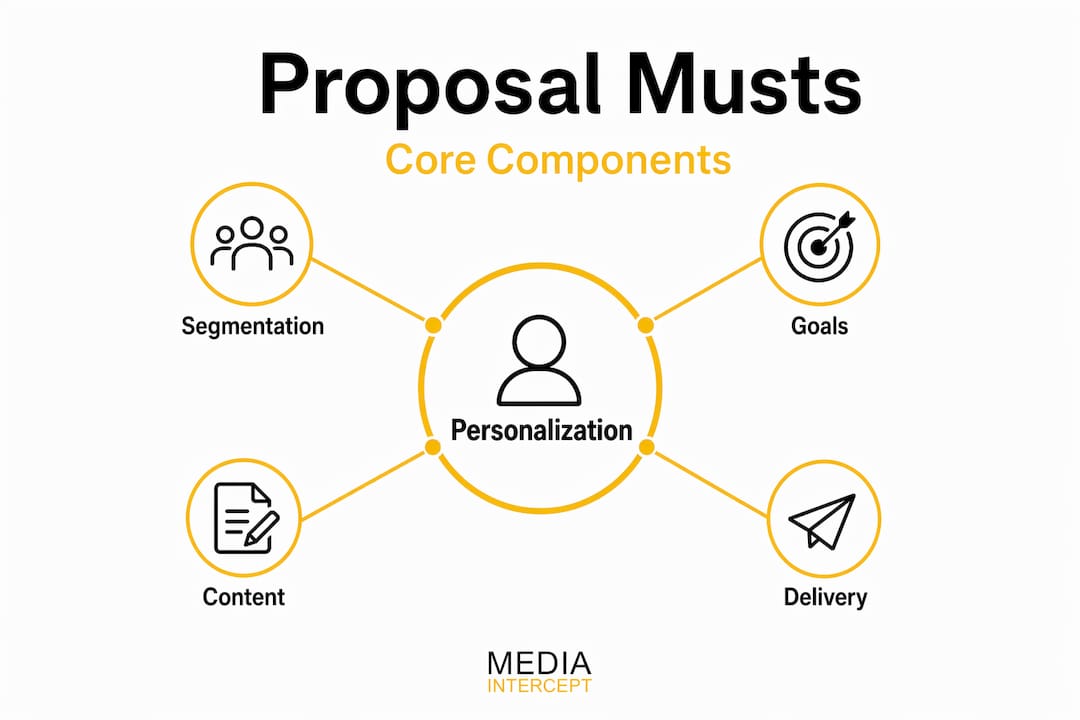
Every solid client newsletter strategy proposal addresses these elements clearly:
Campaign goals: Specific, measurable outcomes (lead generation, retention, brand authority) tied directly to client KPIs
Audience segmentation: Who receives which messages and why, including behavioral or demographic filters the client already uses
Content strategy: The editorial mix, including how frequently educational content appears versus promotional content
Technology and tools: The platforms, integrations, and reporting dashboards you will use to execute and measure the campaign
Timeline and cadence: A month-by-month send schedule with built-in review checkpoints
Budget and pricing model: Flat fee, cost-per-click, or hybrid options with transparent cost breakdowns
One aspect marketers often underestimate is audience segmentation. Personalization and relevance directly increase open rates and reduce unsubscribe rates, which means your proposal should specify exactly how the list will be segmented and what personalization logic will be applied.
Comparing content strategy approaches
Not every client needs the same editorial model. Here is how the two primary approaches stack up:
Approach | Best for | Content ratio | Primary outcome |
Educational-first | B2B, professional services, SaaS | 90% educational / 10% promotional | Trust building, authority, retention |
Promotional-first | E-commerce, product launches, retail | 60% promotional / 40% editorial | Direct conversions, short-term revenue |
Hybrid editorial | Agencies, consultancies, media brands | 75% educational / 25% promotional | Balanced engagement and lead nurturing |
The educational-first model is the one that holds up longest. Newsletters that interpret industry changes for the reader build more durable client trust than ones that push product in every issue.
Pro Tip: Include a one-paragraph content philosophy statement in your proposal. Clients who understand why you are recommending a certain content ratio are far more likely to approve it without second-guessing every editorial decision later.
How to structure a newsletter campaign proposal step by step
A well-structured proposal walks the client through a logical story: here is your problem, here is why it matters, here is what we will do about it, and here is how we will prove it is working. That arc is what separates proposals that get signed from ones that get shelved.
The step-by-step framework
Executive summary (1 page maximum). Open with the client’s core challenge, your proposed solution in two to three sentences, and one or two metrics from past campaigns. One-page summaries with metrics and social proof significantly reduce friction in client decisions.
Client situation analysis. Describe the client’s current position: existing email performance, audience gaps, competitive context. Use their own language from your discovery calls. This section shows you listened.
Proposed newsletter strategy. Lay out the content themes, editorial cadence, and send frequency. For most professional services clients, a monthly send schedule is a reliable starting point. Going to quarterly risks giving competitors room to fill the inbox instead.
Content plan and themes. List three to five specific content pillars tied to the client’s business goals. For a B2B SaaS client, that might include product education, customer success stories, and industry trend analysis. Give concrete examples, not vague categories.
Implementation timeline. Break the campaign into phases: onboarding and setup (weeks 1 to 2), content production and approval (weeks 3 to 4), first send and monitoring (week 5 onward). Each phase should have a named owner and a deliverable.
KPIs and success metrics. Define what success looks like before the campaign begins. Typical metrics include open rate, click-through rate, list growth rate, and conversion rate from newsletter traffic. If the client sells professional services, include pipeline influence as a metric.
Pricing and budget. Offer two or three tiered options. Clients appreciate choice. A starter tier, a growth tier, and a performance tier give the client control while anchoring the conversation at the level you actually want to close.
The section clients scrutinize most is pricing, which is why you need to connect every cost line back to an outcome. “Content production: $X/month” is weak. “Content production covering four educational issues and one campaign-aligned send per month at $X” is a proposal clients can defend internally to their finance team.
You should also address landing page strategy inside the proposal. Newsletter-relevant landing pages convert 5 to 15% better than generic ones, so mentioning that you will create or recommend context-aware landing pages demonstrates that you are thinking about the full conversion path, not just email opens.

Best practices for pitching newsletter proposals to clients
Even a technically perfect proposal can fail at the pitch stage. How you present it matters as much as what is inside it.
Lead with the client’s problem, not your credentials. The first thing out of your mouth in a pitch meeting should be a reflection of their challenge. Your agency bio comes after you have demonstrated that you understand their world.
Brevity is a competitive advantage. Clients sit through long decks every week. When you walk in with a focused one-page summary backed by a supporting appendix, you signal confidence. Leading proposals favor concise summary pages over slide-heavy decks because they close deals faster.
Anchor every recommendation to a client goal stated during discovery
Use real open rates, click-through rates, or subscriber growth figures from past campaigns as social proof
Keep design clean and secondary to content. A cluttered proposal feels unfinished.
Prepare for three standard objections: “We don’t have time to review content,” “Our list is too small,” and “We tried email before and it didn’t work.” Have a factual, specific response ready for each.
Follow up within 48 hours of sending the proposal with a brief, direct email asking for specific feedback, not just a yes or no
One thing that consistently kills otherwise strong proposals is setting unrealistic expectations on results. Be honest about timelines. Newsletter audiences take time to build, and consistent scheduling and formatting are what signal reliability to subscribers. Telling a client they will see dramatic lead volume in month one sets you up for a difficult conversation in month two.
Pro Tip: Record a two-minute Loom walkthrough of your proposal before sending it. Clients who watch the video before reading the document are far more likely to engage with the full proposal because you have already framed the narrative for them.
Measuring success and proving value to clients
Getting the campaign approved is the beginning. What keeps clients renewing is your ability to demonstrate that the campaign is working and to show them what the data means for their business.
The metrics that matter most
Track these in every reporting cycle:
Open rate: Industry benchmarks vary, but a well-segmented, educational-first newsletter should target 35 to 45% open rates
Click-through rate (CTR): Measures content relevance. A CTR under 1% suggests either content or CTA alignment needs adjustment.
Conversion rate from newsletter traffic: Tie newsletter clicks to pipeline events or purchases using UTM parameters and your client’s CRM data
List growth rate: Net new subscribers minus unsubscribes, expressed monthly
Reporting cadence and format
Deliver performance reports within 72 hours of each campaign send, followed by a 30-day summary that includes both quantitative metrics and qualitative observations from any subscriber replies or feedback. Clients notice when you are proactive.
The reporting format matters too. A simple table with prior period comparisons is more persuasive than a wall of screenshots. Here is an example structure:
Metric | Baseline | Month 1 | Month 3 | Change |
Open rate | 18% | 27% | 34% | +16 pts |
Click-through rate | 0.8% | 1.4% | 2.1% | +1.3 pts |
New subscribers | N/A | 140 | 380 | +171% |
Conversions from email | 3 | 11 | 22 | +633% |
When results like these show up in your follow-up proposal, the upsell conversation practically writes itself. The client has seen their own data improve across three months. That is the foundation of long-term client partnerships built on measurable outcomes rather than promises.
My take on what actually makes proposals succeed
I have reviewed hundreds of newsletter campaign proposals over the years, and the ones that win do not win because of better design or more sophisticated analytics frameworks. They win because the writer clearly did the work before sitting down to write.
The proposals I have seen fail most often treat the newsletter as a standalone deliverable. What I have learned is that newsletters work best when they function as connective tissue between content, sales, and business strategy rather than isolated email blasts sent on a schedule. When your proposal reflects that understanding, clients feel it.
The other mistake I keep seeing is proposals that try to do too much. Marketers pack in fifteen tactics, three platform integrations, and a full content calendar for twelve months. The client gets overwhelmed and stalls. A tighter proposal with a clear phase-one focus and a stated expansion path closes faster and creates a healthier working relationship.
My honest advice: write proposals as if you are the client’s internal advocate, not their vendor. Show them you understand their pressures, their skeptical CFO, their past failed email experiments. Newsletters should serve as permission-based authority builders that warm up prospects before any sales conversation happens. When your proposal explains that function clearly, clients stop seeing the budget line as a cost and start seeing it as an investment in their pipeline.
— Media Intercept
Plan your next newsletter campaign with Media Intercept
If you are ready to move from proposal to execution, Media Intercept can help you get there faster. The platform connects brands and publishers across premium newsletter sponsorship networks, with flexible CPC and flat-fee pricing options built for both performance and predictable spend. Whether you are pitching a new client on their first email campaign or scaling an existing program across multiple publisher placements, Mediaintercept gives you the tools, reporting, and workflow support to execute with confidence. Explore the publisher monetization platform to see how brands and publishers are building measurable engagement at scale. You can also access our campaign strategy guides for deeper research to sharpen your next proposal.
FAQ
What should a newsletter campaign proposal include?
A strong newsletter campaign proposal covers campaign goals, audience segmentation, content strategy, implementation timeline, KPIs, and pricing options. Each element should connect directly to the client’s stated business objectives.
How long should a newsletter proposal be?
Keep the main proposal to one page with a detailed appendix available on request. Concise summary pages with metrics and social proof close deals faster than lengthy slide decks.
What content ratio works best in client newsletters?
The 90/10 content balance of 90% educational to 10% promotional is the most effective approach for maintaining subscriber engagement and building client trust over time.
How often should newsletters be sent to clients?
A monthly cadence is recommended for most professional service contexts. Sending quarterly risks losing inbox visibility and gives competitors room to fill the gap.
Which metrics should you track in a newsletter campaign?
Track open rate, click-through rate, conversion rate from newsletter traffic, and net list growth monthly. Deliver a performance report within 72 hours of each send to keep clients informed and confident in the campaign.
Recommended