
How to Scale Newsletter Ad Campaigns for Better ROI

Updated: May 25
Most marketing professionals hit the same wall: a newsletter ad campaign is performing well, so you push the budget up, expand the audience, and wait for results to multiply. Instead, performance drops. To successfully scale newsletter ad campaigns, you need a structured approach that protects what’s already working while creating room for controlled growth. This guide walks you through the preparation, budget frameworks, creative strategy, and measurement systems that actually produce sustainable results at scale.
Table of Contents
Key takeaways
Point | Details |
Stabilize before scaling | Collect at least 20-30 conversions per campaign before increasing spend or changing settings. |
Budget increases require patience | Limit budget jumps to 20-30% every 48 hours to avoid disrupting algorithm learning phases. |
Landing pages drive conversion | Dedicated landing pages can push conversion rates from under 3% to over 15%, making them a critical pre-scaling priority. |
Measure beyond 30 days | Capture pipeline impact and assisted conversions over 30-180 days for accurate scaling decisions. |
Audience before creative, then reverse | Stabilize creative performance first, then expand audiences to isolate what is driving results. |
How to scale newsletter ad campaigns: build your foundation first
You cannot scale something that is not stable. Before you increase spend or expand reach, you need a measurement and creative framework that gives you clean, reliable signals to work from.
The most commonly skipped step is setting up conversion tracking that goes beyond click data. UTM parameters combined with post-purchase surveys capture the full picture, including return visits and conversions that standard cookie-based attribution misses. A simple “how did you hear about us?” question in your onboarding or checkout flow fills attribution gaps that analytics platforms routinely ignore.
Landing page quality is another non-negotiable. Dedicated landing pages consistently convert newsletter traffic at 15-35%, compared to 1-3% for a generic homepage. If you are sending paid newsletter traffic anywhere other than a page built specifically for that audience and offer, you are scaling on a broken foundation.
Here is a pre-scaling checklist to confirm you are ready:
Conversion tracking confirmed: UTM parameters are active, and you have post-click attribution in place.
Dedicated landing page live: The page speaks directly to the newsletter audience and has a single, clear call to action.
Baseline conversion data collected: You have at least 20-30 conversions recorded per campaign to feed algorithm optimization.
30-day measurement window set: You are tracking not just immediate conversions but pipeline and long-term impact over 30-180 days.
Creative volume adequate: You have enough creative variations running to generate clean performance signals without audience fatigue.
Pro Tip: Set up a 90-day measurement calendar before you launch, not after. Scaling decisions made at day 14 based on click data alone routinely produce false confidence. The real picture takes longer to develop.
Budget scaling: a phase-by-phase framework
Once your foundation is stable, scaling budget is not a question of how much to spend. It is a question of how fast to move without destroying the progress you have already made.
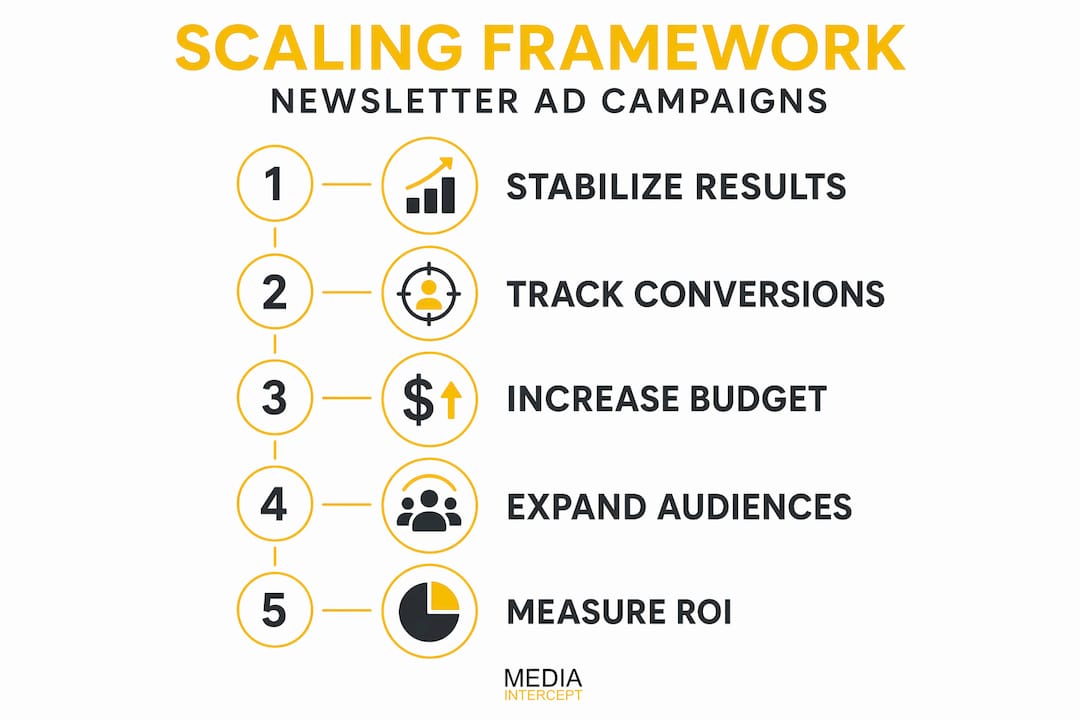
Increasing a campaign budget by more than 20-30% at once forces the algorithm back into a learning phase, which means your campaign effectively starts over in terms of optimization. This is one of the most common and costly mistakes in newsletter advertising. You spend more and get less because the system no longer knows who to target efficiently.
Use this four-phase framework to scale budget with discipline:
Foundation phase (weeks 1-3): Run campaigns at your baseline budget. Focus entirely on collecting conversion data, not hitting volume targets. Wait until you have at least 20-30 conversions before touching any settings.
Conservative scaling phase (weeks 4-6): Increase your budget by 20-25% and wait a full 48 hours before evaluating results. Monitor CPA and conversion rate trends closely. If both remain stable, you are clear to continue.
Aggressive scaling phase (weeks 7-10): Once ROAS has stayed 15% or more above your target for 14 or more consecutive days, you have a strong signal to push harder. Increase budget by up to 30% per interval, still maintaining the 48-hour window.
Optimization phase (ongoing): Shift focus from budget increases to placement testing, creative refresh, and audience segmentation. Budget growth at this stage should follow performance data, not a predetermined schedule.
Timing matters beyond just pacing. Scaling around seasonal demand cycles, like Q4 for consumer brands or Q1 for B2B, can amplify returns significantly. Avoid making budget or targeting changes during a platform’s known algorithm update windows, as these periods already introduce instability.
Pro Tip: If CPA rises by more than 15% after a budget increase and does not correct within 72 hours, roll back the increase. A fast retreat saves far more than waiting it out.
Creative and audience expansion
Once budget scaling is underway, the next lever is creative and audience expansion. The order in which you approach this matters more than most advertisers realize.

Expanding creative volume first, before widening your audience, allows you to identify which messages, formats, and offers actually perform. Once you have that signal, you can carry the winning creative into new audience segments and maintain performance consistency.
Here is how to approach this systematically:
Add creative variations before audiences. Test at least three to five creative variants per placement. Let them run until one shows clear signal dominance before expanding reach.
Segment existing audiences before building new ones. Break your current audience into behavioral and demographic subsets. You will often find that one segment outperforms others by a wide margin, and that insight should guide your lookalike modeling.
Use lookalike audiences anchored to converters, not clicks. Building lookalike audiences from email click lists produces noisier results than building from confirmed converters or high-value customers.
Avoid simultaneous shifts. Changing both creative and audience targeting at the same time makes it impossible to know what caused a performance change. Adjust one variable at a time and give each change at least five to seven days to stabilize.
Prioritize placement testing by vertical. B2B SaaS and finance newsletters command CPMs of $80-$180, reflecting higher audience quality and intent. If your product fits those verticals, premium placements often outperform broader, cheaper inventory on a cost-per-acquisition basis.
The instinct to widen targeting quickly is understandable when a campaign is performing well. Resist it. Audience saturation in a tightly defined segment is usually better than diluted performance across a wide one.
Common pitfalls when scaling newsletter campaigns
Scaling breaks in predictable ways. Knowing what to watch for lets you catch problems early and fix them before they compound.
Creative fatigue is the first failure mode. When the same creative runs to the same audience for too long, open rates and click-through rates decline even when the offer remains strong. Monitor frequency metrics and have fresh creative ready to rotate in before fatigue sets in, not after.
Audience saturation signals itself through rising CPA. If your cost per acquisition is climbing steadily over two weeks with no other variable change, your campaign has likely reached the edges of its most responsive audience. The fix is either a new audience segment or a fresh creative angle, not a budget cut.
Attribution accuracy deserves more attention than most marketers give it. Relying only on click-based metrics misses a significant portion of conversions that come through return visits, direct traffic, or other channels influenced by your newsletter ads. Combining UTM data with explicit referral source feedback closes this gap and produces far more accurate scaling decisions.
Performance dips after scaling are normal. A 10-15% CPA increase immediately after a budget jump does not necessarily indicate failure. Give the algorithm 48-72 hours to re-optimize before reacting. Reacting too quickly by pulling back spend restarts the learning phase unnecessarily.
The deepest problem in newsletter campaign scaling is measuring the wrong things. Optimizing for open rates produces campaigns that look good in dashboards but fail on revenue. Open rate tracking has also become increasingly unreliable due to iOS privacy changes. Focus on downstream metrics: pipeline generated, deals influenced, and revenue attributed.
Measuring success and verifying results at scale
Sustained scale requires a measurement system that captures value across multiple time horizons. A campaign that looks flat at 30 days often shows significant impact at 90.
Here is a framework for the metrics that matter most at each checkpoint:
Checkpoint | Primary metrics | Decision criteria |
Day 30 | CPA, ROAS, click-to-conversion rate | Stable or improving ROAS justifies next budget increase |
Day 60 | Assisted conversions, pipeline generated | Continued pipeline growth confirms audience quality |
Day 90 | Closed-won deals, LTV of newsletter-sourced leads | Strong LTV relative to CAC signals sustainable scale |
AI-powered personalization can provide meaningful performance uplift at scale through dynamic content and behavioral segmentation. Marketers using segmented, personalized email content report measurable lifts in both click-through and conversion rates compared to static campaigns.
Dedicated dashboards that pull CPA, ROAS, and conversion trends into a single view prevent the common problem of making decisions based on isolated metrics. When you can see all three trending together, the scaling picture becomes much clearer.
Pro Tip: Set explicit thresholds before a campaign launches, not mid-campaign. Decide in advance that a CPA above a certain level triggers a pause, and that ROAS consistency above your target for 14 days triggers the next budget increase. Pre-committed rules reduce emotional decision-making under pressure.
Reviewing a newsletter media plan that includes built-in measurement frameworks can also help you structure these checkpoints in a way that aligns budget pacing with verified performance.
My perspective on scaling newsletter campaigns
I have worked with enough campaigns to know that the ones that scale successfully share one trait: the team running them was willing to be patient during the learning phase when every instinct said to push harder.
In my experience, the teams that struggle most with scaling are not the ones with smaller budgets. They are the ones that make changes too fast. They see a good week and double the budget. They see a slow week and overhaul the creative. The algorithm never gets the stability it needs, and performance stays inconsistent.
What I have also found is that landing page quality is consistently underestimated. I have seen campaigns with genuinely strong ad creative that were delivering mediocre results simply because the traffic was hitting a homepage with no clear path to conversion. Fixing the landing page turned those campaigns around faster than any targeting adjustment.
My take on measurement is this: if you are not tracking past 30 days, you are making scaling decisions with incomplete data. The best newsletter campaigns I have seen have compounding effects on pipeline that only become visible at 60 or 90 days. Scaling based on 30-day snapshots often leads to cutting campaigns that were about to break through.
The most useful thing you can do right now is to map your current newsletter ad performance against a 90-day window and set your scaling rules in advance. Then hold to them.
— Media Intercept
Scale your newsletter campaigns with Media Intercept
If you are ready to put these strategies into practice, Media Intercept is built to support exactly this kind of structured, measurable growth. The platform connects brands with premium publisher networks for newsletter sponsorships and dedicated email campaigns, with flexible CPC and CPM pricing options designed to match your performance goals.
Media Intercept handles campaign execution, standardized reporting, and pacing workflows so your team can focus on strategy rather than logistics. Whether you are managing a single brand campaign or looking to scale across multiple advertisers, the platform gives you the inventory access and measurement infrastructure to grow with confidence. Publishers can also access monetization solutions without exclusivity requirements. Explore Media Intercept’s newsletter advertising platform or browse available guides and research to go deeper on the strategies covered here.
FAQ
How do you scale newsletter ad campaigns without losing ROI?
Scale budget incrementally at 20-30% intervals every 48 hours and monitor CPA and ROAS trends closely before each increase. Stabilizing creative and landing page performance before scaling spend is the most reliable way to maintain ROI as you grow.
What is the right number of conversions before scaling?
Collecting at least 20-30 conversions per campaign gives the algorithm enough data to optimize effectively without being disrupted by premature budget changes.
How long should you measure a newsletter campaign before scaling?
A 30-day window captures immediate conversion data, but measuring over 30-180 days is necessary to see the full pipeline and revenue impact that informs accurate, confident scaling decisions.
What metrics indicate a newsletter campaign is ready to scale?
Consistent ROAS that stays 15% or more above your target for 14 or more days, stable conversion rates, and an audience that has not yet reached saturation are the three clearest signals that a campaign is ready for increased spend.
Why do newsletter campaigns underperform after scaling?
The most common cause is a budget increase that resets the algorithm learning phase, combined with creative fatigue in a tightly defined audience. Pacing increases correctly and refreshing creative before fatigue sets in resolves most post-scaling performance drops.
Recommended
