
Newsletter Advertising for SaaS Brands: 2026 Guide

For a broader overview of how the channel works, start with our beginner guide to newsletter advertising. This article focuses specifically on how SaaS brands can use newsletter placements to drive qualified traffic, demos, trials, and pipeline.
Newsletter advertising for SaaS brands is a paid sponsorship channel that places your message inside opt-in email publications read by product-aware, high-intent professionals. Unlike programmatic display, newsletter ads reach subscribers who chose to receive content in a specific niche, which means your ad appears alongside material they already trust. SaaS companies like HubSpot and Aircall have used newsletter sponsorships to drive qualified pipeline at a fraction of their LinkedIn spend. This guide covers ad formats, pricing benchmarks, measurement challenges, copy best practices, and the buying process you need to run profitable campaigns in 2026.
What are the main newsletter ad formats and pricing for SaaS in 2026?
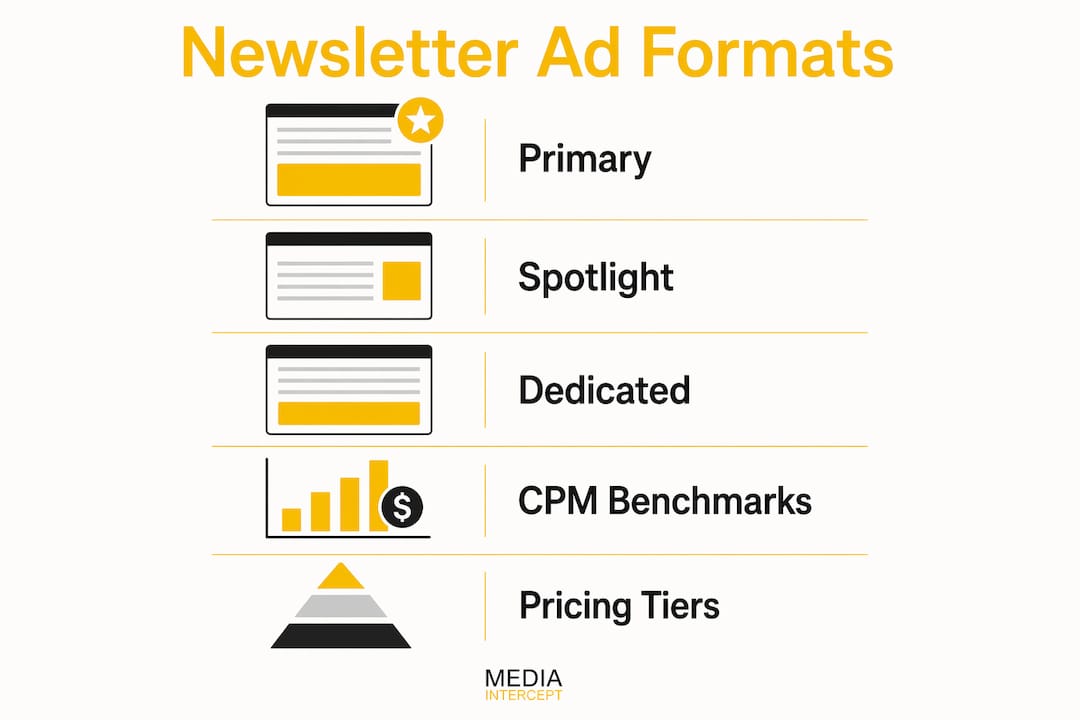
Newsletter advertising for SaaS brands spans five primary formats, each with a distinct placement, price point, and use case. Knowing the difference before you budget prevents overspending on formats that do not match your goal.
Primary sponsorship sits at the top of the newsletter, above the fold, and commands the highest price. Primary placements for mid-sized B2B newsletters cost $1,100 to $5,000 per placement, with dedicated sends on premium lists exceeding $10,000. That price reflects the attention premium of being the first thing a reader sees.
Spotlight ads appear mid-newsletter, typically as a short callout block. They cost less than primary placements and work well for retargeting readers who already know your brand. Native advertorials are longer, editorial-style pieces that blend with the newsletter’s content. They convert well for complex SaaS products that need more explanation before a reader clicks.

Dedicated sends are standalone emails sent to a publisher’s full list on your behalf. They are the most expensive format but give you complete creative control and the highest share of attention. Backlinks are the lightest format: a brief mention with a URL, often used for brand awareness or SEO value.
CPM benchmarks vary sharply by vertical. B2B newsletter CPMs in 2026 range from $5 to $12 for generalist audiences, $10 to $20 for tech and AI newsletters, $15 to $40 for developer-only lists, and $25 to $60 for cybersecurity audiences. Higher CPMs reflect higher audience value, not publisher greed.
Format | Typical price range | Best use case |
Primary sponsorship | $1,100–$5,000 per placement | Brand awareness, lead gen |
Spotlight ad | $300–$1,500 per placement | Retargeting, feature launches |
Native advertorial | $1,500–$6,000 per placement | Complex product education |
Dedicated send | $5,000–$10,000+ per send | Full-funnel campaigns |
Backlink mention | $100–$500 per mention | SEO, light brand awareness |
How does Apple Mail Privacy Protection affect newsletter ad measurement?
Apple Mail Privacy Protection (MPP) is the single biggest measurement challenge in email advertising for SaaS today. MPP pre-fetches email pixels on Apple’s servers before a subscriber even opens the message. The result: open rates are inflated and unreliable because the pixel fires regardless of whether a human actually read the email.
MPP is enabled by default for more than 95% of Apple Mail users. That is not a niche edge case. It means open rate data from a large share of your list is essentially noise.
The fix is to shift your measurement framework entirely. Clicks and conversions are the metrics that matter now. A click requires a human to make a deliberate choice, so it remains a clean signal. Conversion tracking, tied to your CRM or landing page analytics, tells you whether newsletter traffic actually produces pipeline.
Clicks: The primary engagement metric post-MPP. Track unique clicks, not total clicks.
Conversions: Form fills, trial signups, or demo requests attributed to newsletter traffic.
Corporate-domain attribution: Identifies which companies visited your site from a newsletter click, adding ABM context.
Send-time patterns: Use click data, not open data, to determine optimal send times.
Pro Tip: Redefine “engaged subscriber” in your reporting as anyone who clicked in the last 90 days. Open-based engagement scores are now misleading and will skew your audience quality assessments.
Post-MPP, clicks and conversions are the cleanest performance metrics available. Treat open rates as a system health indicator only, not a measure of campaign success.
What are best practices for newsletter ad copy and landing pages?
The structure of your ad copy determines whether a reader clicks or scrolls past. Effective newsletter ad copy opens with a relevance signal in the first few words, includes a specific number to differentiate your offer, removes a common objection, and ends with one clear call to action. Primary ad copy runs 80–150 words. Longer formats like advertorials can run 300–500 words.
Here is a proven structure for a primary newsletter ad:
Relevance signal: Name the reader’s role or pain point in the first sentence. “If you run a SaaS sales team…” immediately filters for the right reader.
Numeric differentiation: Use a specific number. “Cut onboarding time by 40%” outperforms “improve your onboarding” every time.
Objection removal: Address the most common reason someone would not click. “No credit card required” or “Setup takes under 10 minutes” reduces friction.
Single CTA: One link, one action. “Start your free trial” beats “Learn more, sign up, or contact us.”
Specificity and early relevance cues in headlines boost click-through rates, with direct messaging outperforming clever wordplay. Simple beats clever in newsletter ads, every time.
Landing pages are where most SaaS newsletter campaigns lose money. Dedicated landing pages convert at 15–35% compared to 1–3% for homepage traffic. That gap is not marginal. It means a campaign sending traffic to your homepage may be generating one-tenth the leads it could.
Pro Tip: Build one landing page per newsletter placement. Match the headline on the page to the headline in the ad. Readers who see continuity between the ad and the page convert at significantly higher rates.
Your landing page should remove navigation menus, repeat the ad’s core promise, and present a single form or CTA. Treat it as a continuation of the ad, not a separate experience.
What is the process for buying newsletter ads and optimizing for ROI?
Buying newsletter ads follows a six-step process: identify the right publisher, decide between a direct buy or marketplace, negotiate terms, deliver your creative, launch the campaign, and measure results. The biggest decision in that sequence is direct versus marketplace.
Direct buys give you faster turnaround, editorial control, and the ability to negotiate custom placements. Marketplaces give you access to dozens of publishers through a single workflow, which matters when you are testing multiple verticals at once. Platforms like Media Intercept operate as marketplaces that connect SaaS brands with premium newsletter publishers, handling workflow and reporting in one place.
Negotiation is where most SaaS marketers leave value on the table. Publishers often have flexibility on payment terms, bonus placements, and reporting depth. Ask for corporate-domain reporting as a standard deliverable. Corporate-domain reporting adds 2–3x the conversion value beyond direct click data by showing which companies engaged with your ad, even if they did not convert immediately.
Test multiple headlines: Run at least two headline variants per placement to identify which angle resonates.
Budget for iteration: Advertisers who test multiple headlines typically identify winning angles by placement 5–6, reducing wasted spend.
Track by placement: Separate UTM parameters for each newsletter let you compare performance across publishers.
Review after three placements: Do not judge a newsletter on one run. Frequency builds recognition and improves conversion over time.
Pro Tip: Ask publishers for their median click rate on sponsored content, not just their subscriber count. A list of 50,000 engaged readers often outperforms a list of 200,000 passive ones.
A well-structured newsletter campaign workflow covers publisher selection, creative delivery timelines, and measurement checkpoints. Building that workflow before you launch prevents the scramble that kills most first-time newsletter campaigns.
How do newsletter ads compare with other digital channels for SaaS?
Newsletter ads consistently outperform LinkedIn and display ads on cost per click for SaaS brands targeting similar professional audiences. A $15,000 LinkedIn campaign delivered roughly 1,500 clicks at $10 CPC, while a comparable newsletter campaign delivered approximately 2,800 clicks at around $5.36 CPC, plus additional account-based marketing impact from corporate-domain data. That is nearly double the clicks at half the cost.
Display ads have even weaker performance for SaaS. Banner blindness is real, and programmatic inventory often places your ad next to irrelevant content. Newsletter readers, by contrast, opted in to receive content in your category. That intent gap explains the CTR difference.
Channel | Typical CPC | Audience intent | ABM capability |
Newsletter ads | $3–$8 | High (opted-in, niche) | Yes, via domain reporting |
LinkedIn ads | $8–$15 | Medium (job-title targeted) | Limited |
Display/programmatic | $0.50–$2 | Low (broad, passive) | No |
Newsletter ads also build brand familiarity over repeated placements. A SaaS brand that appears in a developer newsletter three times in a quarter becomes a recognized name in that community. LinkedIn and display ads rarely produce that effect at comparable spend levels. For a deeper look at how these channels stack up, the newsletter vs. display ads comparison breaks down engagement and ROI across both formats.
Key takeaways
Newsletter advertising for SaaS brands delivers the strongest ROI when you combine niche publisher selection, dedicated landing pages, and corporate-domain attribution to capture both direct conversions and ABM pipeline impact.
Point | Details |
Format selection matters | Match your ad format to your goal: primary for awareness, dedicated sends for full-funnel campaigns. |
CPM reflects audience value | Developer and cybersecurity newsletters command $15–$60 CPM because their readers are high-value buyers. |
Ditch open rates post-MPP | Clicks and conversions are the only reliable metrics after Apple Mail Privacy Protection. |
Landing pages drive conversions | Dedicated landing pages convert at 15–35% versus 1–3% for homepage traffic. |
Test before you scale | Identify winning headlines by placement 5–6 before committing to a long-term publisher relationship. |
Why newsletter ads reward patience more than most SaaS marketers expect
I have watched SaaS teams run one newsletter placement, see modest click numbers, and write off the channel entirely. That is the wrong read. Newsletter advertising compounds. The first placement builds recognition. The second builds familiarity. By the third, readers who were not ready to click the first time start converting.
The corporate-domain reporting angle is genuinely underused. Most SaaS marketers look at clicks and stop there. But when you pull domain-level data, you often find that companies from your ideal customer profile visited your site without converting. That is pipeline intelligence, not a failed campaign. It tells your sales team exactly which accounts to prioritize.
The MPP shift has actually made newsletter advertising more credible, not less. Marketers who relied on inflated open rates to justify spend are now forced to prove real engagement through clicks and conversions. That accountability benefits everyone who runs honest campaigns.
My strongest advice: do not treat newsletter ads as a one-shot test. Budget for at least five placements across two or three publishers before drawing conclusions. The brands that scale newsletter advertising successfully treat it like SEO: consistent, iterative, and built on compounding returns.
— Natalie
How Media Intercept helps SaaS brands run newsletter campaigns
SaaS brands that want to move from planning to execution without building publisher relationships from scratch have a direct path through Media Intercept.
Media Intercept connects SaaS advertisers with premium newsletter publishers across tech, developer, cybersecurity, and B2B verticals. The platform handles publisher discovery, placement booking, creative delivery, and standardized reporting, including corporate-domain attribution, in one workflow. You can run campaigns on a CPC basis for performance-focused budgets or use flat-fee CPM placements for predictable spend. Whether you are running your first newsletter sponsorship or scaling a campaign that is already working, Media Intercept gives your team the infrastructure to execute faster and measure what actually matters. Plan your next campaign with our team today.
FAQ
What is newsletter advertising for SaaS brands?
Newsletter advertising for SaaS brands is a paid channel where SaaS companies place sponsored content inside opt-in email publications to reach niche, high-intent professional audiences. It includes formats like primary sponsorships, dedicated sends, and native advertorials.
How much does a newsletter ad placement cost in 2026?
Primary sponsorships in mid-sized B2B newsletters cost $1,100 to $5,000 per placement, while dedicated sends on premium lists can exceed $10,000. CPM rates range from $5 for generalist B2B audiences to $60 for cybersecurity-focused lists.
Why are open rates unreliable for measuring newsletter ad performance?
Apple Mail Privacy Protection pre-fetches email pixels on Apple’s servers, inflating open rates regardless of whether a subscriber actually read the email. Clicks and conversions are the reliable metrics to track instead.
What conversion rate should I expect from newsletter ad traffic?
Dedicated landing pages built for newsletter campaigns convert at 15–35%, compared to 1–3% for traffic sent to a generic homepage. Matching your landing page headline to your ad headline is the single biggest conversion lever.
Should SaaS brands buy newsletter ads directly or through a marketplace?
Direct buys offer editorial control and faster turnaround, while marketplaces provide access to multiple publishers through a single workflow. Most SaaS brands benefit from starting with a marketplace to test verticals, then moving to direct relationships with top-performing publishers.
Recommended