
Newsletter Advertising Budget Allocation: 2026 B2B Guide

Newsletter advertising budget allocation is the practice of distributing paid media spend across ad formats, placements, and publisher relationships to maximize return based on engagement and conversion data. For marketing professionals and budget planners, getting this right in 2026 means moving beyond list size as a proxy for value and building spend decisions around CPM benchmarks, CPC performance, and cost-per-lead outcomes. This guide gives you a data-driven framework for testing, scaling, and measuring newsletter ad spend across B2B verticals, with specific numbers you can use immediately.
How do you set a newsletter advertising budget using CPM, CPC, and conversion data?
Newsletter advertising budget allocation starts with understanding three pricing units: CPM (cost per thousand impressions), CPC (cost per click), and CPA (cost per acquisition). Each measures a different layer of campaign performance, and relying on any single metric distorts your true ROI picture.
CPM tells you what you pay to reach a thousand subscribers. But CPM alone misleads when a newsletter has a large list and a low open rate. A 100,000-subscriber list with a 15% open rate delivers 15,000 actual readers. A 30,000-subscriber list with a 45% open rate delivers 13,500 readers. The second list costs less per engaged reader, even if its nominal CPM looks similar. This is why normalizing cost by engagement rather than raw list size is the correct comparison method.
CPM benchmarks vary significantly by vertical. Generalist B2B newsletters run $5 to $12 CPM. Cybersecurity newsletters command $25 to $60 CPM. Fintech newsletters fall between $20 and $45 CPM. These ranges reflect audience specificity and purchase intent, not just list quality. A $50 CPM in a Cybersecurity newsletter reaching 8,000 engaged CISOs is a better investment than a $10 CPM in a generalist list of 80,000 mixed-role subscribers, if your product is a security tool.
CPC and CPA complete the picture. Sponsored newsletter CPC typically runs $1 to $5 for B2B, while qualified B2B leads generated through dedicated landing pages cost between $30 and $120 CPL. That CPL range assumes proper attribution setup. Without dedicated landing pages and corporate-domain tracking, you will undercount conversions and misallocate budget toward placements that appear to underperform.
Pro Tip: Build your budget around a target CPL, then work backward. If your acceptable CPL is $80 and your expected conversion rate is 2%, you need 50 clicks per lead. At a $3 CPC, that is $150 per lead before landing page optimization. Tighten the landing page first, then scale the ad spend.
Metric | What it measures | Budget use |
CPM | Cost per 1,000 subscribers reached | Awareness and reach planning |
Engaged CPM | Cost per 1,000 actual readers (adjusted for open rate) | Comparing placements fairly |
CPC | Cost per click to your landing page | Performance and lead gen campaigns |
CPA / CPL | Cost per acquisition or qualified lead | ROI validation and scale decisions |
What budget allocation strategies optimize risk and maximize scale?
The standard approach to newsletter marketing budget planning follows a test-to-scale model. You start small, validate performance across multiple checkpoints, and increase spend only when the data supports it. This protects budget from premature commitment to placements that have not proven conversion efficiency.
A practical starting point is a test budget of $5,000 to $10,000. One common test configuration combines one Spotlight ad, one Primary placement, and one Backlink, which runs approximately $5,500 total. This spread tests different ad formats simultaneously across the same or similar audiences, giving you comparative data rather than a single data point.
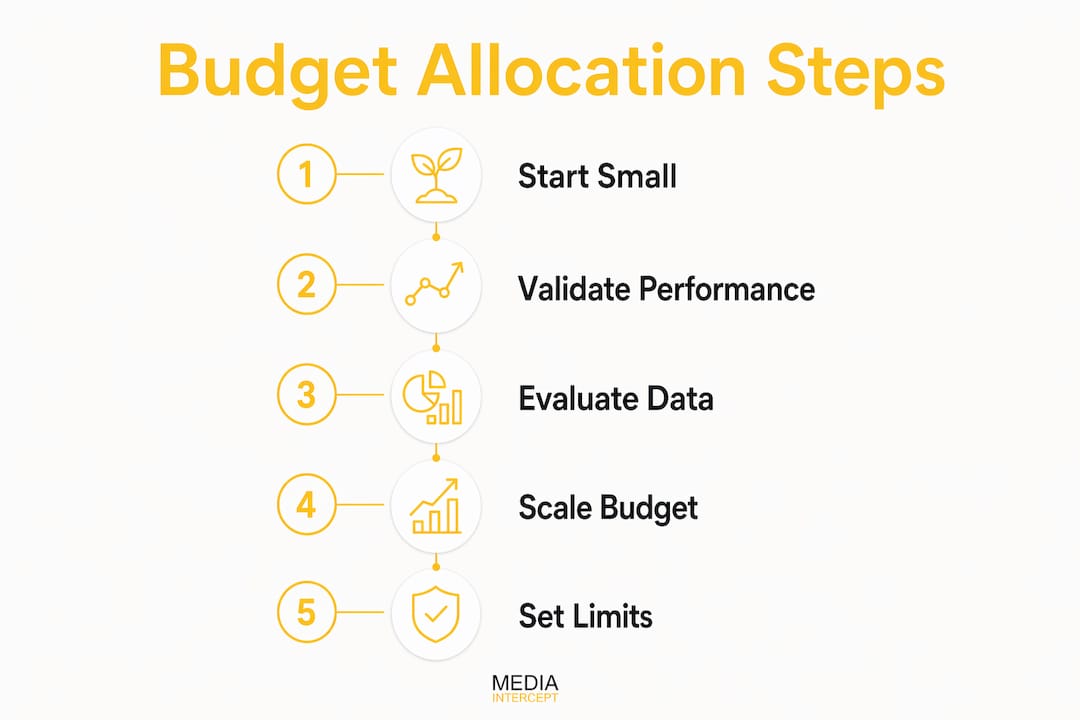
From there, a quarterly pilot budget of roughly $14,000 (a Starter Pack structure) covers enough placements to identify which formats and publishers drive the best CPC and CPL. A growth phase budget of approximately $28,000 per quarter allows you to double down on what worked and test new verticals or formats. These are not arbitrary tiers. They reflect the minimum spend needed to generate statistically meaningful performance data in B2B newsletter campaigns.
Here is a phased framework you can apply directly:
Test phase ($5K to $10K): Run two to three ad formats across one or two publishers. Measure CPC at day 3, day 30, and day 60.
Pilot phase ($14K per quarter): Expand to three to four publishers. Add a dedicated send if CPC from phase one was below your target.
Growth phase ($28K per quarter): Scale spend on the top two performing placements. Test one new vertical or format per quarter.
Optimization phase (ongoing): Shift budget toward placements with the lowest CPL. Reduce or eliminate placements that exceed your CPL ceiling after 90 days.
Evaluating performance at 30, 60, and 90-day windows is not optional for B2B campaigns. Enterprise buying cycles mean a reader who saw your ad in week one may convert in week eight. Cutting a placement after two weeks because you see no direct conversions is a common and costly mistake.
Pro Tip: Set a “floor and ceiling” rule before any campaign launches. Your floor is the minimum CPL you will accept as proof of concept. Your ceiling is the maximum CPL at which you will pause spend. This removes emotion from scale decisions and keeps budget allocation disciplined.
How do ad formats and placements affect your budget decisions?
Ad format selection is where newsletter advertising budget benchmarks become most practical. Each format carries a different price range, engagement profile, and strategic purpose. Matching format to campaign goal prevents overspending on reach when you need conversions, or underspending on awareness when you need brand presence.
Primary newsletter ads in mid-sized B2B newsletters cost between $1,100 and $5,000. Dedicated Sends start at $10,000 and can exceed $25,000 for large, high-engagement lists. Spotlight placements and Backlinks sit below Primary ads in both price and prominence, making them useful for testing creative and offers before committing to a full Primary or Dedicated Send.

Native Advertorials and Sponsored Webinars occupy the premium tier. They require more production investment but generate higher engagement because they deliver value to the reader rather than interrupting them. For B2B brands with longer sales cycles, these formats often produce better CPL outcomes despite higher upfront costs.
Placement scarcity directly affects CTR and justifies higher CPM. Publishers that cap sponsors per issue protect click-through rates for every advertiser. Crowded issues show 30 to 50% lower CTR than capped issues. This means a slot in a newsletter that limits sponsors to two per issue is worth more than a slot in a newsletter running five or six ads, even if the nominal CPM looks identical.
The practical implication for budget planning: prioritize placements in newsletters with explicit sponsor caps. You will pay a higher CPM per slot, but your CPC will be lower and your CPL will follow. This is the kind of placement-level detail that separates effective newsletter ad testing frameworks from generic media buying.
What formulas and benchmarks help forecast newsletter ad spend?
Forecasting newsletter advertising costs requires one core formula. Cost per send equals subscribers multiplied by open rate multiplied by effective CPM divided by 1,000. For example, a newsletter with 25,000 subscribers, a 35% open rate, and a $50 CPM costs $437 per send. That same formula applied to a 100,000-subscriber list at 20% open rate and $15 CPM costs $300 per send, but reaches fewer engaged readers at a higher effective cost per reader.
Use this formula to compare placements before committing budget. The CPC and CPM Calculator from Media Intercept lets you run these comparisons quickly across multiple publisher options. Pair it with vertical benchmarks to set realistic expectations before you negotiate rates.
Vertical | CPM range | CPC range | Best use case |
Generalist B2B | $5 to $12 | $1 to $2 | Brand awareness, top-of-funnel |
Fintech | $20 to $45 | $2 to $4 | Lead gen, product launches |
Cybersecurity | $25 to $60 | $3 to $5 | Account-based targeting, enterprise |
For agency clients managing newsletter ad testing across multiple brands, these benchmarks serve as the baseline for client-facing budget proposals. If a client’s target CPL is $75 and the vertical benchmark CPC is $3, you need a landing page conversion rate of at least 4% to hit that target. That math should drive creative and landing page decisions before the first dollar is spent.
Pro Tip: When comparing two newsletter placements with different list sizes, always calculate the engaged CPM first. Divide the placement cost by the number of expected opens (not subscribers), then multiply by 1,000. This gives you a true cost-per-engaged-reader figure that makes apples-to-apples comparison possible.
For a deeper look at how CPC and flat-fee buying compare across campaign types, the CPC vs flat-fee guide from Media Intercept breaks down when each model delivers better ROI for different budget sizes and campaign goals.
Key takeaways
Effective newsletter advertising budget allocation requires building spend decisions on engaged CPM, CPC, and CPL data rather than raw list size or open rates alone.
Point | Details |
Start with a test budget | Allocate $5,000 to $10,000 across two to three formats before committing to scale. |
Use engaged CPM, not nominal CPM | Divide placement cost by expected opens to compare publishers fairly. |
Match format to campaign goal | Use Backlinks and Spotlights for testing; Primary ads and Dedicated Sends for scale. |
Evaluate at 30, 60, and 90 days | B2B conversion cycles require longer attribution windows to avoid premature budget cuts. |
Prioritize capped-sponsor placements | Newsletters limiting sponsors per issue deliver 30 to 50% higher CTR than crowded issues. |
Why most newsletter budgets are set the wrong way
I have reviewed dozens of newsletter media plans where the entire budget was justified by list size and open rate. The logic sounds reasonable: bigger list, more eyeballs, more value. But that reasoning collapses the moment you look at actual CPL data.
The most common mistake I see is treating CPM as a performance metric rather than a pricing input. CPM tells you what you paid. It tells you nothing about what you got. I have seen campaigns with $8 CPMs generate $200 CPLs because the audience was poorly matched and the landing page was generic. I have also seen $45 CPM placements in Cybersecurity newsletters deliver $55 CPLs because the audience was precise and the offer was specific.
The second mistake is cutting campaigns too early. B2B newsletter readers do not click and convert in 48 hours. A CISO who sees your ad on a Tuesday morning may forward it to a procurement contact three weeks later. If you are measuring success at day seven, you are measuring noise. The 30, 60, and 90-day evaluation windows are not a formality. They are the only way to see real signal in B2B newsletter campaigns.
My honest recommendation: build your budget around a CPL target, not a CPM target. Set your floor and ceiling before the campaign launches. And never allocate more than 30% of your quarterly newsletter budget to a single placement until that placement has proven its CPL over at least two consecutive months.
— Media Intercept
Plan your newsletter ad campaigns with Media Intercept
If you are ready to move from guesswork to a structured newsletter advertising strategy, Media Intercept gives you the tools to plan, execute, and measure campaigns across premium publisher networks.
Media Intercept’s newsletter sponsorship platform connects brands with high-quality B2B newsletter inventory, offering both CPC and flat-fee placement options so you can match your buying model to your campaign goals. The platform handles reporting, execution, and publisher relationships in one place, so your team spends less time on logistics and more time on optimization. For publishers, the newsletter monetization platform manages demand, payouts, and reporting without requiring exclusivity. Whether you are running your first test budget or scaling a growth-phase campaign, our team is ready to help you build a plan that works.
FAQ
What is a reasonable starting budget for newsletter advertising?
A test budget of $5,000 to $10,000 covers two to three ad formats across one or two publishers and generates enough data to evaluate CPC and CPL before scaling.
How do I compare newsletter placements with different list sizes?
Calculate engaged CPM by dividing the placement cost by expected opens (subscribers multiplied by open rate), then multiply by 1,000. This gives you a cost-per-engaged-reader figure that makes fair comparison possible.
What CPM should I expect for B2B newsletter advertising in 2026?
CPM ranges vary by vertical: Generalist B2B runs $5 to $12, Fintech $20 to $45, and Cybersecurity $25 to $60. Higher CPMs in specialized verticals often deliver lower CPL because the audience is more precisely matched.
Why do dedicated sends cost more than standard placements?
Dedicated sends start at $10,000 because they give your brand the entire issue with no competing advertisers, which drives significantly higher CTR and engagement compared to shared placements.
How long should I run a newsletter ad campaign before evaluating results?
B2B newsletter campaigns require 30, 60, and 90-day evaluation windows because enterprise buying cycles mean conversions often occur weeks after the initial ad exposure.
Recommended


