Newsletter Sponsorships for Brands: A Beginner's Guide

Updated: Jun 16
For a full overview of campaign formats, pricing, and tracking, visit our main newsletter sponsorships page.
Newsletter sponsorships are paid ad placements inside email newsletters that give brands direct access to engaged, opted-in audiences. Unlike display advertising or social media ads, these placements land in a subscriber’s inbox alongside content they actively chose to receive. Brands like Grammarly, HubSpot, and Morning Brew advertisers have used this channel for years because it delivers measurable results at a fraction of the cost of comparable digital formats. This guide covers newsletter sponsorship basics from formats and pricing to sourcing, compliance, and measurement so you can plan your first campaign with confidence.
What are newsletter sponsorships for brands and how do they work?
Newsletter sponsorships are a form of email advertising where a brand pays a publisher to feature its message inside a regularly distributed newsletter. The publisher’s audience has already opted in to receive that content, which means your ad appears in a trusted, distraction-free environment. That context is what separates this channel from banner ads or paid social placements.
The mechanics are straightforward. You agree on a format, placement, and price with the publisher. The publisher includes your ad in one or more issues. Subscribers read it alongside editorial content they value. You track clicks, conversions, or brand lift depending on your campaign goals.

Understanding email sponsorships at this level matters because the format is not one-size-fits-all. A fintech brand sponsoring a personal finance newsletter reaches a fundamentally different audience than a SaaS tool sponsoring a developer digest. Matching your offer to the right newsletter is where most of the strategic work happens.
Common newsletter sponsorship formats and pricing models
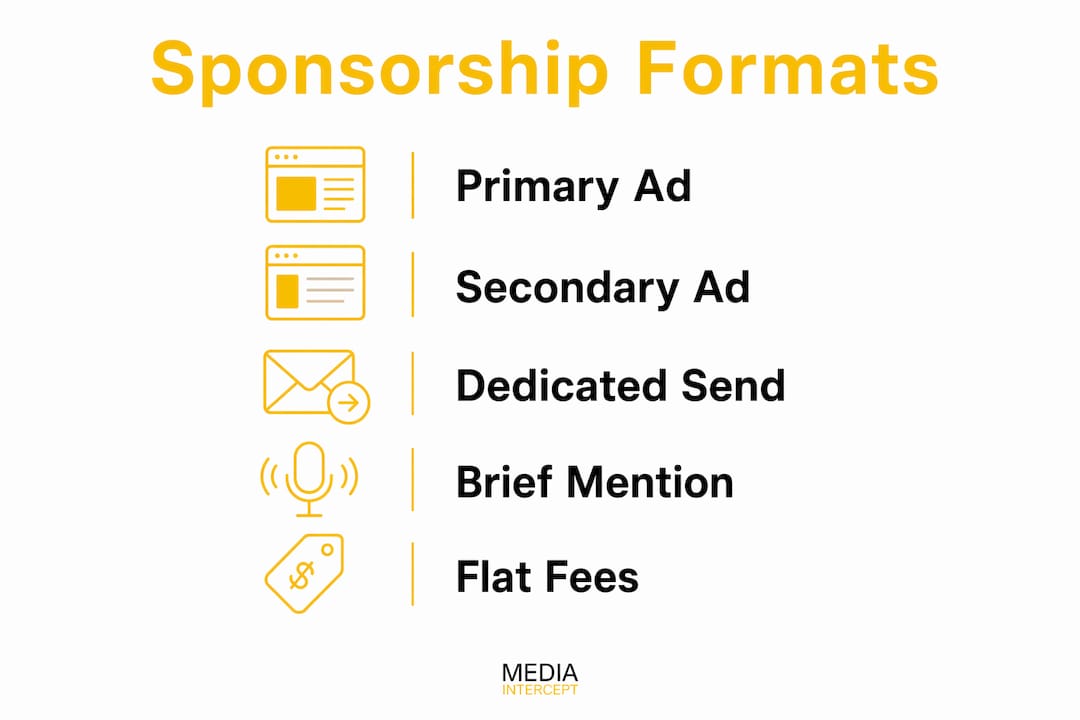
Newsletter advertising in 2026 spans several distinct formats, each with different price points and deliverables. Knowing the options helps you match your budget to your goals before you contact a single publisher.
Format | Description | Typical Price Range |
Primary/top ad | Featured placement at the top of the issue | $1,100–$5,000 per send |
Spotlight ad | Mid-issue placement, shorter copy | $500–$2,000 per send |
Dedicated send | Full newsletter sent on your behalf | $5,000–$50,000 per send |
Native advertorial | Long-form editorial-style content | $1,500–$8,000 per piece |
Backlink/mention | Brief text mention with a link | $100–$500 per issue |
Lead magnet | Co-branded content offer to capture leads | Negotiated flat fee |
Sponsored webinar | Co-hosted event promoted to the list | $2,000–$15,000 |
Frequency pack | Multi-issue bundle at a discounted rate | Custom pricing |
CPM rates vary significantly by vertical. Generalist B2B newsletters run $5–$12 CPM, while specialist verticals like cybersecurity, legal tech, or healthcare can reach $20–$50 CPM. Newsletters with low ad density, meaning fewer ads per issue, command higher prices per slot because capping ads per issue protects click-through rates and increases the value of each placement.
Exclusivity also affects price. A newsletter that runs only one sponsor per issue charges more than one that runs three or four. That premium is often worth paying because your message gets the full attention of the audience rather than competing with other brands in the same send.
Pro Tip: Negotiate flat fees over CPM when you are testing a new newsletter. Flat fees give you cost predictability while you gather performance data. Once you know the CPM your results justify, you can renegotiate from a position of evidence.
For a more detailed pricing breakdown, read our guide to how much newsletter sponsorships cost.
How to find and evaluate newsletter sponsorship opportunities
Sourcing the right newsletter is the most time-intensive part of the process, but it is also where you protect your budget. There are four primary methods brands use to find sponsorship opportunities.
Direct outreach. About 80% of sponsorship inventory runs through direct cold-email loops. You identify newsletters in your vertical, find the operator’s contact information, and pitch your campaign directly. This takes 3 to 5 business days for a reply on average.
Public booking pages. Many newsletter operators publish a media kit or booking page. These are faster to access but often reflect standard rate card pricing with less room to negotiate.
Marketplaces and brokers. Platforms that aggregate newsletter inventory simplify discovery but typically add a 15 to 25% premium to the cost. That premium buys you speed and reduced sourcing friction.
Intelligence databases. Tools that track newsletter growth, sponsor history, and engagement trends let you evaluate opportunities before you reach out, which reduces wasted pitches.
Once you have a list of candidates, evaluate each newsletter on five criteria: subscriber count, list growth rate, sponsor history, publishing consistency, and engagement quality. A newsletter with 50,000 subscribers and a 40% open rate is more valuable than one with 200,000 subscribers and a 10% open rate. Raw subscriber counts are a vanity metric without engagement context.
When you pitch, be specific. A pitch specifying issue date, placement format, and price typically yields a yes or no reply within 48 hours. Generic pitches produce slower, vaguer responses and drag out negotiations unnecessarily.
Pro Tip: Never rely on a single newsletter placement to evaluate the channel. Run pilots across three to five newsletters simultaneously so you can compare performance and avoid drawing conclusions from one data point.
Essential compliance and ethical considerations
CAN-SPAM compliance is not optional for brands running newsletter sponsorships. The law applies to all commercial emails, and brands are liable even when a third-party publisher executes the send. Non-compliance risks penalties of up to $53,088 per email, which makes embedding compliance checks into your workflow a non-negotiable step.
The core CAN-SPAM requirements every brand sponsor should know:
The sender must be clearly identified in the “From” field.
The email must include a visible, functional unsubscribe link.
Opt-out requests must be processed within 10 business days.
The unsubscribe mechanism must remain functional for 30 days after the send.
Commercial emails must be labeled as advertising and include a valid physical address.
Beyond legal compliance, editorial guardrails protect your brand’s reputation. Clear sponsorship labeling, “sponsored by” credits, and honest copy that does not make misleading claims about the publisher’s endorsement are all standard practice among reputable newsletters. Audiences are sophisticated. They tolerate sponsorships when they are transparent and relevant. They lose trust in both the publisher and the brand when they feel deceived.
Treating your newsletter sponsorship as an editorial product, with clear deliverables, honest messaging, and respect for the audience, consistently produces better results than aggressive promotional copy. Transparency is not just an ethical requirement. It is a performance strategy.
Measuring and optimizing newsletter sponsorship impact
Performance measurement separates brands that scale newsletter sponsorships from those that abandon the channel after one test. The metrics that matter go well beyond open rates.
Click-through rate (CTR). This is your primary engagement signal. A strong CTR on a newsletter placement indicates that your creative and offer resonated with the audience. Compare CTR across placements and formats to identify what works.
Cost per click (CPC). Newsletter sponsorship CPC typically ranges from $1 to $5 for B2B audiences, which outperforms LinkedIn ads running $6 to $15 CPC. That cost efficiency is one of the strongest arguments for the channel.
Engagement clustering. Active reader segments are more valuable than raw subscriber counts. Look for newsletters where a consistent core of readers opens and clicks every issue. That behavior signals audience quality and advertiser trust.
Conversion rate and cost per acquisition. Track what happens after the click. Use UTM parameters on every link so you can attribute conversions to specific newsletter placements in your analytics platform.
Time-on-content. For advertorial formats, measure how long readers spend on your landing page after clicking. Short dwell times suggest a mismatch between the newsletter audience and your offer.
Use your reporting data to negotiate better terms on repeat placements. If your CTR consistently outperforms the publisher’s stated benchmarks, you have leverage to request a better rate or a more prominent placement. Engagement and deliverability signals should inform every pricing conversation you have with a publisher.
Build a sponsorship instrumentation checklist before each campaign launches. It should confirm that UTM parameters are in place, that your landing page is live and tracking correctly, and that you have a baseline CPC target to evaluate against. Running campaigns without this infrastructure means you cannot learn from them.
Key takeaways
Newsletter sponsorships deliver measurable, cost-efficient access to engaged audiences when brands match the right format to the right newsletter and track performance from day one.
Point | Details |
Format selection drives cost | Primary placements cost $1,100–$5,000; dedicated sends can reach $50,000, so match format to budget and goal. |
Direct outreach dominates sourcing | 80% of inventory moves through cold-email outreach; detailed pitches get replies within 48 hours. |
Compliance is the brand’s responsibility | CAN-SPAM applies even when a publisher executes the send; penalties reach $53,088 per email. |
Engagement beats subscriber count | CTR, consistent opens, and active reader clusters predict performance better than list size alone. |
CPC efficiency is a key advantage | Newsletter sponsorships deliver $1–$5 CPC for B2B, compared to $6–$15 on LinkedIn. |
Why I tell every new sponsor to start smaller than they think they should
After working with brands across dozens of newsletter campaigns, the pattern I see most often is this: a brand allocates a significant budget to one or two placements in the largest newsletters they can find, gets mediocre results, and concludes the channel does not work. That conclusion is almost always wrong. The channel works. The strategy did not.
The newsletters with the biggest subscriber counts are not always the best fit. A 20,000-subscriber newsletter in a tightly defined niche will frequently outperform a 500,000-subscriber general interest publication for a specialized B2B offer. The audience alignment matters more than the reach number. I have seen $500 placements in focused newsletters generate more qualified leads than $10,000 dedicated sends to broad lists.
My honest advice for any brand new to this channel: run three to five small pilot placements across different newsletters before you commit serious budget. Use those pilots to learn which audience profiles respond to your offer, which formats drive the most clicks, and which publishers are easiest to work with. That data is worth more than any single large placement. Scale what works, and do not be afraid to walk away from what does not. The newsletter sponsorship space rewards patience and specificity, not volume.
— Media Intercept
Plan your first newsletter sponsorship campaign with Media Intercept
Media Intercept is a newsletter sponsorship platform built for brands that want to find, book, and manage placements without the friction of manual outreach and disconnected reporting.
The platform connects you to premium publisher networks with standardized pricing, audience insights, and campaign tracking in one place. Whether you are running a CPC campaign for performance or a flat-fee reserved placement for brand awareness, Media Intercept gives you the tools to execute and measure efficiently. You can explore newsletter sponsorship opportunities across verified publishers or get your full campaign managed end to end. If you are ready to move from research to results, start your campaign with Media Intercept today.
FAQ
What is a newsletter sponsorship?
A newsletter sponsorship is a paid ad placement inside an email newsletter, where a brand pays the publisher to feature its message alongside editorial content delivered to opted-in subscribers.
How much does it cost to sponsor a newsletter?
Costs range from $100 for a brief mention to $50,000 or more for a dedicated send, depending on list size, vertical, placement format, and exclusivity.
How do I find newsletters to sponsor?
The four main methods are direct outreach, public booking pages, marketplace platforms, and intelligence databases. Direct outreach accounts for about 80% of all newsletter sponsorship inventory.
Do I need to comply with CAN-SPAM as a sponsor?
Yes. CAN-SPAM applies to all commercial emails, and brands are liable even when the publisher executes the send. Non-compliance risks penalties up to $53,088 per email.
What metrics should I track for newsletter sponsorships?
Track CTR, CPC, conversion rate, and cost per acquisition using UTM parameters on every link. Newsletter sponsorships typically deliver $1–$5 CPC for B2B, which makes them cost-competitive with most paid digital channels.
Recommended
Ready to plan a campaign? Learn more about Media Intercept’s newsletter sponsorships for brands.