
Email Sponsorship Messaging Strategy That Gets Results

Updated: Jun 5
Looking to monetize your newsletter? Learn how Media Intercept helps publishers grow newsletter revenue without requiring exclusivity.
Most sponsorship outreach fails before the sponsor reads the second sentence. Subject lines that overpromise, pitches that lead with the sender’s achievements instead of the sponsor’s benefit, and follow-ups that just say “checking in” — these are the patterns killing response rates across sponsorship email campaigns right now. A well-built email sponsorship messaging strategy, which marketing professionals formally call sponsorship outreach communication planning, changes that outcome. This guide covers everything from compliance prep and audience segmentation to message structure, follow-up cadence, and measurement. Follow this process and you will close more sponsorships, faster.
Table of Contents
Key takeaways
Point | Details |
Lead with sponsor relevance | Open every email by demonstrating value to the sponsor, not by describing your own credentials. |
Structure emails for attention | Keep sponsorship pitches to 150–250 words across four clear sections to match real inbox behavior. |
Follow up with new information | A four-touch cadence on Days 1, 4, 10, and 21 with fresh details each time drives meaningful replies. |
Set baselines before you launch | Define KPIs and install tracking before your first send so you can prove ROI after the campaign. |
Compliance protects deliverability | CAN-SPAM adherence and technical authentication are not optional. They protect your sender reputation directly. |
Your email sponsorship messaging strategy starts with preparation
Before you write a single word of your pitch, the foundational work determines whether your emails land in the inbox or the spam folder, and whether your messaging connects with the right people at all.
CAN-SPAM compliance basics you cannot skip
CAN-SPAM compliance requires commercial emails to include a clear opt-out mechanism and honor unsubscribe requests within 10 business days. Beyond the unsubscribe requirement, the law also requires truthful sender identification and accurate, non-deceptive subject lines that reflect the promotional intent of the message. A subject line that implies a personal relationship when there is none violates FTC rules and harms your deliverability at the same time.
True compliance is not just a legal checkbox. It combines legal adherence with technical practices that protect your sender reputation and secure actual inbox placement. Think of it as the floor, not the ceiling.
Audience segmentation and goal alignment
Segment your prospective sponsors before you start messaging. Group them by industry vertical, company size, past engagement with your content, and alignment with your audience demographics. Then map each segment to a specific campaign goal.
Here is a quick framework for aligning segments to objectives:
Segment type | Campaign goal | Messaging angle |
High-fit, cold contact | Awareness and first response | Lead with audience match data |
Proposal and commitment | Reference prior touchpoint | |
Renewal candidate | Contract expansion | Highlight previous campaign results |
New vertical, untested fit | Discovery and qualification | Ask a question, invite a conversation |
Segmented nurture and trigger emails increase open rates, click-throughs, and conversion compared to broadcast outreach. Personalization at scale is possible, but it requires that segmentation work done upfront.
Pro Tip: Before your first send, prepare a media kit that includes audience size, demographics, engagement rates, and past campaign performance. Sponsors make faster decisions when proof is already in the email.
Crafting the sponsorship email itself
The structure of your email matters as much as the content inside it. High-performing sponsorship emails run about 150 to 250 words and break into four clear sections. That length is readable in roughly one minute, which aligns with actual inbox behavior.
Here is how each section should work:
Section 1: The subject line. Write for relevance, not cleverness. Reference a specific benefit or audience match. “Your product + 45,000 B2B decision-makers” performs better than “Exciting partnership opportunity.” Vague subject lines reduce opens and signal low effort.
Section 2: The personalized opening. Reference something specific about the sponsor. Their recent product launch, a campaign you noticed, or a shared audience segment. This one move separates real outreach from templated spam.
Section 3: The value proposition. Present concrete metrics. Audience size, average open rate, click-through benchmarks, and relevant case data. Keep it to two or three sentences. Demonstrating relevance upfront is more persuasive than listing your own achievements.
Section 4: The ask. Make it low-friction. A request for a 20-minute call or a link to a one-page overview works better than asking for a signed contract in the first email. One clear next step, nothing more.
This structure applies whether you are sending cold outreach or reconnecting with a lapsed sponsor. The tone shifts, but the architecture stays the same.
Pro Tip: Write the subject line last. Once you know exactly what you said in the email, you will write a much more accurate and compelling subject line than if you start with it.
For more on scaling this kind of personalization across a large publisher network, personalization at scale is a challenge worth understanding before you build your templates.
Following up without losing the relationship
Most sponsorship deals close after multiple follow-ups, not after the first email. The problem is not persistence itself. It is persistence without adding anything new. Sponsors ignore follow-ups that only say “just checking in” because those messages ask for attention without providing a reason for it.
Use this four-touch cadence and update the content at each stage:
Day 1: Initial pitch. Send your full, structured sponsorship email with your value proposition and a clear ask.
Day 4: First follow-up. Add one new piece of information. A recent campaign result, a relevant audience data point, or an article featuring your publication. Keep it to two sentences plus a reference to the original thread.
Day 10: Second follow-up. Shift the angle slightly. If your first two emails focused on audience reach, this one might highlight engagement quality or a specific vertical alignment. Show that you have thought more about the fit.
Day 21: Final follow-up. Keep it brief and genuine. Let the sponsor know this is your last message in this sequence, and leave the door open for them to reach out when the timing is right. No guilt, no pressure.
Always reply within the same thread. This keeps context intact and shows the prospect the full conversation without requiring them to dig through their inbox. Structured follow-up cadences consistently outperform one-time outreach when each message carries new, relevant information.
Pro Tip: Set up your follow-up sequence in your CRM before you send Day 1. Pre-scheduling the touches prevents gaps caused by competing priorities, and your future self will thank you.

Measuring what your sponsorship emails actually do
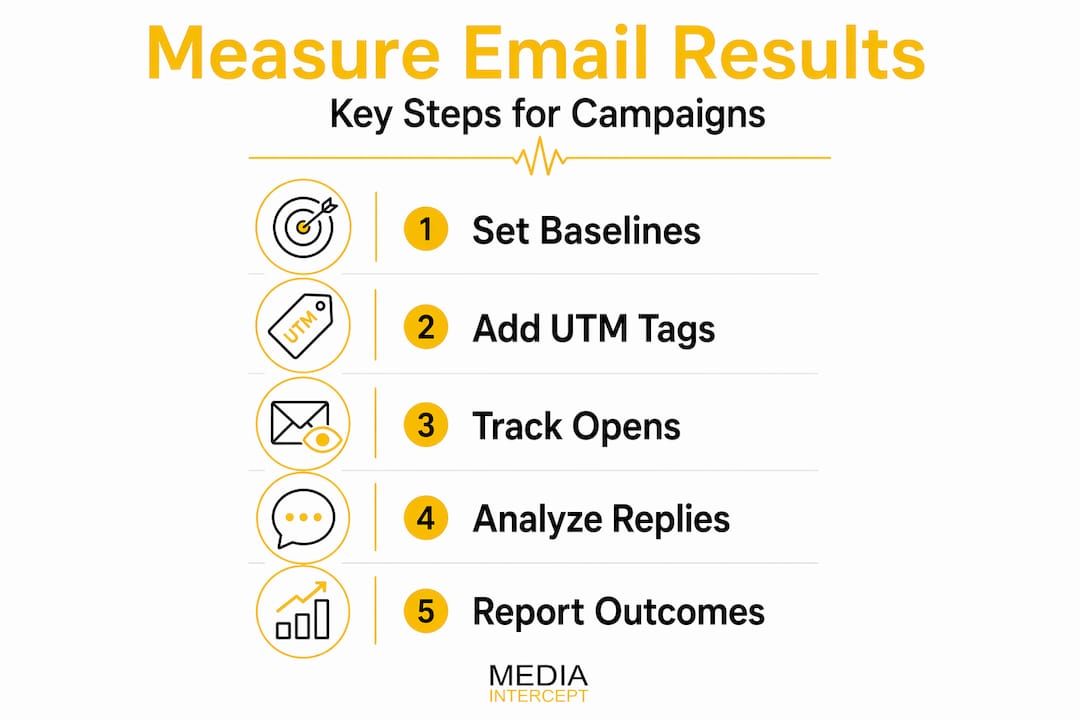
You cannot improve what you do not measure. Before you launch any sponsorship email campaign, define your baseline metrics and install your tracking infrastructure. This matters both for your internal optimization and for proving ROI to stakeholders.
Setting pre-campaign baselines and using UTM tracking plus CRM tagging enables accurate performance verification and campaign optimization. Here is how the two primary approaches compare:
Measurement method | What it tracks | Best for |
UTM parameters | Click source, campaign, and medium | Website traffic attribution |
CRM tagging | Pipeline stage, deal source, contact activity | Revenue and relationship attribution |
Sentiment analysis | Reply tone and engagement quality | Qualitative signal from outreach |
Pre/post brand lift study | Awareness change among target audience | Upper-funnel impact reporting |
Dashboards that combine multiple data sources drive better strategic decisions than single-channel reports. Build yours before Day 1 so every response, click, and conversion gets captured from the start.
Common measurement mistakes to avoid: attributing all awareness lift to email alone, skipping UTM tags on links inside plain-text emails, and waiting until after a campaign closes to set up reporting. These gaps make renewal conversations much harder than they need to be.
Fixing deliverability before it breaks your campaign
Even a perfectly written email fails if it never reaches the inbox. Deliverability problems are often invisible until they are serious, so building good practices from the start protects everything downstream.
Your sender reputation is the single biggest factor in inbox placement. Internet service providers track negative engagement signals including unsubscribes, spam complaints, and low open rates, and they use those signals to filter future emails even when the content is fully compliant.
Here are the core practices that protect your reputation:
List hygiene. Remove hard bounces immediately after every send. Suppress contacts who have not opened any of your last 10 to 15 emails. Sending to disengaged contacts signals low quality to inbox providers.
Engagement segmentation. Audience eligibility rules and engagement-based segmentation are critical to protecting your sender score. Only send to people who have recently shown interest.
Authentication setup. Verify that your domain has SPF, DKIM, and DMARC records configured correctly. These are not optional technical details. They are the basic signals inbox providers use to decide whether your email is legitimate.
Spammy content signals. Avoid excessive capitalization, multiple exclamation points, and words like “FREE” or “GUARANTEED” in subject lines. These patterns trigger filters before a human ever reads the email.
A deliverability issue is not just a technical problem. It is a brand reputation problem. A sponsor who never receives your email cannot say yes, and a domain that keeps landing in spam loses credibility that takes months to rebuild.
My take on what actually moves the needle
I’ve reviewed hundreds of sponsorship email programs across publisher networks, and the pattern I see repeatedly is this: brands spend enormous time on creative messaging and almost no time on the mechanics underneath it. A brilliantly written pitch that goes to the wrong segment, fails authentication checks, or never gets a follow-up is just a well-dressed message going nowhere.
In my experience, the single highest-leverage change most teams can make is committing to the follow-up cadence. Not because persistence alone wins deals, but because the act of planning four touches forces you to develop four genuinely useful things to say. That process deepens your understanding of your value proposition faster than any internal brainstorm.
I also believe that compliance and creativity are not in tension. The brands that treat CAN-SPAM rules and deliverability hygiene as strategic assets, not legal obligations, consistently outperform those who treat them as afterthoughts. Your inbox placement rate is a direct reflection of how much your audience respects your messages. That is a brand signal worth protecting.
Finally, I would push back on the idea that newsletter sponsorships are purely a brand awareness play. When you measure them correctly and message them with precision, they contribute measurably to pipeline. The teams that see those results are the ones who do the preparation work before the first send, not after.
— Media Intercept
How Media Intercept helps you execute at scale
Planning and executing an effective sponsorship outreach program takes infrastructure that most teams build slowly and imperfectly. Media Intercept is built specifically to remove that friction. The platform connects brands with premium publisher networks for newsletter sponsorship campaigns across audiences that are already engaged and primed for relevant advertising.
For publishers, the newsletter monetization platform handles demand, execution, reporting, and payouts without requiring exclusivity. For brands, flexible CPC and flat-fee placement options let you match your spend model to your campaign goals. Built-in reporting gives you the standardized data you need to measure performance, optimize messaging, and make renewal conversations straightforward.
If you are ready to move from strategy to execution, our team is here to help you plan your next campaign. Let’s build something worth opening.
FAQ
What length should a sponsorship email be?
High-performing sponsorship emails run between 150 and 250 words, organized into four sections. This length is readable in about one minute and produces better response rates than longer messages.
How many follow-ups should I send to a sponsor?
A four-touch sequence on Days 1, 4, 10, and 21 is the recommended cadence. Each follow-up should include new information rather than repeating the original pitch.
What does CAN-SPAM require for sponsorship emails?
CAN-SPAM requires a functioning opt-out mechanism, accurate sender identification, and subject lines that reflect the email’s promotional intent. Unsubscribe requests must be honored within 10 business days.
How do I track sponsorship email campaign performance?
Use UTM parameters for web traffic attribution and CRM tagging for pipeline and revenue attribution. Setting baselines before launch lets you measure real impact rather than relative movement from an unknown starting point.
Why do my sponsorship emails go to spam?
The most common causes are poor sender reputation from low engagement rates, missing SPF or DKIM authentication, and content signals that trigger spam filters. Engagement-based segmentation and list hygiene are the fastest ways to improve inbox placement.
Recommended
Related Publisher Resources
Explore Media Intercept’s newsletter monetization platform for publishers.
Download our newsletter advertising guides for more publisher monetization and sponsorship planning resources.
Review our newsletter advertising glossary for common terms around CPC, CPM, publisher payouts, tracking links, and campaign reporting.