
Dedicated Email Campaign for Product Launch: 2026 Guide

Updated: Jun 5
Planning a dedicated send? Learn how Media Intercept helps brands run dedicated email advertising campaigns across trusted newsletter publishers.
A product launch lives or dies in the inbox. Yet most brands treat their launch emails like a single press release, send them to the entire list, and wonder why conversions disappoint. A well-planned dedicated email campaign for product launch is not a broadcast. It is a sequenced, segmented experience that builds anticipation, delivers value at every touchpoint, and closes with enough urgency to move buyers. This guide gives you the exact framework to design, execute, and measure that experience — from list preparation to post-launch follow-up.
Table of Contents
Key takeaways
Point | Details |
Sequence beats single sends | A 5-to-8-email sequence over 7-14 days moves subscribers from awareness to purchase more reliably than one announcement. |
Segmentation drives revenue | Behavioral segmentation consistently lifts conversion by around 30% compared to uniform list sends. |
Pre-launch phase is non-negotiable | Warming up your list and building a waitlist 30 days out improves deliverability and primes buyer intent. |
The close email carries outsized weight | The final deadline email can generate 30-40% of total launch revenue on its own. |
Measure beyond open rates | Track conversion, revenue per subscriber, and post-click behavior to evaluate true campaign performance. |
Dedicated email campaign for product launch: prerequisites
Before you write a single subject line, you need to resolve four things: who receives the emails, what those emails are supposed to accomplish, whether your list can actually deliver results, and whether your conversion path is ready to receive traffic.
Define measurable goals first
A product launch email strategy without a clear target is just noise. Before anything else, decide whether you are optimizing for first-day units sold, waitlist sign-ups, trial activations, or revenue per subscriber. Each goal shapes a different kind of sequence. A digital course launch prioritizes urgency and scarcity. A SaaS feature rollout may focus on trial adoption. Getting this defined first keeps every email intentional.
Segment your list before launch, not during
Generic email blasts consistently underperform segmented sends. At minimum, split your list into three behavioral groups: highly engaged subscribers who open frequently, moderately active subscribers who open occasionally, and cold subscribers who have not engaged in 90 days or more. Each group needs a different message path during the launch.
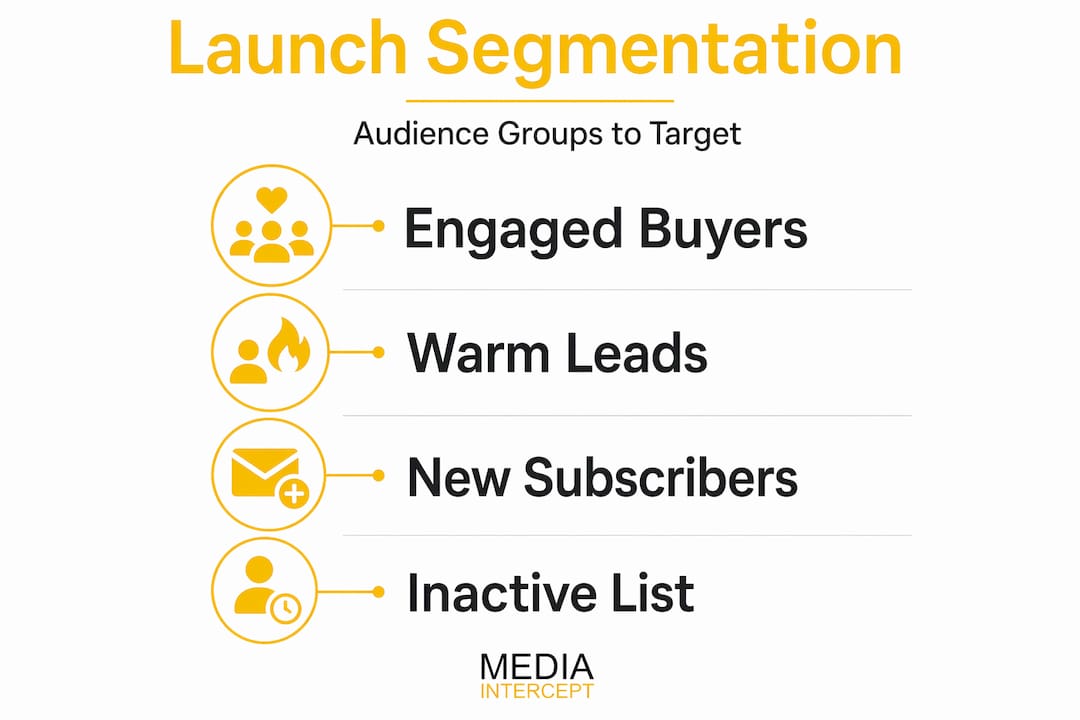
You should also layer in demographic or product-interest data where you have it. Subscribers who previously purchased in your category respond to benefit-forward messaging. New subscribers who came in through content need more context before they will commit.
Pro Tip: Build a pre-launch waitlist landing page at least three to four weeks before your launch date. The subscribers who opt into that waitlist are your hottest prospects and deserve a separate, more direct email sequence.
Warm up your list and fix deliverability issues
A 30-day re-engagement sequence before the pre-launch phase reduces deliverability risk significantly. Send two or three value-driven emails to less active subscribers, give them a clear option to stay subscribed, and remove those who do not engage. Showing up in the inbox means nothing if Gmail routes your launch announcement to the Promotions tab.
A cohesive landing page aligned with each email’s promise is also non-negotiable prep work. Misaligned post-click experiences cause drop-off regardless of how strong your email copy is. Test every link, every form, and every page load speed before day one.
Structuring your launch email sequence
Think of your product launch email strategy as a three-act play with specific scene requirements in each act. The structure follows a clear arc: build desire, make the ask, and close with urgency.

The three phases of a launch sequence
At minimum, a three-part sequence covering pre-launch, launch day, and follow-up handles the fundamental buyer psychology needed for conversion. High-performing campaigns extend this to five to eight emails. Here is what a full sequence looks like in practice:
Teaser email (7-10 days before launch). Hint at what is coming without revealing everything. Create curiosity. Link to a waitlist or early-access sign-up page.
Problem-framing email (5-6 days before launch). Name the pain your product solves. No product pitch yet. Just empathy and recognition of the reader’s situation.
Solution preview email (3-4 days before launch). Reveal the product in broad strokes. Share the story behind it. Begin building desire.
Launch announcement email (launch day, morning). Full reveal, benefits summary, and a single clear CTA to purchase or activate.
Social proof email (launch day + 1 or 2). Early testimonials, results from beta users, or data that validates the product’s promise.
Objection-handling email (mid-launch window). Address the top two or three reasons a qualified prospect might hesitate. Risk reversal, FAQs, or comparison framing works here.
Last-call email (final hours). Urgency-driven, deadline-focused, and direct. No fluff.
Pro Tip: Keep each email to one primary message and one CTA. Multi-CTA emails split attention and reduce click-through. If you want to link to your FAQ and your sales page, make the sales page the CTA button and bury the FAQ link as secondary text.
Timing and segmentation in action
A 5-to-8-email sequence spread over 7-14 days is the standard range that generates the best balance between sustained engagement and subscriber fatigue. One notable campaign generated over $2 million from a 45,000-person list by using behavioral segmentation to send conversion-focused messaging to engaged subscribers while routing story-driven nurture emails to less active ones. The result was a 30% conversion uplift over a uniform send.
Timing | Primary goal | |
Teaser | 7-10 days before | Build curiosity, capture waitlist |
Problem framing | 5-6 days before | Establish relevance |
Solution preview | 3-4 days before | Generate desire |
Launch announcement | Launch day AM | Drive immediate action |
Social proof | Day 1-2 post-launch | Reduce hesitation |
Objection handling | Mid-launch | Remove friction |
Last call | Final hours | Capture fence-sitters |
Writing subject lines and email content that converts
Subject lines are the gateway. Every other effort in your launch sequence collapses if the email does not get opened. And most of your subscribers read email on their phones first.
Subject lines within 30-40 characters avoid truncation on mobile and perform significantly better on open rates. That is a tight constraint. It forces you to drop modifier words and get to the point fast. “It’s almost here” outperforms “We’re so excited to share what we’ve been building.” The first builds intrigue. The second dissipates it.
Write to a problem, not a product
The most effective launch emails name the reader’s pain before they introduce the solution. Start with a situation your reader recognizes: a deadline missed, a process that takes too long, a cost that keeps climbing. Then show how your product changes that specific situation. This structure builds connection before it builds a case.
Social proof belongs earlier in the sequence than most marketers think. You do not need to wait until the social proof email to include a testimonial. A single sentence from a beta user inside your problem-framing email does more persuasive work than a full review at the bottom of your sales page.
Keep email body copy between 150 and 300 words for mid-sequence nurture emails
Use the subscriber’s first name in the subject line or opening line where data quality allows
Personalized subject lines using local or behavioral signifiers increase open rates noticeably
Write your CTA button text as an outcome, not a directive (“Get early access” beats “Click here”)
One image maximum per email, placed after the first paragraph so text loads before assets
Statistic to know: Behavioral segmentation that routes engaged subscribers to direct conversion messaging while sending nurture content to less active subscribers can increase conversions by 30%. That is a meaningful gain from a structural decision alone, not from better copywriting.
Executing and optimizing during the launch window
Send day orchestration matters as much as copy. Even the best email sequence falls flat if it goes out at the wrong time to the wrong segment.
For most consumer-facing launches, Tuesday through Thursday sends between 9 AM and 11 AM in the subscriber’s local time zone outperform other windows. B2B launches tend to perform well mid-week in the same morning window. These are starting benchmarks, not fixed rules. Your own list’s historical open data should take priority.
Segment by engagement status on launch day. Subscribers who opened your teaser emails get the full launch announcement. Those who did not open the teaser should receive a subject line variant before they receive the full reveal, since their entry point into the sequence is different.
A/B test subject lines on 10-20% of your list. Testing subject lines on a small segment first and then rolling out the winning variant to the remainder is one of the highest-return moves during a compressed launch timeline.
Monitor click-to-conversion gaps. High clicks with low conversions point to a landing page problem, not an email problem. Act on this within hours, not days.
Do not add CTAs mid-campaign. Once your sequence is live, resist the urge to insert new offers or redirect subscribers. Consistency in message and destination maintains trust.
Pro Tip: If your last-call email underperforms, send a plain-text version of the same deadline message to non-openers two hours before close. Plain-text emails often bypass promotional filters and feel more personal, which can recover 5-10% of missed conversions.
The final deadline email is the highest-leverage send in the entire sequence. Structuring it to address desire, fear of inaction, and risk reversal in a single email consistently generates 30-40% of total launch revenue. Treat it as a multi-pass close, not just a countdown notice.
Post-launch follow-up and measuring what worked
The campaign does not end when the cart closes. A smart post-launch strategy captures residual demand and builds the data you need for your next launch.
Send a “you missed it” email to non-buyers within 24 hours. Offer a waitlist for the next cohort or a delayed-access option if your product allows it.
Re-engage non-openers with a subject line and first paragraph rewrite. Some subscribers missed the window due to timing, not disinterest.
Track revenue per subscriber, not just open and click rates. One well-structured launch campaign generated $46 per subscriber across 45,000 recipients. That benchmark gives you a realistic ceiling to aim for.
Metric | What it tells you |
Open rate by segment | Which audience groups engaged most with pre-launch content |
Click-to-conversion rate | Whether your landing pages and email alignment held up under real traffic |
Revenue per subscriber | The true efficiency of your list and segmentation strategy |
Unsubscribe rate by email | Which emails in the sequence caused the most friction |
Use these metrics to refine your audience growth strategy and segmentation logic before your next launch cycle. The data from one campaign is the best input for the next. Build a documented debrief within one week of launch close while the details are fresh.
My take: what most launch guides get wrong
I’ve reviewed dozens of product launch email playbooks, and the most common failure is not bad copy. It is a truncated pre-launch phase. Brands compress it because they are eager to start selling, but the pre-launch sequence is where desire gets built. Skipping it means your launch announcement lands cold.
In my experience, the teams that treat a launch sequence as a standalone event rather than a sales campaign see measurably better results. When each email delivers real value whether that is a framework, a data point, or a customer story, readers stay engaged even before you ask for anything. That goodwill transfers directly to conversion rates.
I’ve also seen brands over-segment to the point of paralysis. Behavioral segmentation is powerful, but you do not need six audience paths on your first launch. Two paths — engaged and less active — cover most of the psychological variation in your list. Build from there with each subsequent campaign using the data you collect. The personalization-at-scale challenge is real, but it is solvable incrementally.
The brands that win at email marketing for launches treat the inbox like a relationship channel, not a distribution channel. That shift in thinking changes every decision downstream.
— Media Intercept
Plan your next launch campaign with Media Intercept
If you are planning a product launch and want your email campaign to reach the right subscribers at scale, Media Intercept can help you execute with precision. The platform gives brands access to dedicated email placements across premium publisher networks, with flexible CPC and flat-fee options so you can match your spend model to your launch goals. You can also explore Media Intercept’s marketing guides for in-depth frameworks on launch sequencing, segmentation, and campaign measurement. Whether you are running your first dedicated email campaign or scaling a proven launch strategy, our team is ready to help you get results. Let’s plan your next campaign together.
FAQ
How many emails should a product launch sequence include?
High-performing campaigns typically include 5 to 8 emails spread across 7-14 days, covering teaser, announcement, social proof, objection handling, and last-call phases. A three-email minimum is the baseline for covering core buyer psychology.
What is the best subject line length for launch emails?
Subject lines between 30-40 characters perform best on mobile devices, where most emails are first opened. Short, curiosity-driven lines outperform long descriptive ones in open rate tests.
When should I send the final deadline email?
Send it in the last two to four hours of your cart-close window and time it for when your list is most active based on historical data. The last-call email alone can drive 30-40% of total launch revenue when structured to address desire, risk, and urgency together.
How do I measure if my launch email campaign worked?
Go beyond open rates. Track revenue per subscriber, click-to-conversion rate, and unsubscribe rate by email position. These metrics reveal whether your sequence and landing pages held up under real launch conditions, not just whether people clicked.
How early should I start my pre-launch email sequence?
Start warming your list at least 30 days before your pre-launch content begins. A re-engagement sequence in that window improves deliverability and filters out unengaged subscribers before your launch emails go out.
Recommended