
Why Email Newsletters Drive Engagement in 2026

Curious how newsletters fit into a broader advertising strategy? Visit our newsletter advertising page to see how brands use this channel.
Email newsletters are the most reliable marketing channel for sustained audience engagement because they give you precise control over messaging cadence, personalization, and delivery. Unlike social media platforms where algorithms decide who sees your content, newsletters land directly in subscriber inboxes on your schedule. AI-personalized campaigns achieve 41% higher click-through rates and equivalent revenue lifts compared to non-personalized sends. Tools like Klaviyo and ActiveCampaign make that personalization scalable. For marketing professionals and brand managers, understanding why email newsletters drive engagement means understanding this control advantage and how to use it strategically.
Why email newsletters drive engagement better than social media
Email newsletters give marketers something social platforms cannot: guaranteed delivery to a known audience at a time you choose. When a subscriber signs up, they opt into a direct relationship. No algorithm decides whether your content is worth surfacing that week.
Consistent scheduling builds a repeatable engagement routine. Readers know when your newsletter arrives and what format to expect. That predictability trains attention. Over time, your send day becomes a habit for your audience, not just a calendar entry for your team.

The contrast with social media is stark. On platforms like Instagram or LinkedIn, organic reach fluctuates based on engagement signals, ad spend, and policy changes outside your control. A newsletter list is an owned asset. You built it, you manage it, and no platform update can reduce its reach overnight.
Editorial structure matters here too. Newsletters with clear, consistent sections, such as a lead story, a curated link roundup, and a single call to action, perform better than loosely formatted sends. Readers scan faster when they know where to look. That clarity directly increases clicks.
Own your audience: A newsletter list belongs to your brand, not a platform.
Control your timing: Send when your data shows peak engagement, not when an algorithm allows it.
Set reader expectations: Consistent structure and cadence reduce unsubscribes and increase opens.
Reduce dependency risk: Platform policy changes cannot cut off your subscriber access.
Pro Tip: Schedule your newsletter for the same day and time each week for at least eight consecutive sends before evaluating cadence performance. Audience habits take time to form.
How personalization and segmentation increase newsletter engagement
Personalization is the single most effective lever for improving newsletter performance. Behavior-triggered emails sent within five minutes of a subscriber action outperform batch campaigns by 429%. That number reflects a fundamental truth: relevance at the right moment converts far better than relevance at the wrong one.
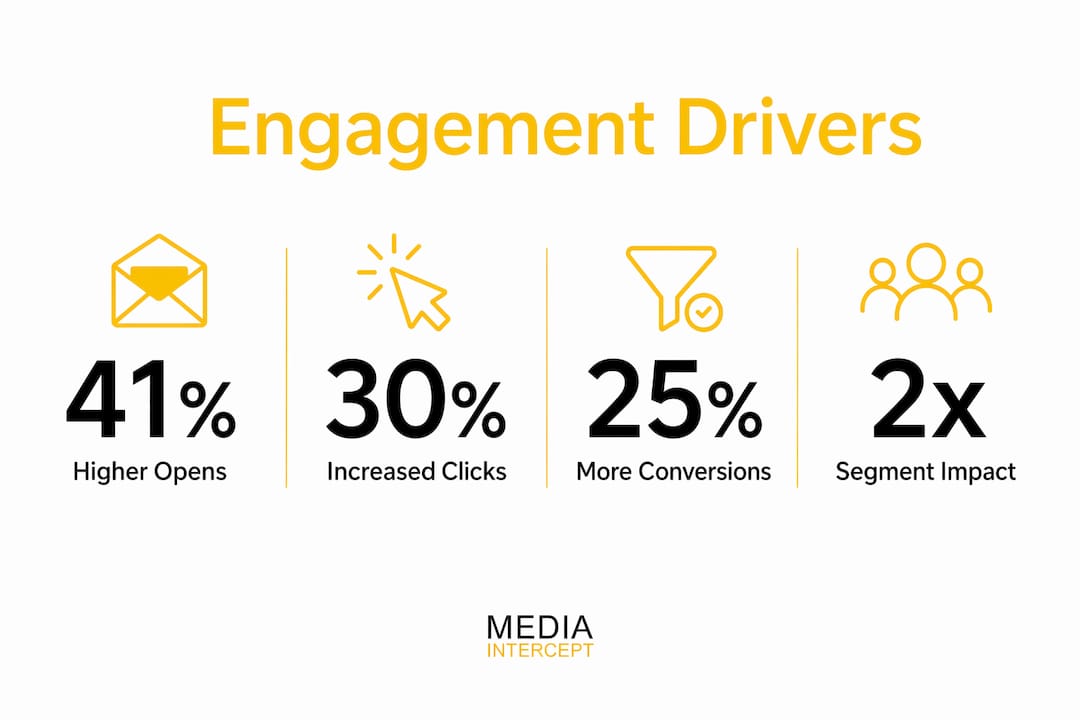
AI tools like Klaviyo, ActiveCampaign, and Iterable make behavioral segmentation practical at scale. Rather than sending one newsletter to your entire list, you create distinct subscriber clusters based on past clicks, purchase history, or content preferences. Each cluster receives content framed to match their specific interests, even when the underlying story is the same.
Here is a practical framework for building a segmentation model that improves engagement:
Define two to three subscriber personas. A B2B brand might segment by job function: practitioners who want tactical how-tos versus executives who want strategic summaries.
Tag subscribers based on click behavior. If a subscriber consistently clicks product comparison content, tag them as evaluation-stage. If they click thought leadership, tag them as research-stage.
Build triggered sequences for each segment. New subscribers get an onboarding sequence. Lapsed subscribers get a re-engagement series. Active clickers get your highest-value content first.
Use send-time optimization. AI tools analyze when individual subscribers historically open emails and schedule sends accordingly, rather than blasting at a fixed time.
Test content framing, not just subject lines. The same article can be framed as a time-saving tip for practitioners and a competitive advantage for executives. Both receive value; neither feels like a generic broadcast.
AI segmentation works best when it organizes human-created content, not when it replaces editorial judgment. Generic AI-generated newsletters lack the distinctive voice that builds subscriber loyalty. Use AI for workflow and targeting. Keep your editorial perspective human.
Pro Tip: Start segmentation with just two groups: highly engaged subscribers (clicked in the last 30 days) and less active ones. Send your best content to the engaged group first, then test subject line variations on the less active segment.
Why clicks and conversions matter more than open rates
Open rates are no longer a reliable measure of newsletter engagement. Apple Mail Privacy Protection prefetches tracking pixels, recording opens even when subscribers never read the email. This inflates open rate data across the industry and distorts list hygiene decisions.
The practical consequence is significant. If you use open rates to identify inactive subscribers for re-engagement campaigns, you will retain subscribers who are genuinely disengaged. If you use open rates to declare a campaign successful, you may be celebrating a metric that no longer reflects reality.
The shift is toward click-based and conversion-based KPIs. Here is how the two measurement approaches compare:
Metric | Reliability in 2026 | Best use case |
Open rate | Low (inflated by Apple MPP) | Relative A/B comparisons only |
Click-through rate | High | Primary engagement indicator |
Click-to-open rate | High | Content relevance measurement |
Revenue per email | Very high | ROI and campaign value tracking |
Conversion rate | Very high | Full-funnel performance analysis |
Multi-layered engagement scoring models weight clicks and conversions more heavily than opens to reflect actual subscriber value. This approach also improves list hygiene. A subscriber who has not clicked in 90 days is genuinely disengaged, regardless of what their open rate suggests.
For brand managers running sponsored newsletter placements, revenue per email and click-to-open rate are the metrics that tell you whether your content investment is paying off. Build your reporting dashboards around these numbers, not open rates.
How deliverability determines whether engagement is even possible
Deliverability is the prerequisite to every engagement strategy. Globally, about 83 to 84% of emails reach inboxes, meaning roughly one in six never arrives. Gmail achieves the highest inbox placement rate at approximately 87.2%. Microsoft Outlook and Hotmail sit significantly lower at around 75.6%. That gap matters if your subscriber base skews toward enterprise users on Microsoft environments.
Microsoft’s filtering weighs sender reputation and historical engagement more heavily than content optimization. You cannot write your way into the inbox if your domain reputation is poor. This is a critical distinction for marketers who focus on creative but neglect infrastructure.
The technical foundations of strong deliverability include:
DMARC with a reject policy: Only about 4.8% of top domains have p=reject DMARC policies in place. Upgrading from p=none to p=reject signals domain authority to ISPs and reduces spoofing risk.
SPF and DKIM authentication: Both protocols confirm your sending identity. Missing either one increases spam filter risk across all major ISPs.
List hygiene: Sending to unengaged or invalid addresses raises your bounce rate and spam complaint rate, both of which damage sender reputation over time.
Engagement-based segmentation: ISPs interpret high engagement as a signal of sender quality. Suppressing disengaged subscribers before large sends protects your domain score.
Dedicated IP warm-up: New sending IPs require gradual volume increases to build reputation. Jumping to high volume immediately triggers spam filters.
Deliverability problems often surface as engagement declines rather than obvious delivery failures. If your click rates drop without a content change, check your inbox placement rate before assuming the content is the problem. Infrastructure issues can mask as audience disinterest.
How newsletters build brand loyalty beyond the click
Newsletters create something social media followers cannot: a direct, owned relationship with an audience that chose to hear from you. Marketers who prioritize relational content, including newsletters and onboarding sequences, consistently achieve higher ROI than those focused purely on promotional sends. The mechanism is trust built through repeated, valuable contact.
A subscriber who reads your newsletter every week for three months knows your brand’s perspective, tone, and areas of expertise. That familiarity reduces purchase hesitation and increases lifetime value. It is the difference between a brand a customer recognizes and one they trust.
Editorial voice is the differentiator that makes this work. Newsletters succeed when they have a distinctive perspective that appeals to a specific audience rather than generic coverage that appeals to no one in particular. The Morning Brew built a media company on this principle. Axios built a news format around it. Both demonstrate that a clear editorial identity drives subscriber loyalty at scale.
For brand managers, this means treating your newsletter as a content product, not a distribution mechanism. Consider these practices for building loyalty through email content:
Lead with insight, not promotion. Subscribers who receive genuine value stay subscribed longer and click more often.
Use a consistent editorial voice. Readers should recognize your newsletter’s tone immediately, even without seeing your logo.
Link to your own content strategically. Newsletters that drive traffic to high-value site content compound their engagement impact through SEO and return visits.
Prioritize a smaller, engaged list over a large, passive one. An engaged list of 10,000 subscribers outperforms a disengaged list of 100,000 on every revenue metric that matters.
The customer engagement strategies that perform best in digital media share one trait: they treat the audience as a relationship to develop, not a number to grow.
Key takeaways
Email newsletters outperform social media for sustained engagement because they combine owned audience access, AI-driven personalization, and direct delivery control into a single, measurable channel.
Point | Details |
Control over delivery | Newsletters reach subscribers directly, without algorithm interference, on your schedule. |
Personalization drives results | AI segmentation tools like Klaviyo produce 41% higher click-through rates versus generic sends. |
Clicks beat opens as KPIs | Apple Mail Privacy Protection inflates open rates; click-to-open rate and revenue per email are more reliable. |
Deliverability is foundational | Gmail places ~87% of emails in inbox; Outlook ~75.6%. Authentication protocols like DMARC directly affect these rates. |
Relational content builds loyalty | Marketers who prioritize newsletter relationships over pure promotion achieve stronger long-term ROI. |
What I’ve learned about newsletter engagement after years in the channel
The marketers I see struggle most with newsletters are the ones treating them as a broadcast tool. They optimize subject lines obsessively, debate send frequency endlessly, and then wonder why their list feels disengaged. The issue is almost never the subject line.
What actually moves the needle is the combination of a clear editorial identity and a technical foundation that gets you into the inbox in the first place. I have watched brands with genuinely excellent content underperform because their DMARC policy was set to p=none and their Outlook placement rate was sitting at 60%. No amount of personalization fixes a deliverability problem.
The other thing I would push back on is the assumption that AI personalization means less work. It means different work. You still need to define your subscriber segments thoughtfully, write content worth segmenting, and make editorial decisions that no algorithm can make for you. AI handles the routing and timing. You handle the perspective.
My honest recommendation: stop measuring success by open rates entirely. Build a click-based engagement score, suppress your lowest-scoring subscribers before major sends, and invest the time you save on vanity metrics into making your newsletter genuinely worth reading. That combination, solid infrastructure plus distinctive content plus smart segmentation, is what separates newsletters that grow from ones that plateau.
For teams looking to grow newsletter audiences with a performance-first mindset, the fundamentals above apply regardless of list size or industry.
— Natalie
Scale your newsletter engagement with Media Intercept
If you have built an engaged newsletter audience and want to monetize it, or if you are a brand looking to reach subscribers through premium newsletter placements, Media Intercept connects both sides of that equation.
The Media Intercept publisher platform gives publishers access to sponsorship demand, standardized reporting, and flexible payout structures without exclusivity requirements. For brands, the platform offers CPC and CPM placements across a curated network of high-engagement newsletters, with campaign reporting tied to the click and conversion metrics that actually matter. You plan the campaign, Media Intercept handles execution and measurement. Explore the newsletter advertising solutions built for brand managers who want performance, not just impressions.
FAQ
Why do email newsletters drive higher engagement than social media?
Newsletters deliver content directly to a subscriber’s inbox without algorithm interference, creating a predictable, owned communication channel. Consistent scheduling and personalized content build reader habits that social media feeds cannot replicate.
What metrics should I use to measure newsletter engagement in 2026?
Click-through rate, click-to-open rate, and revenue per email are the most reliable engagement metrics. Open rates are inflated by Apple Mail Privacy Protection and should only be used for relative A/B comparisons.
How does AI personalization improve newsletter performance?
AI tools like Klaviyo and ActiveCampaign segment subscribers by behavior and optimize send timing, producing 41% higher click-through rates compared to non-personalized batch sends. Personalization works best when it organizes human-written content rather than generating it.
What inbox placement rate should I expect from my newsletter?
Global average inbox placement sits at 83 to 84%. Gmail achieves approximately 87.2% placement, while Outlook and Hotmail average around 75.6%. Sender reputation, list hygiene, and DMARC authentication directly influence where your emails land.
How do newsletters build long-term customer loyalty?
Newsletters create a direct, owned relationship through consistent, value-driven content that builds trust over repeated contact. Marketers who prioritize relational newsletter content over purely promotional sends achieve stronger subscriber retention and higher customer lifetime value.
Recommended

