
The Role of Exclusivity Newsletter Campaigns Drive

Exclusivity in newsletter marketing gets misunderstood constantly. Most marketers treat it as a luxury brand tactic or a simple scarcity gimmick, slapping “VIP access” on a subject line and calling it a strategy. The real role of exclusivity newsletter campaigns goes much deeper. When executed with clear criteria, genuine content differentiation, and ethical scarcity, exclusivity becomes one of the most reliable tools for increasing engagement, building subscriber loyalty, and driving measurable revenue. This article breaks down exactly how to build that kind of program, with practical frameworks you can apply today.
Table of Contents
Key takeaways
Point | Details |
Exclusivity drives measurable lift | VIP email programs produce 20-40% higher open rates and up to 3.4x more revenue per email than standard sends. |
Segmentation quality determines results | Behavioral and spend-based criteria produce the strongest exclusive audiences; arbitrary thresholds dilute the program’s credibility. |
Fake scarcity destroys trust | Real constraints build durable loyalty; manufactured urgency erodes it quickly and permanently. |
Content must be substantively different | Cosmetic repackaging of general newsletters fails. VIP subscribers expect meaningfully higher quality and relevance. |
Frequency and discipline matter | Exclusivity compounds over time only when maintained consistently with editorial discipline and milestone recognition. |
How exclusivity drives engagement and conversion
The psychology behind exclusivity is not complicated. People want what not everyone can have, and they respond differently when they believe they have been recognized for their behavior or loyalty. This is the core mechanism behind the role of exclusivity newsletter campaigns in driving subscriber action.
Three psychological triggers activate when a subscriber receives genuinely exclusive content. First, FOMO (fear of missing out) creates urgency without requiring artificial countdown timers. Second, status recognition makes subscribers feel seen and valued, which builds emotional attachment to your brand. Third, perceived access to something scarce raises the perceived value of whatever you are offering, whether that is a product discount, early access, or insider content.
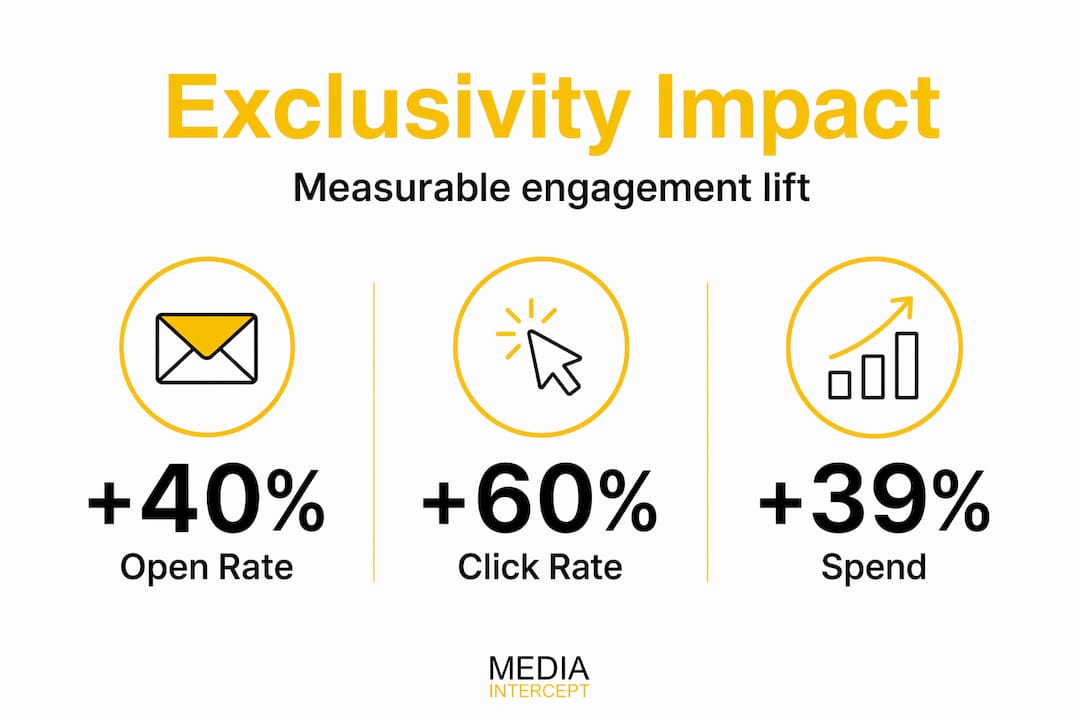
The data backs this up directly. VIP email programs produce 20-40% higher open rates and 30-60% higher click rates compared to standard campaigns. In one documented case study, a brand achieved 3.4x higher revenue per email with a personalized VIP program. That is not a marginal improvement. That is a structural shift in how that audience relates to the brand.

Unique discount codes are a concrete example of exclusivity producing commercial results. Unique code users spend 39% more per order, averaging $131 compared to $89.23 for generic codes. The exclusivity of a personalized code signals to the subscriber that this offer was made for them, not blasted to a list of thousands.
Pro Tip: Do not just label your newsletter “VIP.” Create a genuine content or offer difference that a subscriber can actually feel. If you cannot articulate what is different about this email versus your standard send, your audience will not feel the exclusivity either.
Here is what makes exclusive newsletter content actually work:
Personalized subject lines that reference a subscriber’s behavior or status
Offers tied to individual thresholds (e.g., spend history or engagement milestones)
Content that is genuinely unavailable to general subscribers, not just earlier access by 24 hours
Messaging that acknowledges the subscriber’s membership explicitly and specifically
Segmenting your exclusive newsletter audience
The quality of your exclusive newsletter program depends almost entirely on how you define who belongs in it. Vague or arbitrary criteria produce a diluted experience for subscribers and weak results for your campaigns.
There are three primary segmentation approaches marketers use for exclusive programs.
Approach | How it works | Best for |
Spend-based | Segments by total purchase value or order frequency | E-commerce brands with clear purchase data |
Engagement-based | Segments by open, click, or content interaction history | Publishers and content-driven brands |
Hybrid | Combines spend and engagement signals | Brands wanting aspirational tiers with depth |
Campaigns using behavioral segmentation show 36.69% higher open rates and 50-100% higher click-through rates compared to unsegmented sends. Top-performing campaigns use subscriber filters 28% more than bottom performers. That gap does not happen by accident. It reflects how much audience precision matters when you are trying to deliver content that feels personal and relevant.
Finding the right audience size is its own challenge. Too large, and the exclusivity perception collapses. Too small, and you limit the commercial impact of the program. Effective VIP tiers are aspirational yet achievable, balancing genuine exclusivity with enough audience volume to drive meaningful engagement and revenue.
One common mistake is what you might call criteria drift. A brand starts with a clear threshold, say the top 10% of customers by spend, and then gradually expands the criteria to include more subscribers because “more is better.” Within a few months, 40% of the list is labeled VIP and the word has lost all meaning. Guard your criteria deliberately. Audit your subscriber behavior and engagement data regularly to keep membership thresholds grounded in real signals rather than wishful thinking.
Pro Tip: Due to Apple’s Mail Privacy Protection affecting open rate reliability, focus your segmentation on revenue per recipient and click-through rate as your primary success metrics for exclusive programs.
Ethical and effective use of scarcity
Scarcity is one of the most powerful tools in a newsletter marketer’s toolkit. It is also one of the easiest to misuse in ways that permanently damage subscriber trust.
The distinction between real scarcity and fake scarcity matters more than most marketers admit. A campaign that used a realistic “only 14 spots left” message tied to actual inventory generated more revenue than the previous month combined. The same brand using fabricated countdown timers on every email would have achieved the opposite effect over time. Subscribers are perceptive. They recognize when urgency is manufactured, and once they do, they stop responding to it entirely.
Ethical FOMO in marketing replaces anxiety with excitement by anchoring exclusivity to honest, relevant constraints that match actual user needs and behaviors. That shift in framing, from “you might miss out” to “this was made for you and it is genuinely limited,” produces a fundamentally different subscriber response.
Practical scarcity tactics that hold up over time include:
Timed access windows tied to actual inventory or event capacity, not artificial deadlines
Subscriber-only pricing that genuinely is not available through other channels
Personalized expiry triggers based on individual behavior, such as a subscriber who browsed a product category receiving a 48-hour window offer for that specific category
Low-stock alerts sent only when stock is actually limited, not pre-configured to fire at arbitrary thresholds
The frequency of scarcity signals matters enormously. Scarcity tactics work best when reserved for 20-30% of promotional emails. When every email contains a countdown timer or a “limited time” label, subscribers become numb to the message and ignore your calls to action. Reserve urgency for moments when it is genuinely warranted, and it will carry weight every time.
Creating content that keeps VIP subscribers engaged
Exclusive access means nothing if the content behind the door is disappointing. The biggest failure mode for exclusive newsletter programs is cosmetic differentiation. A repackaged version of the general newsletter with a different header graphic does not create loyalty. It creates cynicism.
VIP newsletters must offer substantively different content, with meaningfully higher quality, stronger relevance, and a production standard that reflects the care you claim to have for this audience. Here is a practical framework for content that genuinely sustains subscriber interest over time:
Early product access. Give VIP subscribers first access to new launches, limited collections, or beta features before they go public. This creates real, tangible value that cannot be faked.
Behind-the-scenes insights. Share what is actually happening inside your business, product development decisions, sourcing stories, team perspectives. This builds the kind of transparency that turns subscribers into advocates.
Subscriber-only offers with genuine exclusivity. The offer must actually be unavailable elsewhere. If the same deal appears on your website homepage, the “exclusive” label becomes a credibility problem.
Expert interpretation and curation. Exclusive content increasingly means saving subscribers time through curated, expert analysis rather than just raw information. Position your newsletter as the filter, not the firehose.
Milestone recognition and personalized onboarding. Acknowledge subscriber anniversaries, purchase milestones, or engagement streaks. This signals that you are paying attention, and it deepens the relationship at low cost.
The long-term compounding effect of exclusive programs is real. Repeat purchase rates grow from 20.9% at day 90 to 23.8% at day 365, with ongoing exclusive nurturing driving a meaningful share of lifetime purchases after the initial retention window. Exclusivity is not a launch tactic. It is a long-term retention strategy that grows more valuable the longer you maintain it with discipline.
A note on frequency: more exclusive content is not always better. A weekly VIP edition where every send feels genuinely crafted will outperform a daily exclusive that feels rushed. Subscribers in a VIP program expect quality over quantity. Set a frequency you can sustain at a high standard, and hold to it.
My take on what actually works
I’ve worked with enough newsletter programs to know that the marketers who get the most from exclusivity are not the ones with the cleverest tactics. They are the ones who treat exclusivity as a positioning decision, not a promotional one.
What I’ve found consistently is that the brands trying to manufacture urgency through fake scarcity always hit a wall. The first few campaigns perform well, because novelty is its own form of engagement. But within three or four cycles, subscribers have seen through it, and the open rates tell the story clearly. Marketing strategist Keith Lacy put it well: genuine supply constraints create durable exclusivity in a way that simulated urgency simply cannot replicate.
The most effective exclusive programs I’ve seen share one characteristic. They have real constraints built into the design. A fixed audience size. A genuinely limited offer. Content that actually required effort to produce. Those constraints are not bugs in the program. They are the point.
I’ve also seen marketers underestimate how much the onboarding moment matters. When someone first joins a VIP tier, that first email is your single best chance to demonstrate that the exclusivity is real. Most brands waste it with a generic welcome message. The brands that get it right send something that makes the subscriber feel the decision to join was worth it before they even click anything.
My honest advice: before you build the tactics, decide what your exclusivity program actually stands for. What is the real constraint? What is the genuine benefit? If you cannot answer those questions in one sentence each, the program is not ready. You can explore dedicated email campaign strategy to sharpen your thinking before you build.
— Media Intercept
Run exclusive newsletter campaigns with Media Intercept
Media Intercept gives brands and publishers the infrastructure to run exclusive newsletter campaigns with precision targeting across premium publisher networks. Whether you want reserved placements in high-engagement newsletters or performance-based CPC campaigns reaching specific subscriber segments, the platform handles execution, reporting, and optimization in one place. You can reach VIP-level audiences without building the audience from scratch. Explore Media Intercept’s newsletter sponsorship options to see which placements fit your exclusivity strategy, or download one of the in-depth marketing guides to build your campaign framework before your next send.
FAQ
What is the role of exclusivity in newsletter campaigns?
Exclusivity creates psychological triggers including status recognition and genuine scarcity that increase subscriber engagement, open rates, and revenue per email. VIP programs with real constraints consistently outperform standard campaigns across every key metric.
How do exclusive newsletters improve engagement?
Personalized VIP programs produce 20-40% higher open rates and 30-60% higher click rates than standard sends. The lift comes from subscribers feeling genuinely recognized and receiving content that is substantively different from general emails.
What makes scarcity tactics work without hurting trust?
Real constraints tied to actual inventory, event capacity, or subscriber behavior build trust. Fake scarcity, such as countdowns that reset daily, erodes it. Reserve urgency signals for 20-30% of promotional emails to maintain their impact over time.
How should I segment an exclusive newsletter audience?
Use behavioral and spend-based data to define clear membership thresholds, then audit those criteria regularly to prevent criteria drift. The best segments are aspirational and achievable, large enough to drive impact but small enough to feel genuinely exclusive.
How do I measure the success of an exclusive newsletter program?
Focus on revenue per recipient and click-through rate rather than open rates, which have become less reliable since Apple’s Mail Privacy Protection changes. These metrics give you the clearest signal of whether your exclusive content is actually driving commercial outcomes.
Recommended

