
Newsletter Advertising for Health and Wellness Brands

If you’re new to newsletter advertising, start with our broader guide to newsletter advertising for brands. It explains how newsletter sponsorships work, how placements are priced, and what marketers should measure before launching a campaign.
This guide goes deeper into one of the strongest-fit categories for the channel: health and wellness. For fitness, nutrition, mental health, supplement, skincare, longevity, and lifestyle brands, newsletter advertising offers something harder to find in most digital channels: a trusted, opted-in audience already looking for advice, products, and solutions in a specific wellness niche.
Newsletter advertising for health and wellness brands is the practice of placing sponsored messages inside health-focused email newsletters that reach opted-in subscribers already interested in fitness, nutrition, and mental health. This channel delivers something most digital formats cannot: a permissioned, engaged audience that chose to receive health content. Health and wellness newsletters average 40–50% open rates and 3–6% click-through rates, well above typical display ad benchmarks. That combination of reach and engagement makes newsletter advertising one of the most direct paths to brand awareness and measurable response in the wellness market.
What makes newsletter advertising for health and wellness brands effective?
Newsletter sponsorships work because the audience is self-selected. Readers of a nutrition newsletter already care about what they eat. Readers of a mental health digest are actively looking for solutions. Your ad appears inside content they requested, not alongside content they stumbled into. That context creates trust before a single word of your copy is read.
Newsletter audiences deliver stronger brand affinity and higher conversion rates compared to display ads. The reason is simple: display inventory is bought against demographics, while newsletter inventory is bought against demonstrated interest. A fitness supplement brand advertising in a strength training newsletter reaches people who already spend money on fitness. That alignment shortens the path from impression to purchase.

Health brand newsletters also benefit from editorial credibility. When a respected wellness publisher includes your sponsorship, readers associate your brand with the publisher’s authority. This effect is especially strong in niches like mental health, where trust is the primary purchase driver.
What key strategies ensure successful health and wellness email campaigns?
Successful wellness product promotion in newsletters starts with matching your brand to the right sub-niche. A meditation app belongs in a mindfulness newsletter, not a general health digest. A sports nutrition brand fits a performance training list, not a chronic illness support newsletter. Mismatched placements waste budget and damage brand perception.
Once you have the right newsletter, your creative approach determines results. Education-first email content outperforms promotion-heavy campaigns in wellness, improving both retention and conversion. Readers in health niches are skeptical of hard sells. An ad that teaches something, such as explaining why magnesium affects sleep quality before mentioning your supplement, builds credibility and earns clicks.
Key strategies for effective health brand newsletter campaigns:
Match the sub-niche precisely. Fitness, nutrition, mental health, and chronic wellness each have distinct audiences with different purchase triggers.
Lead with education. Teach before you sell. A short insight or data point in your ad copy signals expertise.
Write compliant copy. Avoid unsubstantiated health claims. Every claim in your ad must be supportable under FTC guidelines.
Use a single, clear call to action. One link, one offer, one next step. Multiple CTAs dilute click-through rates.
Segment by topic. Run separate creative for fitness audiences versus nutrition audiences. Generic wellness messaging underperforms.
Pro Tip: Test a “sponsored content” format where your ad reads like a short editorial tip. This format consistently outperforms banner-style placements in health newsletters because it matches the editorial tone readers expect.
How should marketers measure newsletter advertising effectiveness in 2026?
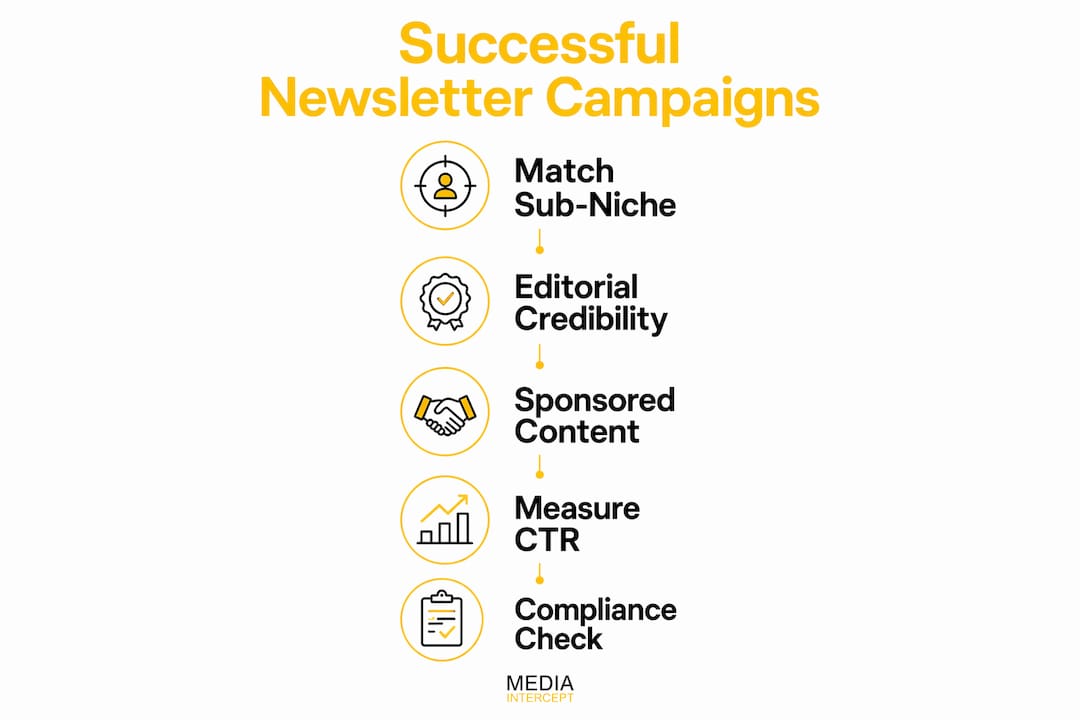
Open rates are no longer a reliable primary metric. Apple Mail Privacy Protection pre-loads email content, which inflates open rate data significantly. CTR is the more reliable engagement metric because it reflects actual reader intent. Track unique clicks using UTM parameters tied to dedicated landing pages for each newsletter placement.
Beyond clicks, use a multi-stage attribution framework to capture the full value of newsletter advertising:
Attribution Window | What to Measure | Why It Matters |
Day 0–30 | Direct clicks and landing page conversions | Captures immediate response from the sponsorship |
Day 30–90 | Assisted conversions and branded search lift | Shows readers who clicked later or searched your brand |
Day 90–180 | Pipeline influence and customer lifetime value | Reflects long-term brand awareness impact |
Branded search lift is one of the most underused metrics in wellness advertising. A campaign reaching 100,000 to 1,000,000 impressions can generate 10–30% uplift in branded search volume. That lift shows up in Google Search Console and represents real purchase intent that last-click models never capture.
Last-click attribution consistently under-credits newsletter impact. A reader sees your ad in a newsletter, searches your brand name three days later, and converts through organic search. Last-click gives organic search full credit. Multi-touch attribution gives the newsletter its share.
Pro Tip: Create a unique discount code or landing page URL for each newsletter placement. This gives you direct attribution data even when UTM tracking is disrupted by email clients or privacy tools.
What compliance challenges affect health and wellness newsletter advertising?
Compliance in health and wellness advertising is not optional. The FTC, CAN-SPAM, and HIPAA each create specific obligations that apply directly to newsletter sponsorships.
FTC endorsement rules are the most immediate concern. FTC guidelines updated in July 2023 require that all endorsements reflect honest opinions and clearly disclose any material connection between the endorser and the brand. This applies to influencer testimonials, customer reviews, and AI-generated endorsements used in newsletter ads. If a wellness publisher writes a sponsored recommendation for your product, that relationship must be disclosed clearly in the newsletter.
CAN-SPAM compliance applies to every email marketing placement. CAN-SPAM requires clear identification of the message as an advertisement, no deceptive subject lines, a valid physical mailing address, and a working unsubscribe mechanism. Publishers handle most of these requirements, but advertisers share responsibility for the content they provide.
HIPAA considerations apply when your targeting or tracking could reveal a patient-provider relationship. Key compliance controls include:
Use server-side conversion tracking instead of pixel-based tracking to avoid sending protected health information to ad platforms.
Avoid condition-specific audience segments that could identify individuals as patients.
Do not pass medication names, diagnosis codes, or treatment identifiers to third-party platforms.
Review all ad copy with a compliance team before placement, especially for prescription-adjacent wellness products.
HIPAA risk in paid acquisition is real even when you are not a covered healthcare entity. If your tracking setup reveals that a specific person visited a condition-specific page, that data can constitute protected health information under certain interpretations.
How does newsletter advertising compare to other digital channels for wellness brands?
Newsletter advertising outperforms display advertising on engagement for health and wellness brands. The gap comes down to context and permission. Display ads interrupt. Newsletter sponsorships appear inside content the reader chose to receive.
Channel | Avg. Open/View Rate | Typical CTR | Audience Trust | Compliance Risk |
Health newsletters | 40–50% | 3–6% | High | Moderate (FTC, CAN-SPAM) |
Display ads | Low | Under 1% | Low | Low |
Social media ads | Variable | 1–3% | Medium | Medium |
Social media ads offer scale and targeting precision, but wellness audiences on platforms like Meta face ad fatigue and growing skepticism. Newsletter readers, by contrast, have a direct relationship with the publisher. That relationship transfers partial trust to your sponsorship.
Newsletter sponsorship pricing in 2026 reflects audience quality, with base CPM rates around $25–40 adjusted upward for high-engagement, high-deliverability lists. That pricing is higher than typical display CPMs, but the conversion performance justifies the premium. A wellness brand paying $35 CPM for a newsletter placement with a 4% CTR is generating clicks at a cost that competes directly with paid search.
Wellness purchases also involve longer consideration cycles than impulse categories. A customer researching a new supplement or therapy program may take 60–90 days from first exposure to purchase. Newsletter advertising fits this cycle well because it reaches readers repeatedly across multiple issues, building familiarity over time. For guidance on comparing CPC and flat-fee buying models, the choice depends on whether you prioritize performance certainty or budget predictability.
Key takeaways
Newsletter advertising for health and wellness brands delivers the highest ROI when you combine precise sub-niche targeting, education-first creative, multi-stage attribution, and strict compliance controls.
Point | Details |
CTR over open rate | Use click-through rate as your primary engagement metric since Apple MPP inflates open rate data. |
Multi-stage attribution | Measure impact across 0–30, 30–90, and 90–180 day windows to capture full campaign value. |
Education-first creative | Ads that teach before selling outperform promotional formats in health and wellness niches. |
Compliance is non-negotiable | FTC, CAN-SPAM, and HIPAA rules apply directly to newsletter sponsorships in the wellness space. |
Sub-niche alignment | Match your brand to the specific newsletter topic, not just a broad wellness category. |
Why I think most wellness brands are measuring newsletter ads wrong
After working with health and wellness brands across fitness, nutrition, and mental health categories, the single most common mistake I see is evaluating newsletter campaigns on a 30-day last-click window. A brand runs a sponsorship, sees modest direct conversions, and pulls the budget. Three months later, branded search volume is up 20%, and no one connects it to the newsletter.
The wellness purchase cycle is long. Readers who see your supplement ad in a nutrition newsletter in January may not buy until March, after they have read two more issues, visited your website twice, and searched your brand name. Last-click attribution gives that conversion to organic search. The newsletter gets nothing. That is not a measurement problem. It is a strategic blind spot.
The other pattern I see is brands treating compliance as a legal checkbox rather than a trust signal. In health and wellness, your audience is making decisions about their bodies. They are more sensitive to misleading claims than almost any other consumer category. A newsletter ad that discloses its sponsorship clearly and avoids exaggerated claims actually converts better than one that hides the relationship. Readers reward honesty with clicks.
The brands that win in health newsletter advertising are the ones that commit to a 90-day measurement window, invest in education-first creative, and treat compliance as a competitive advantage. That combination is not common. Which means the opportunity is still wide open for brands willing to do it right.
— Natalie
How Media Intercept helps health and wellness brands run better newsletter campaigns
Health and wellness marketers need a platform that connects them to premium newsletter audiences without the complexity of managing individual publisher relationships.
Media Intercept gives you access to a curated network of health and wellness newsletter publishers, with flexible buying options including CPC and CPM pricing. The platform includes standardized reporting dashboards that track clicks, conversions, and branded search lift across the full attribution window. Compliance workflows support FTC disclosure requirements and help you review ad content before it goes live. Whether you are running a single campaign or scaling newsletter sponsorships across multiple wellness sub-niches, Media Intercept handles the execution so your team can focus on strategy and creative. Our team is ready to plan your next campaign with you.
FAQ
What are realistic open rates for health newsletter ads?
Health and wellness newsletters average 40–50% open rates, but Apple Mail Privacy Protection inflates these figures. Click-through rate, which benchmarks at 3–6%, is the more reliable metric for measuring actual engagement.
How do I stay FTC-compliant in wellness newsletter advertising?
FTC guidelines require that all paid endorsements disclose the material connection between the advertiser and the endorser. This applies to testimonials, influencer mentions, and AI-generated reviews used in newsletter placements.
Does HIPAA apply to newsletter advertising for wellness brands?
HIPAA risk applies when digital tracking could reveal a patient-provider relationship. Use server-side conversion tracking and avoid passing condition-specific identifiers to ad platforms to stay compliant.
What is the best attribution model for newsletter sponsorships?
A multi-stage attribution model covering 0–30 days for direct response, 30–90 days for assisted conversions, and 90–180 days for pipeline influence gives the most accurate picture of newsletter ROI.
How does newsletter advertising compare to display ads for wellness brands?
Newsletter sponsorships consistently outperform display ads on engagement and brand trust for wellness audiences. Newsletter audiences provide stronger brand affinity, and the permissioned, niche context drives higher conversion rates than display inventory.
Recommended
