
How to Measure Newsletter Sponsorship Performance

Measuring newsletter sponsorship performance is one of the most important parts of running campaigns across multiple publishers.
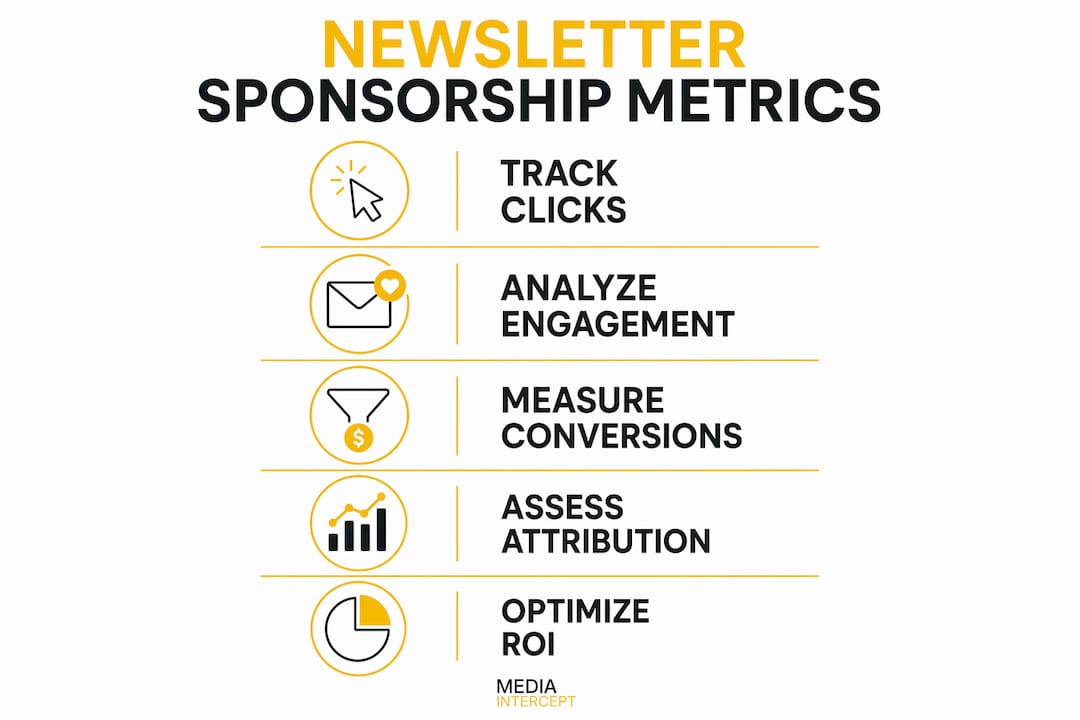
Newsletter sponsorship performance measurement is defined as the systematic tracking of direct engagement metrics, conversion proxies, and attribution signals to calculate the true ROI of paid newsletter placements. Most marketers undervalue these campaigns because they rely on last-click attribution, which misses the majority of newsletter-driven conversions. The right framework combines click-through rate (CTR), cost per click (CPC), cost per acquisition (CPA), UTM parameters, GA4 attribution models, branded search lift, and promo code redemptions. Together, these data points give you a complete picture of how to measure newsletter sponsorship performance across every stage of the funnel.
What metrics and KPIs should you track for newsletter sponsorships?
The most important metrics for assessing newsletter advertising fall into three categories: direct response, indirect engagement, and content engagement. Each category answers a different question about campaign impact.
Direct response metrics tell you what happened immediately after a reader clicked:
Unique clicks and CTR: Typical newsletter CTR sits around 0.5%, with 1% or higher considered exceptional. That number is lower than paid search because newsletter sponsorships function more like brand advertising than direct response.
CPC and CPA: These tell you the cost efficiency of each click and each converted customer. Compare CPA against your average customer lifetime value to judge whether the channel pays.
Landing page conversion rate: A high CTR paired with a low conversion rate signals a mismatch between the ad copy and the landing page experience.
Indirect engagement proxies capture readers who saw your ad but did not click immediately:
Branded search volume lift measured in Google Search Console or Google Trends
Custom promo code redemptions tied to specific newsletter placements
“How did you hear about us?” survey responses collected at checkout or signup
Newsletter readers often search brand names days after seeing an ad rather than clicking in the moment. Ignoring this behavior causes you to undercount newsletter-driven revenue by a significant margin.
Content engagement metrics include time on page, scroll depth, and returning visitor rates from newsletter traffic segments. These signals confirm whether the audience you reached was genuinely interested or just curious.

The metric that connects all three categories is click-to-conversion (CTC). CTC ties specific clicks to purchase events rather than measuring clicks in isolation. Overall email CTC benchmarks around 2.5%, while targeted banner content can reach 18.3%. CTC is the number your finance team actually cares about because it links ad spend directly to revenue.
Pro Tip: Build a simple spreadsheet that tracks CTR, CTC, and CPA side by side for every newsletter placement. Patterns across placements reveal which publishers deliver buyers, not just browsers.
How do attribution models affect newsletter sponsorship ROI?
Attribution model choice is the single biggest variable in how newsletter sponsorship ROI gets reported. Last-click attribution assigns 100% of conversion credit to the final touchpoint before purchase. Newsletter sponsorships almost always appear earlier in the buyer journey, so last-click systematically undercredits them.
GA4 offers a practical solution. The GA4 model comparison tool lets you view last-click and data-driven attribution side by side for the same conversion set. Data-driven attribution distributes credit across all touchpoints based on actual conversion probability, which typically surfaces newsletter’s true contribution.
Here is how to use attribution data effectively:
Open GA4 and navigate to Advertising > Attribution > Model Comparison.
Set the conversion window to 90 days to capture delayed newsletter-driven purchases.
Compare last-click versus data-driven credit for your newsletter traffic source.
Check the Conversion Paths report to see how often newsletter appears as a first or mid-funnel touchpoint.
Pull the Assisted Conversions report to count conversions where newsletter was present but not the final click.
For B2B campaigns with long sales cycles, assisted conversions acknowledge the early touchpoint role that newsletters play before a prospect becomes a sales-qualified lead. Tracking influenced pipeline over 90–180 days gives you a far more accurate picture of newsletter’s contribution than a 30-day last-click window.
Pro Tip: Tag every link in your newsletter placement with utm_content to differentiate multiple links within the same email. Missing UTM parameters cause untagged clicks to appear as direct traffic in GA4, making your newsletter channel look weaker than it actually is.
How to set up a measurement system for newsletter sponsorships
A reliable measurement system requires consistent setup before the campaign launches, not after. Follow these steps to build one that captures both short-term and long-term performance signals.
Define your goal and primary KPI. Brand awareness campaigns prioritize branded search lift and returning visitor rates. Lead generation campaigns prioritize CPA and MQL volume. Performance campaigns prioritize CTC and revenue per click.
Tag every link with full UTM parameters. Use utm_source (newsletter name), utm_medium (email), utm_campaign (campaign name), and utm_content (specific link position or creative variant). Consistent tagging is the foundation of accurate attribution.
Configure GA4 reports before launch. Set up Traffic Acquisition, User Acquisition, Conversion Paths, and Model Comparison reports. Create a custom segment for your newsletter utm_source so you can isolate its traffic at any time.
Set up indirect tracking. Create a unique promo code for each newsletter placement. Monitor branded search volume in Google Search Console weekly. Add a “How did you hear about us?” field to your lead or checkout form.
Plan your measurement timeline. A multi-layer timeline recommends reviewing direct response in days 0–30, assisted conversions and demand signals in days 30–90, and influenced pipeline in days 90–180. This prevents premature conclusions about campaign value.
The table below summarizes what to measure and when:
Metric Type | Specific Metrics | Measurement Window |
Direct response | CTR, CPC, CPA, landing page conversion rate | Days 0–30 |
Assisted engagement | Assisted conversions, promo code redemptions | Days 30–90 |
Demand signals | Branded search lift, survey attribution | Days 30–90 |
Influenced pipeline | MQLs, sales accepted opportunities, closed deals | Days 90–180 |
Pro Tip: For B2B campaigns, build an outcomes ladder that maps each funnel stage from click efficiency to MQL quality to influenced pipeline. This gives your sales team and CFO a shared language for evaluating newsletter ROI.
What are the most common newsletter measurement mistakes?
Tracking sponsorship effectiveness breaks down in predictable ways. Knowing these pitfalls in advance saves you from drawing wrong conclusions and cutting campaigns that are actually working.
Relying solely on last-click attribution. Last-click makes newsletter sponsorships look weak because most readers do not convert on the first visit. Always run the GA4 model comparison before making budget decisions.
Inconsistent or missing UTM tagging. A single untagged link sends traffic into the direct channel bucket, fragmenting your data. Audit every link before the campaign goes live.
Misreading low CTR as poor performance. A 0.5% CTR is normal for newsletter sponsorships. The channel builds awareness and intent over time. Evaluate it on CTC and influenced pipeline, not CTR alone.
Claiming incrementality without controls. A rise in branded search after a newsletter campaign does not prove causality. Seasonal trends, PR activity, or other campaigns could explain the lift.
The most rigorous way to prove causality is a geo holdout test. Geo holdout tests use control and treatment market splits to isolate the newsletter’s actual contribution. A well-designed test includes a pre-period baseline of at least 9 weeks and a test duration of 17 weeks or more.
For B2B marketers running account-based campaigns, ask your newsletter publisher for a corporate-domain click report. Corporate domain clickers typically represent 15–40% of total clicks, and that data feeds directly into your ABM outreach sequences.
Key takeaways
Accurate newsletter sponsorship measurement requires layered tracking across direct response, assisted conversions, and influenced pipeline over a 90–180 day window.
Point | Details |
Track CTC, not just CTR | Click-to-conversion links ad spend to revenue and is the metric finance teams prioritize. |
Use GA4 model comparison | Comparing last-click to data-driven attribution reveals newsletter’s true funnel role. |
Tag every link with UTM parameters | Include utm_content to differentiate links within the same email and prevent data loss. |
Measure over 90–180 days | B2B sales cycles require a longer window to capture assisted and influenced pipeline value. |
Validate lift with holdout tests | Geo control tests confirm whether branded search lift is caused by the campaign or external factors. |
Why most marketers are measuring newsletter sponsorships wrong
I have reviewed dozens of newsletter sponsorship reports where the conclusion was “low ROI” based entirely on a 30-day last-click window. Every single one of those campaigns was being judged by the wrong standard.
Newsletter sponsorships are not paid search. They do not convert the same day. The reader sees your ad on a Tuesday morning, thinks about it, searches your brand name on Thursday, and converts the following week. Last-click gives that conversion to organic search. The newsletter gets nothing. That is not a measurement result. That is a measurement failure.
The fix is not complicated, but it requires patience. You need to run GA4’s model comparison, pull assisted conversion data, and monitor branded search trends for at least 60 days after a campaign ends. When you do that consistently, newsletter sponsorships almost always look better than the initial last-click report suggested.
I also want to push back on the obsession with CTR benchmarks. A 0.5% CTR in a niche B2B newsletter reaching 20,000 senior decision-makers is worth far more than a 2% CTR in a broad consumer list. The quality of the audience matters more than the click rate. Pair your CTR data with CPA and pipeline influence, and you will make much better budget decisions.
The marketers who get the most out of newsletter sponsorships are the ones who commit to a 90-day measurement cycle, use multiple attribution signals, and communicate that framework to their stakeholders before the campaign launches. Set the right expectations upfront, and the results will speak for themselves.
— Natalie
Plan your newsletter sponsorship campaigns with Media Intercept
Measuring newsletter sponsorship performance is only as good as the data infrastructure behind your campaigns. Media Intercept is built to give you that infrastructure from day one.
The Media Intercept newsletter sponsorship platform supports standardized UTM tagging, CPC and CPM campaign options, and reporting that tracks clicks, conversions, and cost efficiency across every placement. Whether you are running a direct response campaign or building brand awareness across premium publisher networks, Media Intercept connects you to newsletter advertising solutions designed for measurable results. Publishers can also access the newsletter monetization platform to manage demand, reporting, and payouts in one place. Let’s plan your next campaign together.
FAQ
What is a good CTR for a newsletter sponsorship?
A typical newsletter sponsorship CTR is around 0.5%, with 1% or higher considered strong performance. Newsletter sponsorships function as brand advertising, so CTR alone is not a reliable measure of campaign success.
How do i measure newsletter sponsorship ROI without click data?
Track branded search volume lift in Google Search Console, monitor custom promo code redemptions, and collect “how did you hear about us?” survey responses. These proxies capture readers who saw your ad but did not click immediately.
What attribution model works best for newsletter sponsorships?
Data-driven attribution in GA4 is more accurate than last-click for newsletter campaigns because it distributes conversion credit across all touchpoints. Use the GA4 model comparison tool to see how credit shifts between models for your specific campaigns.
How long should i measure a newsletter sponsorship campaign?
Measure direct response in the first 30 days, assisted conversions and demand signals through day 90, and influenced pipeline through day 180. B2B campaigns with longer sales cycles require the full 90–180 day window to avoid undervaluing the channel.
What is click-to-conversion and why does it matter?
Click-to-conversion (CTC) measures the percentage of clicks that result in a purchase or conversion event. It is a more precise ROI signal than CTR because it connects ad spend directly to revenue rather than measuring interest alone.
Recommended
