
How to Buy Newsletter Sponsorships Across Multiple Publishers

Managing newsletter sponsorships across multiple publishers starts with having the right platform and process in place.
Buying newsletter sponsorships across multiple publishers is defined as the practice of placing paid ad placements in several independent email newsletters simultaneously to reach a concentrated, opted-in audience at scale. The industry term for this approach is multi-publisher newsletter advertising, and it combines direct publisher deals with marketplace platforms like Paved, Beehiiv Ad Network, and Sparkloop. B2B newsletter CPMs range from $10 to $50 depending on niche, with premium sectors like fintech and cybersecurity sitting at the higher end. Measurement discipline and creative adaptation are what separate campaigns that scale from those that stall.
What are the primary models for buying newsletter sponsorships?
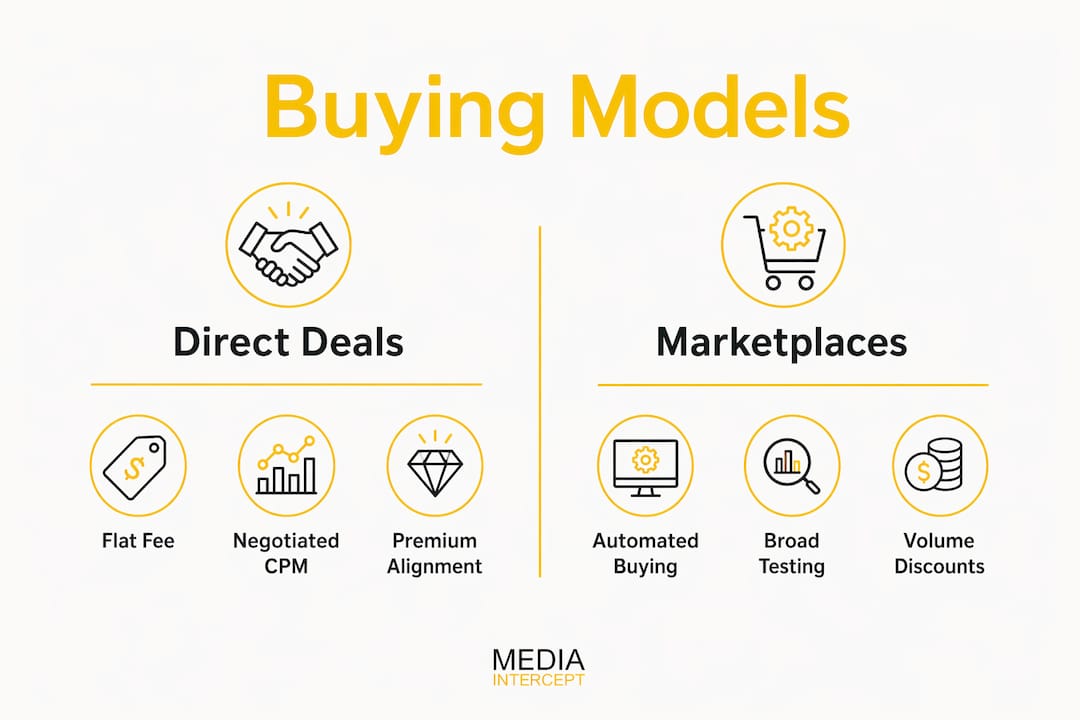
Multi-publisher buying operates through two distinct models: direct deals and marketplace platforms, each with different tradeoffs on control, speed, and cost.
Direct negotiation means contacting publishers individually to secure placements. You get editorial alignment, faster creative approvals (often within 48 hours), and the ability to negotiate premium top-of-newsletter slots. The tradeoff is time. Building a roster of 10 to 15 direct publisher relationships takes weeks, not days.
Marketplace platforms like Paved, Beehiiv Ad Network, and Passionfroot solve the scale problem. You access hundreds of vetted newsletters through a single interface, with automated scheduling and consolidated reporting. The tradeoff is less editorial control and occasionally slower approval cycles compared to direct deals.
Pricing models vary by publisher size and campaign goal:
Flat fee: Common for newsletters under 50,000 subscribers. Predictable spend, easy to budget.
CPM: Standard for larger lists. B2B CPMs range $10 to $50, with niche sectors commanding the top end.
Cost-per-subscriber: Used by platforms like Sparkloop for list growth goals, not direct sales.
CPC: Rare in newsletter advertising. Most publishers resist it because it shifts all performance risk onto them.
Model | Pricing structure | Best use case |
Direct deal | Flat fee or negotiated CPM | Premium alignment, editorial fit, B2B niche |
Marketplace (Paved, Beehiiv) | CPM or flat fee via platform | Scale, automation, broad audience testing |
Sparkloop | Cost-per-subscriber | List growth, subscriber acquisition |
Programmatic (LiveIntent) | CPM, auction-based | Enterprise scale, retargeting |
B2B SaaS brands get the best results by combining both models: marketplaces for broad testing, direct deals for high-performing newsletters once you have conversion data.

Pro Tip: When bundling three or more placements with a single publisher, ask for a frequency pack. Volume discounts of 25 to 35% off standard rates are common and give you better budget predictability across a quarter.
How to identify and select the right publishers for your campaign
Publisher selection is where most multi-publisher campaigns succeed or fail. Subscriber count is the least useful metric. What matters is audience composition, topical relevance, and engagement quality.
Start by building an ideal customer profile (ICP) for your campaign, then map it to newsletter categories. A cybersecurity SaaS targeting CISOs needs different publishers than a B2C fintech app targeting retail investors. Platforms like Passionfroot and Dupple let you filter publishers by industry vertical, audience size, and engagement benchmarks, which cuts research time significantly.
When evaluating a specific newsletter, look beyond the media kit:
Open rate benchmarks: B2B newsletters in focused niches typically see 30 to 40% open rates. Anything below 20% in a B2B context warrants scrutiny.
Click-through rates: A healthy newsletter ad placement targets 2 to 5% CTR. Ask publishers for historical sponsor CTR data, not just general engagement stats.
Audience demographics: Request a breakdown of job titles, company sizes, or geographic distribution if you are running a B2B campaign.
Sponsorship history: A newsletter that has run consistent, relevant sponsors signals an engaged, monetization-tolerant audience.
Content quality: Read three to five recent issues. If the editorial voice is inconsistent or the content is thin, your ad will underperform regardless of list size.
Negotiating bundled placements across a publisher’s premium slots is more effective than buying single sends. Premium top placements carry visibility rates over 90%, while footer placements are significantly less effective. Always negotiate for above-the-fold positioning.
Pro Tip: Run a small test send with any new publisher before committing to a multi-send package. A single placement at full price tells you far more about real audience fit than any media kit.
Step-by-step process to negotiate, launch, and measure sponsorships
A repeatable workflow is what makes multi-publisher buying manageable at scale. The standard six-step process covers every stage from discovery to optimization.
Identify publishers. Use platforms like Paved, Passionfroot, or direct outreach to build a shortlist of 8 to 12 newsletters aligned with your ICP.
Choose your buying model. Decide which publishers warrant direct negotiation and which are better accessed through a marketplace.
Negotiate terms. Bundle three or more sends per publisher to unlock volume discounts. Request off-peak scheduling discounts for slower months. Avoid aggressive rate haggling with tier-one publishers since they have enough demand to walk away.
Supply creative. Write ad copy that matches the newsletter’s editorial voice. Native ads that feel like a natural recommendation consistently outperform display-style corporate copy.
Launch with tracking in place. Assign a unique UTM parameter and a dedicated landing page to each publisher. This is non-negotiable for attribution accuracy.
Measure and optimize. Review performance after each send. Kill underperformers after two sends, scale winners into quarterly packages.
“Publishers prefer reliable revenue streams over one-off placements. When you show up as a consistent partner rather than a one-time buyer, you get better rates, better placement, and faster approvals.”
On measurement: open rates are inflated 30 to 50% by Apple Mail Privacy Protection, which auto-loads tracking pixels regardless of whether a subscriber actually opened the email. Treat open rates as directional signals only. Your real performance indicators are UTM-tracked clicks, landing page conversions, and post-purchase survey responses asking “How did you hear about us?”
Brand search lift is a useful secondary signal. A 20% increase in branded search volume during a campaign period indicates strong awareness impact even when direct attribution is incomplete.
Pro Tip: Create a unique discount code per publisher. It gives subscribers an incentive to convert and gives you clean attribution data that works even when UTMs break in certain email clients.
What are the best tools and platforms for managing sponsorships at scale?
Choosing the right platform depends on your campaign goals, budget, and internal bandwidth. No single tool does everything well.
Platform | Best for | Pricing model | Key feature |
Paved | B2B and niche audience reach | CPM and flat fee | Large vetted publisher network |
Beehiiv Ad Network | Consumer and creator newsletters | CPM | Native to Beehiiv ecosystem |
Sparkloop | Subscriber acquisition | Cost-per-subscriber | List growth focus |
Passionfroot | Creator-led newsletters | Flat fee | Direct booking interface |
LiveIntent | Enterprise programmatic | CPM, auction | Retargeting and scale |
Letterhead | Agency and managed buys | Managed service | Workflow and creative tools |
For B2B campaigns, Paved and direct publisher deals remain the strongest combination. Beehiiv Ad Network works well for consumer brands targeting younger, creator-economy audiences. Sparkloop is purpose-built for list growth and should not be evaluated on direct sales metrics.
Enterprise buyers running campaigns across 20 or more publishers benefit from programmatic options like LiveIntent, which handles bidding, delivery, and reporting at a level of automation that manual direct deals cannot match. The tradeoff is reduced editorial alignment and less control over exact placement context.
Mixing direct deals with marketplace buys gives you the best of both approaches. Use marketplaces to test new publishers at lower commitment, then migrate top performers to direct quarterly packages for better rates and placement priority. You can also explore creator partnership platforms that specialize in deal infrastructure between brands and newsletter publishers.
How to optimize and troubleshoot campaigns for improved ROI
Treating a newsletter sponsorship as a set-and-forget placement is the most common reason campaigns underperform. Newsletters are live channels with shifting audiences, editorial calendars, and seasonal engagement patterns.
Start every multi-publisher campaign with a test phase across three to five publishers. Allocate 20 to 30% of your total budget to this phase. The goal is not conversions. The goal is identifying which publisher audiences actually respond to your offer before you commit to quarterly packages.
Key optimization levers once campaigns are live:
Placement negotiation: If a publisher defaults to footer placements, push back. Premium slots near the top of the newsletter have visibility rates over 90% versus significantly lower rates for footer positions.
Creative rotation: Refresh ad copy every three to four sends. Audience fatigue is real in newsletters because subscribers read every issue, unlike display ads they scroll past.
Attribution refinement: Use unique landing pages per publisher to eliminate overlap in conversion tracking. Shared landing pages make it impossible to know which publisher drove which conversion.
Frequency management: More sends to the same list does not always mean more conversions. Monitor diminishing returns after the third send in a short window.
Survey data: Add a one-question post-purchase survey asking how customers found you. This captures conversions that UTMs miss, particularly from mobile email clients that strip tracking parameters.
Native ad creative that matches the publisher’s tone consistently outperforms generic corporate copy. A cybersecurity newsletter audience responds to a sponsor message written in the same direct, technical voice as the editorial content. A personal finance newsletter audience responds to conversational, relatable copy. One creative template across all publishers is a reliable way to underperform everywhere.
Pro Tip: Never use open rates as your primary KPI. Apple Mail Privacy Protection inflates open data by 30 to 50%, making it an unreliable signal. Focus on clicks, conversions, and brand search lift instead.
Key takeaways
Buying newsletter sponsorships across multiple publishers works best when you combine direct deals for quality, marketplaces for scale, and rigorous per-publisher attribution to optimize spend continuously.
Point | Details |
Use both buying models | Combine direct deals for premium alignment with marketplace platforms for broad reach and testing. |
Negotiate volume discounts | Bundle three or more sends per publisher to unlock 25 to 35% discounts off standard rates. |
Track per publisher | Assign unique UTMs and landing pages to each publisher to avoid attribution overlap. |
Prioritize premium placement | Top-of-newsletter slots carry over 90% visibility; always negotiate above-the-fold positioning. |
Ignore open rates as KPI | Apple Mail Privacy Protection inflates opens by 30 to 50%; use clicks and conversions instead. |
Why most newsletter sponsorship campaigns underperform (and how to fix it)
I have reviewed dozens of multi-publisher newsletter campaigns, and the pattern is consistent. Brands spend significant budget on placements, then report disappointing results because they measured the wrong things and optimized too late.
The biggest mistake is treating newsletter sponsorships like display advertising. You are not buying eyeballs on a banner. You are buying a trusted recommendation from a publisher whose subscribers have opted in specifically to read their content. That relationship is the asset. Generic corporate copy destroys it.
The second mistake is consolidating creative across all publishers. A single ad that runs in a fintech newsletter, a marketing newsletter, and a developer newsletter will feel out of place in at least two of them. Adapting copy to match each publisher’s voice takes an extra hour per placement and routinely doubles CTR.
On the measurement side, I have seen brands abandon high-performing publishers because UTM data looked weak, only to discover through post-purchase surveys that the newsletter was driving a significant share of conversions that were not being tracked. Build your attribution stack before you launch, not after.
The campaigns I have seen perform best share three traits: they start small and test before scaling, they negotiate quarterly frequency packs rather than one-off buys, and they treat the publisher relationship as a partnership rather than a transaction. Publishers talk to each other. A brand that shows up as a good partner gets better placements, faster approvals, and first access to new inventory. A brand that haggles aggressively and misses creative deadlines gets deprioritized. That dynamic is real and it compounds over time.
If you are building a newsletter sponsorship media plan from scratch, start with five publishers, run two sends each, and let the data tell you where to invest the rest of your budget.
— Natalie
Plan and execute your next multi-publisher campaign with Media Intercept
Media Intercept is built specifically for marketing teams that need to buy, manage, and measure newsletter sponsorships across multiple publishers without the operational overhead of managing every deal manually.
The platform gives you access to vetted premium newsletter inventory, consolidated reporting across all placements, and flexible pricing options including flat-fee and CPM reserved placements. Creative approvals, scheduling, and publisher payouts are handled within a single workflow, so your team spends time on strategy rather than coordination. Whether you are running a focused B2B campaign or scaling across consumer newsletters, Media Intercept connects you to the right publishers with the reporting clarity to optimize confidently. Visit the newsletter advertising platform to start planning your next campaign.
FAQ
What is a newsletter sponsorship across multiple publishers?
Multi-publisher newsletter advertising is the practice of placing paid sponsorships in several independent newsletters simultaneously to reach a concentrated, opted-in audience at scale. It combines direct publisher deals and marketplace platforms to balance editorial alignment with broad reach.
How much does it cost to sponsor newsletters?
B2B newsletter CPMs range from $10 to $50 depending on niche and audience quality, with flat fees common for smaller lists under 50,000 subscribers. Bundling three or more placements with a single publisher typically unlocks volume discounts of 25 to 35%.
What platforms can I use to buy newsletter ads at scale?
Paved, Beehiiv Ad Network, Passionfroot, Sparkloop, and LiveIntent each serve different campaign goals. Paved and direct deals work best for B2B campaigns; Sparkloop is purpose-built for subscriber acquisition rather than direct sales.
How do I measure newsletter sponsorship performance accurately?
Assign a unique UTM parameter and dedicated landing page to each publisher to avoid attribution overlap. Supplement tracking with post-purchase surveys and monitor brand search lift, since open rates are inflated 30 to 50% by Apple Mail Privacy Protection.
How do I negotiate better rates with newsletter publishers?
Bundle three or more sends into a quarterly package to access volume discounts, request off-peak scheduling discounts, and position your brand as a reliable long-term partner. Avoid aggressive rate negotiation with tier-one publishers since they have sufficient demand to prioritize other advertisers.
Recommended
