
What is CPC Newsletter Buying? A Guide for Marketing Pros

Updated: Jun 5
Most marketers shopping for newsletter ad placements default to flat fees or CPM without ever questioning whether a performance-based alternative might serve their campaigns better. CPC newsletter buying, which means paying only for clicks your ad generates rather than impressions or sends, sits at the edge of newsletter marketing practice but offers something flat fees simply cannot: direct alignment between what you pay and what you get. If you are managing performance-driven campaigns with real ROI targets, understanding what is CPC newsletter buying and when to apply it could change how you allocate your next budget cycle.
Table of Contents
What is CPC newsletter buying and how does it differ from other pricing models?
Newsletter advertising pricing structures and metrics you should know
Comparing CPC newsletter buying to other ad channels: advantages and challenges
How to implement CPC newsletter buying strategies for effective campaigns
Why conventional newsletter pricing wisdom misses the value of CPC buying
How Media Intercept can help you optimize CPC newsletter buying
Key Takeaways
Point | Details |
CPC newsletter buying defined | CPC buying means paying based on actual clicks, unlike common flat fee or CPM models. |
Pricing varies by audience size | Large newsletters usually use CPM, smaller ones flat fees, with CPC being less frequent but gaining traction. |
CTR is key metric | Historical click-through rates on sponsored content are critical to evaluating cost-effectiveness. |
Newsletter CPC often cheaper | Cost per click in newsletters can be 2-5 times cheaper than LinkedIn, offering cost advantages. |
Secondary placements high ROI | Mid-newsletter ad spots often deliver better returns at lower cost than top placements. |
What is CPC newsletter buying and how does it differ from other pricing models?
CPC newsletter buying means you pay a publisher a fixed or negotiated rate for every click your sponsored ad receives inside their newsletter. You are not paying for how many subscribers receive the email or how many open it. You pay only when a reader takes action and clicks your link. That distinction matters enormously when your campaign has a defined cost-per-acquisition target.
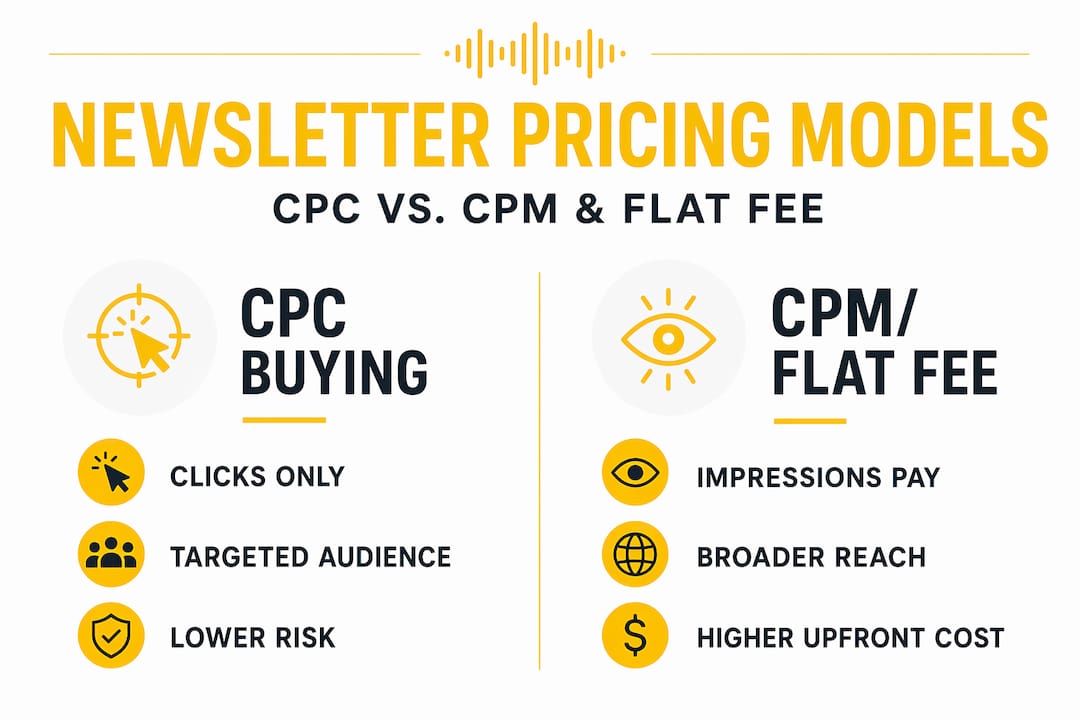
Newsletter advertising is primarily priced via flat fees or CPM, with CPC being a less common, performance-based alternative. Understanding where CPC fits means knowing what you are comparing it against:
Flat fee: You pay a fixed price per newsletter send, regardless of how many people open or click. Common for smaller lists with loyal, engaged audiences.
CPM (cost per thousand impressions): You pay based on the number of opens or sends, usually calculated per 1,000. Works well when your goal is brand exposure.
CPC (cost per click): You pay only for verified clicks. Rare in newsletters but gaining traction as publishers adopt better tracking.
Hybrid models: A lower base flat fee combined with a CPC bonus for performance above a threshold. This is the model that tends to make publishers say yes.
Most publishers prefer CPM or flat fee models, with CPC being rare and hard to negotiate. The reason is straightforward: publishers carry the delivery risk in a CPC deal. If your creative underperforms, they earn less. That makes CPC a harder sell unless you come to the table with strong creative and a compelling offer. Knowing this ahead of time shapes how you approach the negotiation. For practical guidance on optimizing newsletter ads with CPC, it helps to understand how clicks behave differently across placement types before you commit to a rate.
Newsletter advertising pricing structures and metrics you should know
Pricing in newsletter advertising is not uniform. CPM is the standard pricing model for newsletters over 50,000 subscribers, varying by vertical, while smaller lists mostly use flat fees. In practical terms, a B2B cybersecurity newsletter with 80,000 subscribers might charge a $50 to $80 CPM, while a niche personal finance newsletter with 12,000 subscribers might charge a flat $300 to $500 per send. The vertical drives a significant portion of that price difference.
To make CPC decisions intelligently, you need to understand four key metrics:
Open rate: The percentage of subscribers who open the email. Industry averages sit between 30 and 45 percent for quality newsletters.
CTR (click-through rate): The percentage of openers who click a sponsored link. Sponsored content CTR is almost always lower than editorial CTR.
CPA (cost per acquisition): The total ad cost divided by the number of paying customers or conversions generated.
Effective CPC: Even in a flat fee or CPM deal, you can calculate your implied cost per click by dividing total spend by total clicks. This lets you compare deals across pricing models.
Here is a simple example. A newsletter with 50,000 subscribers, a 35% open rate, and a 2% sponsored CTR generates roughly 350 clicks per send. At a $1,000 flat fee, your effective CPC is about $2.86. Knowing that number lets you evaluate whether a publisher offering a direct $4.00 CPC deal is a good or bad trade.
Pricing model | How you pay | Best for | Risk profile |
Flat fee | Per send | Smaller lists, brand awareness | Low risk for publisher |
CPM | Per 1,000 opens | Larger lists, reach campaigns | Shared risk |
CPC | Per click | Performance campaigns | Higher risk for publisher |
Hybrid | Base fee + CPC bonus | Negotiated deals | Balanced |
Most marketers evaluate newsletter sponsorships on intuition rather than math and must model full funnel metrics before committing. A free CPC and CPM calculator can help you build that model before you sign anything. For more context on cost-effective email marketing across channels, comparing implied CPCs across deals is a foundational practice.
Pro Tip: Always ask publishers for sponsored content-specific CTR data, not just their overall newsletter average. Editorial links routinely outperform sponsored links by a factor of 3 to 5x, and using the wrong number will make your ROI projection look far better than reality. CTR is the most direct evidence of commercial effectiveness, and experienced advertisers always request historical CTR on sponsored content before agreeing to any pricing model.
Track all of this using the key newsletter metrics that reflect real campaign performance rather than vanity numbers.
Comparing CPC newsletter buying to other ad channels: advantages and challenges
One of the most compelling reasons to explore CPC newsletter buying is the cost difference compared to other B2B channels. Newsletter CPC is often 2 to 5x cheaper than LinkedIn sponsored content for B2B IT or security audiences. That gap is not marginal. It is the difference between a $3 click and a $15 click reaching a comparably qualified professional.

Channel | Typical CPC range | Audience intent | Click quality | Avg. CPA |
Newsletter (CPC deal) | $1.50 to $6.00 | High, self-selected | Very high | Low to medium |
Newsletter (flat fee, implied) | $1.00 to $8.00 | High | Very high | Low to medium |
LinkedIn sponsored content | $8.00 to $20.00 | Medium to high | High | Medium to high |
Display/programmatic | $0.25 to $2.00 | Low | Low | High |
Newsletter readers opt in voluntarily and often open emails they have subscribed to for months or years. That context creates a fundamentally different click than a display ad impression. When a reader clicks a sponsored link in a newsletter they trust, they are genuinely curious. That intent gap is real and it shows up in conversion rates downstream.
“The most efficient newsletter programs in 2026 run on flat fees or CPM with conversion-based ROI tracking rather than relying on a single pricing metric.”
A few practical advantages and challenges of CPC newsletter buying:
Advantage: You only pay for real engagement, not exposure that may not reach interested readers.
Advantage: Easier to calculate ROI because your cost numerator is fixed per click.
Advantage: Arbitrage opportunity when newsletter CPC underprices LinkedIn or other paid channels for the same audience.
Challenge: Fewer publishers offer it, so your inventory options are narrower.
Challenge: Requires strong creative to protect your cost-per-click efficiency.
Challenge: Negotiation takes longer because publishers need to understand your tracking setup.
Pro Tip: Consider mid-roll or secondary placements when negotiating CPC deals. They often cost significantly less than primary placements while capturing a large share of clicks from engaged readers who read past the first ad. Compare newsletter vs display ads to see how engagement patterns differ by placement and format. You can also explore content monetization strategies to understand how publishers think about pricing decisions.
How to implement CPC newsletter buying strategies for effective campaigns
Getting a CPC newsletter deal off the ground requires more preparation than a standard flat fee buy. Here is a step-by-step approach that works in practice:
Analyze your target audience’s newsletter habits. Identify which newsletters your ideal customer actually reads. This is more specific than “B2B marketers.” Think “B2B marketers at Series B SaaS companies who read about growth.” The tighter your match, the more your CPC spend justifies itself.
Request historical CTR and conversion data from publishers. Before agreeing to any rate, ask for sponsored CTR data from the last three to five sends. If a publisher cannot provide it, that is a yellow flag. Always request historical CTR data for sponsored content specifically since it varies significantly from editorial CTR.
Negotiate a base-plus-performance hybrid deal. Offer the publisher a modest flat fee or CPM floor to reduce their risk, then add a CPC bonus above a baseline click threshold. This structure makes publishers more willing to offer CPC terms because they are not fully exposed to creative underperformance.
Implement UTM tracking on every sponsored link. Use UTM parameters on every link to ensure accurate performance tracking. Without UTMs, you cannot attribute clicks to specific newsletter placements, and your attribution data becomes unreliable fast.
Model the full funnel before committing. Model the full funnel before signing a newsletter sponsorship deal, including open rate, CTR, and post-click conversion. Use your average landing page conversion rate and your target CPA to work backward to the maximum CPC you can afford. If the publisher’s rate exceeds that ceiling, the deal does not work regardless of how great the audience sounds.
Pro Tip: Secondary placements in a newsletter, the second or third sponsor slot, cost less but often yield strong CTR from readers who engage with the full issue. These placements are underpriced relative to their actual performance and worth testing before scaling a primary placement.
Explore newsletter sponsorships with detailed performance data to validate your full-funnel assumptions. And for more on building campaigns that compound over time, the guide on email newsletter strategies covers audience growth mechanics that affect your CPC efficiency directly.
Why conventional newsletter pricing wisdom misses the value of CPC buying
Most marketers who buy newsletter ads do so the way they buy display: they accept the pricing model the publisher presents, look at the open rate, and call it due diligence. That approach leaves real money on the table.
The deeper problem is that flat fee and CPM acceptance without click analysis makes it impossible to know what you actually paid for engagement. You might be paying a $10,000 CPM-equivalent for a newsletter that delivers clicks at $15 each, while a comparable newsletter available on a CPC basis delivers clicks at $3.50. The difference is not in audience quality. It is in how you structured the deal.
Secondary or mid-roll placements often yield 30% better ROI and cost 50% less than primary slots while still capturing most clicks. Yet advertisers consistently fight for the top placement because it feels more prestigious. That instinct is costing them performance.
The other blind spot is the overreliance on open rate as a proxy for engagement. Open rates tell you that someone viewed the email, not that they read your ad or had any intent to act. A newsletter with a 50% open rate and a 0.8% sponsored CTR is a worse media buy than one with a 30% open rate and a 3% sponsored CTR. CPC buying forces you to confront that math directly, and that is exactly why it makes you a sharper buyer overall.
Our perspective at Media Intercept is that CPC newsletter buying is not just a pricing model. It is a discipline. It requires you to define what a click is worth to your business before you spend anything. That discipline transfers back to every other channel you buy. Treat CPC negotiation as an opportunity to align your interests with the publisher’s, because when they only earn when you get clicks, they have a real reason to place your creative thoughtfully. See how optimizing newsletter ads at the placement level connects to better CPC outcomes across your campaigns.
How Media Intercept can help you optimize CPC newsletter buying
You now have the framework. The next step is finding the right inventory, negotiating with confidence, and measuring accurately across every placement. That is exactly where our team can help.
At Media Intercept, we give advertisers like you access to premium newsletter inventory with transparent performance data, including sponsored CTR history, open rates, and conversion benchmarks by vertical. Our platform supports both CPC and CPM pricing models, so you can structure campaigns for performance or predictable spend depending on your goals. We also support hybrid deal structures and provide standardized UTM-based reporting so your tracking is consistent from day one. Explore available newsletter sponsorships or download our guides to go deeper on newsletter advertising strategy. Our team is ready to plan your next campaign with you.
Need help comparing CPC, CPM, and flat-fee pricing? Use our CPC and CPM calculator for newsletter advertising.
Frequently asked questions
Is CPC newsletter buying better than CPM or flat fee pricing?
CPC buying aligns your costs directly with clicks, which can improve ROI if you have the data and infrastructure to track performance, but CPM or flat fees remain more common and can be easier to manage when publisher inventory is limited.
What metrics should I request from publishers before buying CPC newsletter ads?
Always request historical click-through rates on sponsored content specifically, open rates, and post-click conversion data if available. Sponsored CTR varies significantly from editorial CTR, and using the wrong number will skew your ROI projection.
Are there newsletter ad placements that perform better on a CPC basis?
Yes. Secondary placements can yield 30% better ROI and cost 50% less than primary placements, making them an often overlooked option for performance-focused buyers.
How does CPC in newsletters compare to social platforms like LinkedIn?
Newsletter CPC is often 2 to 5 times cheaper than LinkedIn’s sponsored content for B2B audiences, offering a meaningful cost advantage for targeted campaigns reaching highly engaged professional readers.
What’s the best way to track performance when buying CPC newsletter ads?
Use UTM parameters on every sponsored link from day one. UTM parameters on every link ensure accurate attribution, which is essential when you are paying per click and need to verify publisher-reported numbers against your own analytics.
Recommended
Related Newsletter Advertising Resources
Use our CPC and CPM calculator for newsletter advertising to compare clicks, impressions, CTR, CPC, CPM, and flat-fee campaign costs.
Learn more about newsletter sponsorships and how brands can use CPC, CPM, or flat-fee buying models across premium publisher newsletters.
Review our newsletter advertising glossary for definitions of CPC, CPM, CTR, attribution, tracking links, conversions, and other campaign terms.
Explore newsletter advertising for brands to see how Media Intercept helps advertisers plan, manage, and measure newsletter campaigns across publishers.


