
Newsletter Sponsorship Media Plan: Build One That Works

New to newsletter sponsorships? Start with our beginner’s guide to newsletter sponsorships for brands before diving deeper into this topic.
A newsletter sponsorship media plan is a strategic framework that defines how you package, price, and pitch newsletter ad placements to attract sponsors and deliver measurable ROI. Without one, you are selling on gut feel instead of data, and sponsors notice. The most effective plans organize sponsorable content sections, audience engagement metrics, tiered pricing, and outreach templates into a single repeatable system. Publishers like those using the ContentCreators blueprint and pricing benchmarks from Dupple have shown that structured plans shorten sales cycles and command higher rates. This article walks you through every component, in the order you need to build it.
How to build a newsletter sponsorship media plan that actually works
A newsletter sponsorship media plan works when it starts with a clear inventory of what you are selling. Before you write a single pitch email, map every section of your newsletter and ask one question: does this section serve the reader first? Audience-first sections produce premium impressions sponsors trust and that perform consistently. Sections that feel like ads from the first sentence kill click-through rates and erode reader trust at the same time.
Limit yourself to four recurring sponsorable sections per issue. More than four and you dilute the value of each placement. Each section should have a defined format, a consistent position in the issue, and a clear audience benefit. A “tool of the week” section in a B2B SaaS newsletter, for example, gives readers a genuine recommendation while giving sponsors a native, high-intent placement. That combination is what justifies a premium price.

Track click-through rate per section for at least four consecutive issues before you approach a single sponsor. This gives you real performance data instead of projections. Sponsors making decisions in 2026 expect CTR by placement, not just aggregate open rates. A section averaging 3.2% CTR is a concrete selling point. A vague “highly engaged audience” claim is not.
Here are the section types that consistently attract sponsor interest:
Curated resource or tool spotlight: Readers expect a recommendation; sponsors get a native endorsement with tracked clicks.
Industry news digest with sponsor credit: High read-through rates because the content is inherently useful.
Case study or success story: Longer dwell time and strong association with outcomes sponsors want to be linked to.
Job board or opportunity listing: High intent, niche audience, and easy to attach a sponsor CTA without disrupting the format.
Pro Tip: Design each sponsorable section as if the sponsor did not exist. If the section only makes sense with a sponsor in it, readers will skip it and your CTR data will reflect that.
How should you price newsletter sponsorship tiers?
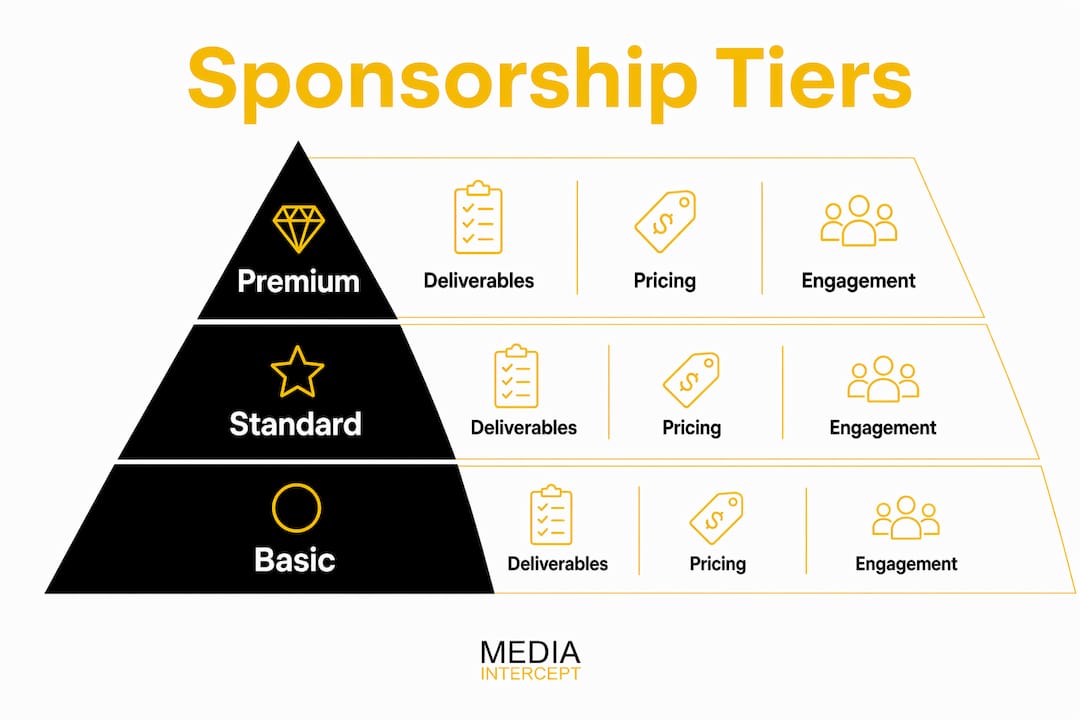
Pricing is where most newsletter operators leave money on the table. The industry standard is three tiers, each with distinct deliverables and a clear value step between them. Three pricing tiers based on placement value improve sponsor clarity and create natural upsell paths.
Tier | Deliverables | Best for |
Premium | Logo, dedicated CTA, tracked link, performance report | Brands wanting full visibility and measurable ROI |
Mid-Tier | Badge, short CTA, tracked link | Brands testing the audience before committing to premium |
Entry | “Presented by” credit, tracked link | Early-stage brands or budget-conscious sponsors |
The CPM formula for newsletter sponsorships adjusts for engagement. Multiply your subscriber count by your average open rate to get your effective audience, then apply your CPM rate to that number. A newsletter with 20,000 subscribers and a 42% open rate has an effective audience of 8,400. At a $40 CPM, that is $336 per placement. This approach is more honest than charging on raw list size, and it is increasingly what sophisticated sponsors expect.
Primary placements in mid-sized B2B newsletters typically range from $1,100 to $5,000 per issue, with dedicated sends reaching $10,000 or more. These benchmarks give you a market floor and ceiling. If your engagement data is strong, you should be pricing toward the upper end of your tier, not the lower.
Apply a 20 to 30 percent premium for multi-issue series commitments. A sponsor booking four consecutive issues is worth more than four individual bookings because they reduce your sales overhead and signal audience trust. Price that value explicitly. Engagement-based pricing that segments active, moderately active, and dormant subscribers produces more accurate CPMs and stronger sponsor confidence than flat-rate pricing ever will.
Pro Tip: Build a separate pricing line for your top 20% most active readers. If your ESP lets you segment by open frequency, that cohort’s CPM can legitimately be 40 to 60 percent higher than your blended rate.
What should a newsletter media kit include?
A media kit is the document that converts a curious sponsor into a paying one. Clear media kits build sponsor trust and shorten sales cycles. Every element should answer one question the sponsor is already asking.
The non-negotiable components are:
Subscriber count and growth trend: Show the last six months. Flat growth is fine if engagement is high; declining growth without explanation is a red flag you need to address proactively.
Open rate and CTR by section: Use unique opens and unique clicks. Transparent open rates and corporate-domain click reporting improve advertiser trust more than inflated aggregate numbers.
Audience demographics: Job titles, industries, seniority levels, and geography. A newsletter reaching 8,000 CFOs is worth more per subscriber than one reaching 80,000 general business readers.
Publishing schedule: Frequency, send day, and send time. Sponsors plan campaigns around calendars.
Sponsorable section descriptions: One paragraph per section explaining the format, the audience benefit, and what the sponsor placement looks like.
Pricing tiers: All three tiers with deliverables listed clearly.
Editorial guardrails: What categories you will not accept, what approval process looks like, and how you handle creative that does not meet your standards.
Recent performance data and sample issues: Link to two or three recent issues. Let the quality speak.
Media kit element | Why sponsors care |
Unique open rate | Confirms real engagement, not bot inflation |
CTR by section | Proves placement-level performance |
Audience demographics | Validates audience fit before spending |
Editorial guardrails | Signals professionalism and brand safety |
Sample issues | Shows creative context and placement quality |
The media kit is a living document. Update it every quarter with fresh performance data. A media kit with numbers from 18 months ago signals that you are not paying attention to your own metrics.
How do you pitch sponsors and build recurring partnerships?
The strongest sponsor pitches lead with audience fit and placement performance, not subscriber count. A pitch that opens with “we have 15,000 subscribers” is forgettable. A pitch that opens with “our readers are mid-market HR directors, and our ‘tool spotlight’ section averaged 4.1% CTR over the last six issues” is a conversation starter.
Structure your outreach in this order:
Open with audience fit. Name the specific reader profile and why it matches the sponsor’s customer. One sentence.
State the placement and its performance. Reference the section, the average CTR, and the number of issues tracked.
Present the pricing tier. Be specific. “The mid-tier placement is $800 per issue and includes a badge, 40-word CTA, and tracked link” removes friction and signals professionalism.
Link to a recent issue. Let the sponsor see the placement in context. A screenshot is acceptable but a live link is better.
State the next step. “I have two open slots for the next four-issue series starting March 10. Reply to hold your spot.” Urgency without pressure.
Defined reporting and tracked links are what turn one-off sponsors into recurring partners. After each sponsored issue, send a performance report within 48 hours. Include unique clicks, CTR, and any notable audience response. Sponsors who see clean data renew. Sponsors who hear nothing after their placement do not.
Follow up once, five business days after your initial pitch. Keep it to two sentences. If there is no response after the follow-up, move on and revisit in 90 days. Chasing unresponsive prospects wastes time you could spend on sponsors who are already engaged.
Common mistakes that undermine newsletter sponsorship plans
Most newsletter sponsorship programs fail for predictable reasons, and nearly all of them are fixable.
Pricing on list size alone. Raw subscriber count is a vanity metric. Engagement and deliverability are now the central drivers of sponsorship pricing. A 5,000-subscriber newsletter with a 55% open rate commands more than a 50,000-subscriber list with 8% opens.
Overloading issues with sponsors. More than two sponsors per issue compresses the attention each placement receives and drives CTR down. Lower CTR means weaker renewal conversations.
Skipping performance reporting. Sponsors who do not receive post-campaign data have no reason to renew. Reporting is not optional; it is the product.
Freezing pricing. Dynamic pricing based on recent engagement outperforms fixed rates that ignore performance changes. Review your rates every quarter.
Ignoring editorial guardrails. Accepting any sponsor that pays damages reader trust faster than it builds revenue. Define your category restrictions before your first sponsor conversation, not after a bad placement.
Even small newsletters can build profitable sponsorship programs. 500 engaged subscribers can command $50 to $150 per sponsored issue when the audience is niche and the engagement data is clean. The size of your list matters less than the quality of your documentation.
Pro Tip: Refresh your sponsorship rates every quarter using the previous 90 days of engagement data. If your open rate climbed 5 points, your pricing should reflect that. Sponsors respect publishers who know their numbers.
Key takeaways
A newsletter sponsorship media plan succeeds when it combines audience-first content design, engagement-based pricing, transparent reporting, and a media kit that updates with every new performance cycle.
Point | Details |
Design sections for readers first | Sponsorable sections that serve audience interests produce higher CTR and attract better sponsors. |
Price on engagement, not list size | Use open rate and active subscriber segments to calculate CPM and justify premium tiers. |
Build a complete media kit | Include CTR by section, demographics, pricing tiers, editorial guardrails, and recent sample issues. |
Lead pitches with performance data | Open with audience fit and section CTR, not subscriber count, to convert sponsors faster. |
Report results within 48 hours | Post-campaign performance reports are the single strongest driver of sponsor renewal. |
Why audience-first design is the part most plans skip
I have reviewed a lot of newsletter sponsorship pitches, and the pattern that separates the ones that close from the ones that stall is almost always the same. Publishers who built their sponsorable sections around what their readers actually want, before any sponsor was in the picture, have CTR data that sells itself. Publishers who built sections around what sponsors might pay for have mediocre numbers and spend twice as long justifying their rates.
The counterintuitive truth is that protecting your editorial integrity is a revenue strategy, not a constraint on one. Sponsors in 2026 are more sophisticated than they were five years ago. They read your newsletter before they sign. They notice when the “sponsored section” reads like a press release dropped into an otherwise useful email. When you treat your media plan strategy as a living document and update it with real performance data every quarter, you stop selling ad space and start selling a proven audience relationship. That is a fundamentally different conversation, and it commands fundamentally different pricing.
The other thing I would push back on is the instinct to wait until your list is “big enough” to start monetizing. The newsletter monetization window opens earlier than most publishers think. A tight, engaged niche audience at 2,000 subscribers with documented CTR data is more sellable than a 20,000-subscriber list with no performance history. Start tracking, start documenting, and start pitching earlier than feels comfortable.
— Media Intercept
Let Media Intercept help you execute your sponsorship plan
Building a newsletter sponsorship media plan is one thing. Executing it at scale, with consistent reporting and efficient sponsor management, is where most publishers hit friction. Media Intercept is built specifically for that gap.
The Media Intercept platform connects publishers with premium brand partners, manages placement execution, and delivers standardized performance reporting without requiring exclusivity. Whether you are running CPC campaigns or flat-fee reserved placements, the workflow handles demand, reporting, and payouts in one place. Publishers looking to grow their newsletter sponsorship revenue can access the full platform overview and get started without a long onboarding process. If you are ready to turn your media plan into a working revenue program, Media Intercept is the place to start.
FAQ
What is a newsletter sponsorship media plan?
A newsletter sponsorship media plan is a structured document that defines your sponsorable content sections, audience metrics, pricing tiers, and outreach strategy. It gives sponsors the data they need to make a buying decision and gives you a repeatable system for selling placements.
How do you calculate CPM for newsletter sponsorships?
Multiply your subscriber count by your average open rate to get your effective audience, then apply your CPM rate to that number. Mid-sized B2B newsletters typically price primary placements between $1,100 and $5,000 per issue based on this calculation.
How many sponsors should a newsletter include per issue?
Two sponsors per issue is the practical maximum for maintaining strong CTR on each placement. More than two compresses reader attention and reduces the performance data you need to justify renewal pricing.
When should a small newsletter start selling sponsorships?
A newsletter with as few as 500 engaged subscribers can command $50 to $150 per sponsored issue when the audience is niche and the engagement data is documented. Start tracking CTR by section from your first issue so you have performance history ready when you pitch.
What makes sponsors renew newsletter sponsorships?
Sponsors renew when they receive a clear performance report within 48 hours of their placement. Defined reporting with tracked links and unique click data is the single strongest driver of recurring sponsorship deals.
Recommended
