
Publisher Newsletter Growth: Strategies for Engagement and Performance

Updated: Jun 5
Looking to monetize your newsletter? Learn how Media Intercept helps publishers grow newsletter revenue without requiring exclusivity.
Newsletter advertising is not the same game it was two years ago. Open rates that once signaled strong performance now need a second look, subscriber growth metrics mean little without context, and the tactics publishers relied on to scale audiences have matured into something far more nuanced. If you’re managing newsletter campaigns or planning sponsorships, the gap between what worked in 2023 and what works now is wider than most benchmarking posts admit. This article gives you the updated picture, practical mechanics, and the measurement clarity you need to plan and execute smarter in 2026.
Table of Contents
Newsletter growth is accelerating: Recent benchmarks and what they mean
Newsletter engagement metrics: Interpreting benchmarks and measurement nuance
Practical strategies to accelerate newsletter audience and campaign ROI
Why most newsletter growth advice falls short in 2026 and what actually works
Connect your newsletter growth to actionable advertising solutions
Key Takeaways
Point | Details |
Newsletter growth persists | Publisher newsletters are expanding rapidly, with engagement benchmarks still strong in 2026. |
Targeted audience strategies | Successful growth relies on niche positioning, consistency, and smart use of referrals and incentives. |
Measurement is nuanced | Engagement metrics should be interpreted wisely due to privacy changes and self-reported data. |
Practical tactics drive ROI | Optimized segmentation, incentives, and attribution are essential for elevating campaign performance. |
Solutions can boost results | Platforms like Media Intercept help connect publisher growth to actionable advertising outcomes. |
Newsletter growth is accelerating: Recent benchmarks and what they mean
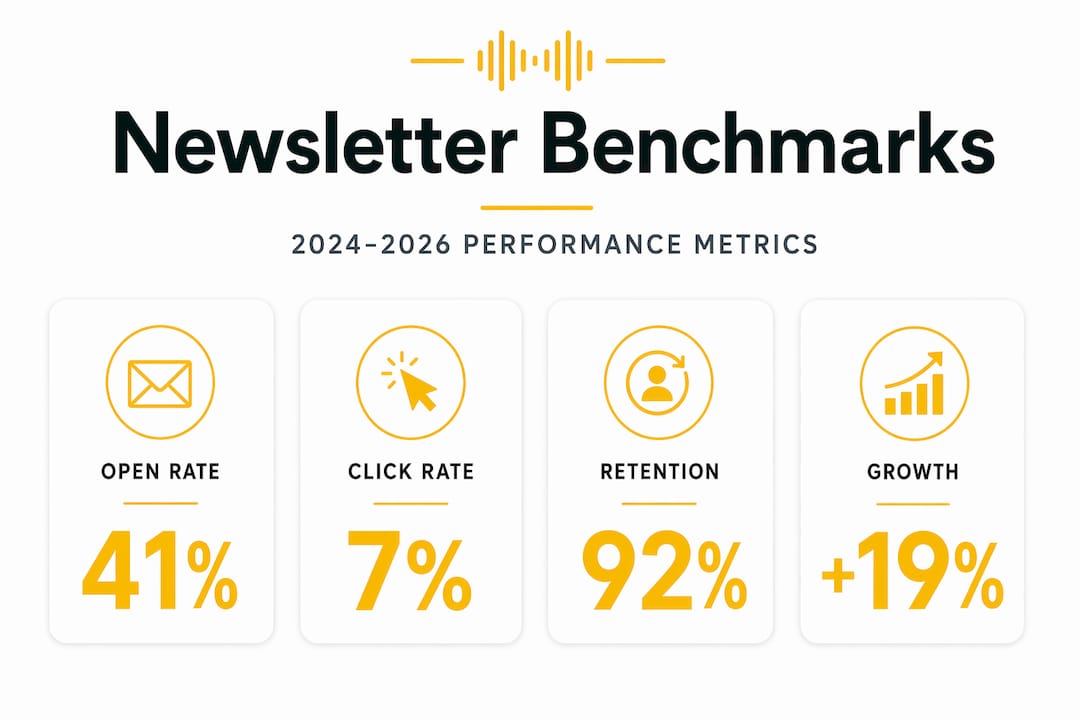
The volume of newsletter activity in 2025 was significant by any measure. Publishers sent 28 billion emails in 2025 across one major platform alone, reaching 255 million unique readers. The average open rate climbed to 41.24%, and a strong benchmark for 2026 sits in the 40–42% range. Those numbers signal real momentum for the format.
But here’s the important context: volume growth and engagement growth are two different signals. A channel growing in subscriber count does not automatically mean your ad placement will perform better. What matters more is whether the audience behind that growth is targeted, retained, and engaged.
“Growth benchmarks tell you where the floor is. They don’t tell you whether a specific newsletter list is the right fit for your campaign or your brand.”
For brand managers and marketers, the practical takeaway is this: use platform-wide benchmarks as orientation, not as a scorecard. If you’re evaluating a publisher for a sponsorship placement, you need their segment-specific data, not an industry average.
The table below compares key newsletter engagement benchmarks and what they mean for campaign planning:
Metric | 2024 average | 2025 average | What it signals for advertisers |
Open rate | ~38% | 41.24% | Audience attention is improving, but MPP inflation is real |
Click-through rate (CTR) | ~2–4% | ~2.5–4.5% | More reliable performance signal than open rate |
List growth rate (monthly) | ~3–5% | ~4–6% | Healthy lists are still scaling across niches |
Unsubscribe rate | ~0.2–0.5% | ~0.2–0.4% | Retention improving with better content targeting |
Use this data to set your initial hypotheses. Then validate against the specific publisher data you’re working with. You can explore newsletter growth strategies for a deeper look at how these numbers translate into execution.
For brands evaluating newsletter inventory, the newsletter marketplaces guide walks through how to assess publisher quality beyond surface-level metrics.
The mechanics behind publisher newsletter growth
Knowing the benchmarks is step one. Understanding why some newsletters grow while others stagnate is where the real edge lives. Beehiiv’s growth guidance makes the underlying mechanics clear: list growth comes down to sharper positioning, retention habits, and referral mechanics that reduce friction.
Niche positioning and subscriber personas
Broad newsletters lose readers because they lack a specific reason to exist in someone’s inbox. The publishers growing fastest in 2026 are the ones who have defined their audience down to a detailed persona. Not just “marketers” but “B2B SaaS marketers managing budgets over $500K.” Not just “finance readers” but “early-career professionals managing their first investment portfolio.”

When you’re a brand evaluating newsletter sponsorships for your campaign, that specificity is exactly what you should be looking for. A smaller, tightly positioned list will often outperform a large, general-interest newsletter for conversion-focused placements.
Retention through consistent publishing
Subscriber retention is the silent driver of list health. Publishers who post on a predictable schedule train their audience to expect and open their emails. Irregular publishing erodes that habit fast. Retention is not glamorous to talk about, but it directly affects the engaged-subscriber percentage that determines real campaign reach.
This matters for advertisers because a list with 10,000 subscribers and 45% open rates delivers more genuine impressions than a list with 50,000 subscribers and 8% open rates.
Referral programs and incentive mechanics
Referral loops are one of the highest-leverage growth tools available to publishers, and they are still underused. A well-structured referral program, where existing subscribers earn access to premium content or early releases for referring new readers, compounds growth without paid acquisition costs.
Here is a quick comparison of growth tactics:
Growth tactic | Cost level | Speed | Engagement quality |
Organic SEO / content | Low | Slow | High |
Paid acquisition | High | Fast | Variable |
Referral programs | Low-medium | Medium | High |
Social media cross-posting | Low | Medium | Medium |
Lead magnets (free guides, tools) | Low | Medium-fast | High |
Key tactics to prioritize for quality list growth:
Create a lead magnet closely tied to your core topic (free templates, guides, or data reports)
Build a referral program with tiered rewards that incentivize sharing without creating spam behavior
Maintain a fixed publishing cadence, even if it means reducing frequency slightly
Use confirmed opt-in flows to protect list quality from the start
Segment new subscribers into an onboarding sequence to accelerate habit formation
Pro Tip: When you’re partnering with a publisher for a brand awareness campaign, ask for their 90-day new subscriber data. A newsletter growing through referrals and organic search will have higher engagement from recent additions than one inflated by sweepstakes or co-registration traffic.
Newsletter engagement metrics: Interpreting benchmarks and measurement nuance
Here is where most marketers run into trouble. You pull an open rate benchmark from a blog post, compare it to your publisher’s reported numbers, and feel confident you’re making a data-driven decision. The problem is that measurement changes like MPP distort open rates and make cross-platform comparisons actively misleading.
Apple’s Mail Privacy Protection (MPP), which pre-fetches email content regardless of whether the reader actually opened the email, inflated open rates across the industry starting in late 2021. By 2025, a significant portion of the “open” signals recorded in many ESP dashboards are machine-triggered, not human-triggered.
What that means in practice
If you’re evaluating a newsletter that reports a 55% open rate, some of that number is likely synthetic. A 55% reported open rate in 2026 may reflect genuine engagement closer to 30–35% when MPP inflation is removed from the picture. This doesn’t make open rates useless. It makes them a relative indicator rather than an absolute one.
Key takeaways for interpreting newsletter engagement:
Click rates are more reliable. A human has to actually click a link, which makes CTR a cleaner performance signal.
Trend your own data. If a publisher’s click rate has stayed consistent or grown over 12 months, that’s meaningful. A single static benchmark is not.
Use reply rates and forwards when available. These signals are nearly impossible to fake and indicate genuine reader investment.
Avoid cross-platform comparisons. An ESP that uses MPP-corrected tracking will report different numbers than one that doesn’t.
Stat to note: Self-reported benchmark studies from different newsletter ecosystems often stitch together data from incompatible tracking environments, making the resulting averages less useful than they appear.
For campaign planning, our newsletter performance calculator helps you model expected returns based on realistic engagement inputs rather than inflated benchmarks.
Pro Tip: When you’re negotiating a newsletter sponsorship, request 30, 60, and 90-day click rate trends from the publisher, not just a point-in-time average. Consistent or growing CTR is the indicator you actually want to see.
Understanding CPC for newsletter ads gives you a framework for tying performance measurement directly to campaign spend, which keeps accountability clear for both you and the publisher.
Practical strategies to accelerate newsletter audience and campaign ROI
Now that you understand both the growth mechanics and the measurement nuances, it’s time to put them together into a campaign strategy that delivers results.
Publisher growth mechanics follow a clear pattern: narrow positioning attracts the right audience, consistent publishing retains them, and referral loops amplify growth without heavy ad spend. Each of these mechanics has a direct analog for brand campaign strategy.
Step-by-step approach to maximize ROI from newsletter campaigns:
Start with segment fit, not list size. Identify publishers whose subscriber persona matches your customer profile as closely as possible. A 15,000-subscriber niche newsletter will often outperform a 200,000-subscriber general list for conversion goals.
Use dedicated email placements for high-intent campaigns. Sponsorship slots within regular newsletters are great for brand awareness. But when you need action, a dedicated email placement puts your message in front of the audience without competing content.
Set up attribution before you launch. Use UTM parameters, unique landing pages, or promo codes specific to each newsletter placement. This lets you compare performance across publishers and identify which ones warrant increased spend.
Build referral mechanics into your campaign offer. If your product supports it, include a shareable element in your newsletter ad. Something like a referral code or a “forward this to a colleague” call to action can extend your reach beyond the original send list.
Segment your analysis by audience subset. If a publisher has segmented their list by topic interest or engagement level, negotiate placement in the most engaged segment, even if the total audience is smaller. Smaller and more engaged beats larger and lukewarm every time.
Optimize based on CTR trends, not open rate snapshots. Plan your first placement as a test, track click performance over 30 days, and use that baseline to inform your next campaign iteration.
Reinvest in what works before scaling new placements. Once a publisher list consistently delivers above-benchmark CTRs, deepen that relationship before adding new partners. Familiarity and frequency with an engaged audience compounds over time.
Pro Tip: Pair effective newsletter strategies with your advertiser playbook to ensure your creative and targeting align with how the most engaged newsletter audiences actually behave.
For brand teams focused on awareness-building alongside performance, the goal is to balance top-of-funnel impressions with mid-funnel clicks that indicate genuine interest.
Why most newsletter growth advice falls short in 2026 and what actually works
Here is the honest take: most published newsletter growth advice is written to rank on search engines, not to help you navigate real conditions in 2026. The articles recommending “post consistently and use a lead magnet” are not wrong. They’re just incomplete.
The bigger issue is that many of those posts benchmark against aggregated, self-reported numbers from different ecosystems that were measured with different tracking environments, different MPP correction approaches, and different list hygiene standards. When you stack those numbers together and call it an “industry benchmark,” you get a number that is accurate for no one in particular.
The advice we’d give you from working inside the newsletter advertising ecosystem is this: stop comparing yourself to a blended industry average and start comparing yourself to your own historical segments. If your click rate grew 15% quarter over quarter, that matters far more than whether you’re above or below a published benchmark.
Retention and referral mechanics are also deeply underestimated in most growth playbooks. Publishers and marketers spend a lot of energy on acquisition, running paid ads or social campaigns to grow subscriber counts. But a list that retains 95% of subscribers month over month, with a strong referral loop converting 5% of readers into recruiters, will outgrow a heavily acquired list within a year and at a fraction of the cost.
The practical recommendation is to treat real audience growth strategies as an ongoing system, not a one-time tactic. Growth, retention, and referral mechanics need to be in place simultaneously for the compounding effect to take hold.
What this means for brand managers: when you’re selecting publisher partners, look for newsletters that have strong retention signals, not just impressive subscriber counts. A publisher who can tell you their 6-month retention rate, their referral-sourced subscriber percentage, and their consistent click trends over time is a far better partner than one who leads with a large list and vague engagement claims.
Connect your newsletter growth to actionable advertising solutions
Understanding newsletter growth mechanics is only part of the equation. Translating that knowledge into measurable advertising results is where strategy becomes execution.
Media Intercept connects brands with premium newsletter publishers across high-engagement, niche-specific audiences. Whether you’re looking to run a sponsorship in a targeted publisher’s regular send or want the focused impact of a dedicated email campaign, our platform gives you flexible pricing, standardized reporting, and efficient workflows to execute quickly. For publishers ready to monetize engaged lists, our newsletter monetization platform handles demand, execution, and payouts without requiring exclusivity. For brands scaling newsletter campaigns, our newsletter advertising platform gives you the tools to plan, run, and optimize placements across premium inventory. Let’s plan your next campaign together.
Frequently asked questions
How can publishers reliably grow newsletter subscription lists in 2026?
Consistent niche positioning, combined with retention-first publishing habits and a structured referral program, are the most reliable drivers of sustainable list growth. Paid acquisition can accelerate this, but only when the foundational mechanics are already working.
What newsletter open rate is considered strong for publishers in 2026?
An open rate of 40–42% is the current strong benchmark, though MPP inflation means the true engaged-reader percentage may be lower. Click rates are a more reliable signal of genuine audience engagement.
Why are newsletter engagement metrics sometimes unreliable?
Privacy changes like MPP pre-fetch email content and trigger false opens, inflating open rates across platforms. Cross-platform comparisons are unreliable because different tools handle this differently, so your own historical trends are the most accurate benchmark.
What strategies help brands get the best newsletter advertising performance?
Target niche publisher lists with high retention and consistent click rate trends, and use dedicated placements for high-intent campaigns. Building attribution into every placement from day one lets you identify top-performing partners and scale what works efficiently.
Recommended
Related Publisher Resources
Explore Media Intercept’s newsletter monetization platform for publishers.
Download our newsletter advertising guides for more publisher monetization and sponsorship planning resources.
Review our newsletter advertising glossary for common terms around CPC, CPM, publisher payouts, tracking links, and campaign reporting.

