Newsletter vs. Display Ads: Which Drives Better Results?

Most marketers assume that more impressions mean more impact. That assumption costs budgets every quarter. Display advertising can technically serve millions of impressions, yet a significant share of those ads are never truly seen by a human being. Meanwhile, newsletter advertising quietly delivers messages to opted-in readers who actively chose to receive that content. The gap between what each format promises and what it actually delivers is wider than most campaign reports suggest, and understanding it is the difference between wasted spend and measurable results.
Table of Contents
Key Takeaways
Point | Details |
Viewability vs attention | Display ads are measured by viewability, but actual user attention is not guaranteed. |
Audience trust matters | Newsletter ads leverage trusted, known audiences for precise targeting and higher engagement. |
Choose by campaign goal | Select newsletters for intent-driven messaging; use display for broad awareness campaigns. |
Metrics need nuance | Go beyond impressions—measure actual engagement and resonance for true ROI. |
Platforms enable synergy | Combining newsletter and display ads can create a balanced, stronger digital marketing strategy. |
Understanding newsletter and display advertising mechanics
The structural differences between these two formats shape everything, from how audiences receive your message to how you measure success. Let’s break down how each one actually works.
Newsletter advertising places your brand message directly inside an email or newsletter feed. Whether you choose newsletter sponsorships or dedicated send placements, your ad appears alongside content that readers subscribed to on purpose. The audience context is known. The publisher has a direct relationship with those readers. Your message lands in a trusted environment with clear intent signals already attached.
Display advertising operates very differently. Ads are served programmatically across web and app environments, where placement and viewability can vary dramatically. As noted in viewability documentation, newsletter ads run inside an email or newsletter feed with known audience context, while display ads are served into web and app placements where viewability and attention measurement materially affect whether impressions can drive clicks or downstream lift.
Here is a quick breakdown of where each format stands on core mechanics:
Placement: Newsletter ads sit inside publisher content; display ads sit on web pages or in apps
Audience knowledge: Newsletter audiences are subscriber-verified; display audiences are inferred through targeting signals
Environment: Inboxes create focused reading moments; web environments compete with dozens of page elements for attention
Creative context: Creative email formats can align closely with editorial tone; display creative must interrupt browsing patterns
Operational execution: Newsletter placements often run on flat-fee or CPC terms with predictable delivery; display campaigns require ongoing bid management
“The inbox is one of the few digital environments where a reader has given explicit permission for a brand to appear. That permission changes the entire dynamic of how messages are received.”
Following email marketing best practices means understanding that permission is not just a compliance checkbox. It is a trust signal that directly influences how your creative performs once it lands. This is a mechanic advantage that display advertising structurally cannot replicate.
Viewability, attention, and metrics: What actually gets seen?
Now that the mechanics are clear, let’s examine how each format measures and values actual user attention. This is where campaign reporting often misleads even experienced marketing teams.
For display advertising, viewability is defined using MRC standards: at least 50% of an ad’s pixels must be visible on screen for at least one second for standard display units, and 30% for large format ads. That is the minimum bar. Hitting it does not mean a user looked at the ad. It does not mean they processed the message. It means the ad was technically eligible to be seen.
The distinction between viewability and attention is significant. A user scrolling quickly past a sidebar ad can generate a viewable impression without ever consciously registering the brand. Conversely, a newsletter reader moving through their inbox is in a lower-distraction environment, actively consuming content, and more likely to pause on sponsored placements that align with the editorial context.
Metric | Display advertising | Newsletter advertising |
Primary attention metric | Viewability (MRC standard) | Open rate and click rate |
Audience verification | Inferred via targeting | Opted-in subscriber base |
Environment competition | High (many page elements) | Low (inbox focus) |
Click intent signal | Variable | Higher (active reading mode) |
ROI measurement approach | Impression-based optimization | Engagement-based performance |
Pricing flexibility | CPM, CPC, programmatic bids | Flat-fee, CPC, CPM reserved |
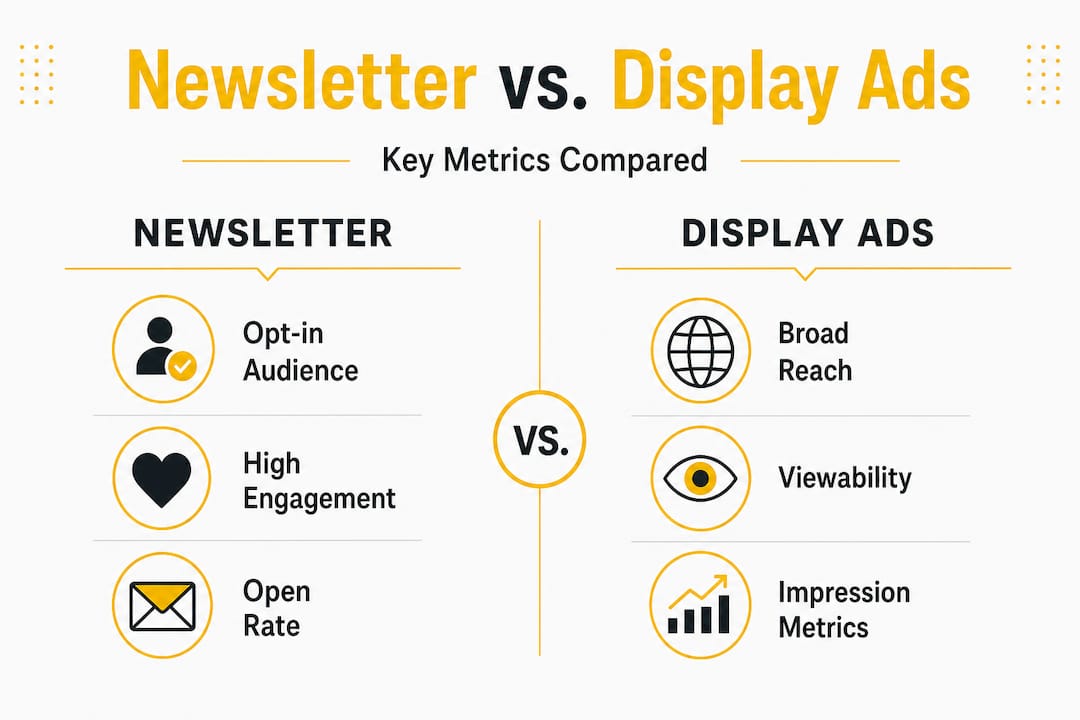
Key insight: A display campaign generating two million impressions at a 65% viewability rate has roughly 1.3 million technically viewable impressions. But how many of those translated into brand recall or action? Without additional measurement layers like attention tracking or brand lift studies, that number tells you very little about real impact.
Our CPC and CPM calculator can help you model the actual cost of engagement across both formats, so you are comparing apples to apples rather than impressions to clicks. For deeper research on channel performance benchmarks, our Newsletter Advertising Guides offers data-backed analysis to sharpen your planning decisions.
Audience quality and targeting: Navigating signal versus noise
Metrics are one side of the story. Now let’s look at how well each channel pinpoints and persuades the right audience, because reach without relevance is just noise.
Newsletter advertising gives you something display campaigns have to work hard to approximate: a known, opted-in audience with verified interest signals. When a publisher sends to their subscriber list, every person on that list made an explicit choice to receive that content. That is a fundamentally different targeting foundation than a third-party cookie pool or a behavioral segment built from browsing patterns.

Display advertising offers broad targeting options: demographic overlays, interest categories, contextual keyword targeting, retargeting lists, and lookalike audiences. These tools are powerful when configured carefully. The challenge is signal quality. As Google’s Active View documentation makes clear, viewability indicates the ad was viewable but cannot guarantee the user was looking at the screen at that time, meaning display campaigns still require attention-aware creative and placement optimization to close the gap between served and seen.
Here is how targeting quality compares across practical campaign scenarios:
Campaign scenario | Newsletter advantage | Display advantage |
B2B decision-maker targeting | High: niche publisher audiences | Moderate: LinkedIn-style overlays |
Consumer product awareness | Moderate: trusted context | High: broad scale reach |
Retargeting warm prospects | Moderate: depends on list match | High: cookie-based retargeting |
Niche interest communities | High: enthusiast publisher lists | Low: broad segment matching |
Geographic precision | Moderate: publication reach varies | High: geo-targeting is granular |
Newsletter sponsorships align your brand with publisher editorial tone, which creates a contextual trust transfer that display placements cannot produce organically
Display campaigns can scale rapidly across platforms, making them efficient for top-of-funnel awareness where individual impression quality matters less than volume
Newsletter dedicated sends put your brand as the sole sponsor, eliminating the creative clutter that reduces display ad recall
Display retargeting remains one of the most cost-efficient ways to stay visible to users who already showed intent on your site
The newsletter marketplaces guide walks through how to evaluate publisher audience quality before committing spend, which is a critical step many brands skip when buying newsletter inventory for the first time.
Pro Tip: Before comparing open rates to click-through rates across channels, normalize your data. Use cost-per-engaged-visitor rather than raw CTR. This gives you a common denominator that reflects actual audience behavior, not just format mechanics.
Making the choice: When to use newsletter vs display advertising
Having dissected metrics and targeting, let’s lay out practical criteria for choosing the right format for your next campaign. Both have genuine strengths. The key is matching format to objective.
Use newsletter advertising when your campaign requires audience trust. If you are launching a new product to a skeptical or niche audience, appearing inside a respected publisher’s newsletter signals credibility. The reader trusts the publication, and some of that trust extends to your placement.
Use display advertising when scale and speed are the priority. If you need rapid awareness at high volume across broad demographics, programmatic display can deliver that reach efficiently. Display campaigns can be live within hours and scaled across thousands of placements.
Choose newsletters for campaigns where engagement rate is the primary KPI. Newsletter readers are in active consumption mode. Click rates in newsletter placements consistently outperform standard display benchmarks in comparable verticals, particularly for B2B and enthusiast audiences.
Choose display for retargeting and dynamic creative strategies. Display platforms excel at serving personalized creative to users based on their recent behavior. If someone visited your pricing page, a display retargeting campaign keeps your brand present through the consideration phase.
Evaluate your creative resources before deciding. Newsletter placements often require copy-forward creative that reads naturally within editorial content. Display campaigns may require multiple creative sizes, A/B testing infrastructure, and ongoing bid optimization. Your team’s bandwidth matters.
Avoid assuming that inbox placement equals guaranteed attention. Even newsletter advertising requires strong subject line performance, compelling creative within the email body, and a clear call to action. A poorly executed newsletter placement underperforms just as a poorly optimized display campaign does.
As the placement mechanics documentation reinforces, newsletter ads run with known audience context while display placements depend on viewability and attention measurement to determine downstream lift. This is not an argument against display. It is an argument for building campaigns with eyes open to what each format can and cannot guarantee.
If you are evaluating a CPC strategy for newsletters, pay close attention to publisher open rate benchmarks. A newsletter with a 40% open rate and strong subscriber engagement will deliver more cost-effective clicks than one with a large list and low engagement, even at a lower flat rate.
Pro Tip: Run a head-to-head test with a controlled audience. Place the same core message in a newsletter sponsorship and a comparable display placement targeting the same demographic. Measure cost-per-click, downstream conversion rate, and post-click time on site. The data will tell you which format earns real attention from your specific audience.
Our take: Rethinking how brands measure impact in digital campaigns
Here is the uncomfortable truth about digital advertising measurement: most brand teams are still optimizing for metrics that were designed for a different era of the internet. Impressions made sense when attention was easier to capture and digital environments were less crowded. Viewability standards were an improvement. But viewable impressions in 2026 are not a reliable proxy for business outcomes.
The real issue is not which format is better. It is that marketers often apply display-era thinking to every channel, including newsletters. They expect a single exposure to drive conversion. They measure newsletter campaigns by impression volume rather than subscriber engagement depth. They treat a click as the end of the measurement story rather than the beginning.
What we consistently see is that brands performing well in newsletter advertising are not just running better ads. They are thinking about audience relationships differently. They prioritize creative email engagement because they understand that a reader who clicks through a newsletter placement and spends three minutes on a landing page is more valuable than ten display impressions that generated no recall.
The smartest campaigns we see are not choosing between newsletter and display. They are building sequential journeys where display creates initial awareness at scale, and newsletter placements convert that awareness into genuine consideration from audiences who are primed to engage. That is not a novel idea. But executing it requires honest attribution, channel-appropriate creative, and the willingness to measure engagement quality rather than just quantity.
Stop defending impressions in your reporting decks. Start defending engaged audiences.
Connect your campaigns to the right digital audiences
If these comparisons between newsletter and display advertising have shifted how you think about your next campaign, the practical next step is finding the right tools to execute with precision.
Media Intercept is built for exactly this kind of decision. Whether you are a brand looking to reach opted-in audiences through premium publisher relationships, or a publisher looking to monetize your subscriber base with the right advertisers, the platform handles the complexity so you can focus on strategy. Explore the newsletter advertising for brands section to see how flexible CPC and CPM options let you optimize for performance or predictable spend. If you manage a publication and want to maximize revenue from your audience, the newsletter monetization platform gives you access to brand demand without requiring exclusivity. Our team is ready to help you plan campaigns that connect the right message to the right audience at the right moment.
Frequently asked questions
What is the primary advantage of newsletter advertising over display advertising?
Newsletter advertising targets opted-in subscribers, leading to higher relevance and often stronger engagement than display ads because the audience context is known and verified. As placement mechanics confirm for newsletter ads, the audience relationship is built into the format itself.
How is viewability measured for display ads?
Viewability uses MRC standards, requiring at least 50% of an ad’s pixels to be visible for at least one second, but this threshold does not confirm that the user was actually looking at the screen or absorbed the message.
Can display ads achieve the same level of audience targeting as newsletters?
Display ads offer broad targeting options but rely on inferred signals, while newsletters deliver granular targeting through verified publisher subscriber relationships, which typically produces cleaner audience quality for niche campaigns.
Should marketers use both newsletter and display advertising in campaigns?
Integrating both formats is a strong strategy: display builds broad awareness at scale, while newsletter placements convert that awareness into engaged consideration from high-trust, opted-in audiences, resulting in more complete campaign performance.
Recommended