Unlock Higher Engagement With Creative Email Formats

Most marketing teams treat creative formats as the last item on the checklist. You finalize the copy, lock in the offer, and then hand it off to a designer to “make it look good.” That approach leaves serious performance on the table. Creative format is not decoration. It is the structural decision that determines whether your email feels like a broadcast or a conversation, and whether a reader scrolls past or takes action. Understanding format as a strategic lever, not a cosmetic one, is what separates campaigns that generate real results from those that generate reports full of excuses.
Table of Contents
Key Takeaways
Point | Details |
Creative format matters | The structure and style of your emails are as influential as your message for driving results. |
Match format to journey | Select creative formats that map to specific stages and goals within your customer lifecycle. |
Experiment for growth | Regularly test and optimize creative variations to discover what best boosts your campaign performance. |
Leverage automation | Automation and data relevance enable smarter use of creative formats for higher engagement. |
What are creative formats in email campaigns?
Creative formats are the structural and design frameworks that shape how your email content is organized, presented, and experienced by the reader. This goes well beyond color palettes and font choices. Format includes the overall layout, the type of content featured, the level of interactivity, the narrative structure, and the visual hierarchy that guides the reader’s eye from subject line to call to action.
Common creative formats include:
Newsletter layouts that bundle multiple stories, links, and sponsor placements into a single curated send
Single-message promotional emails focused on one product, offer, or announcement
Interactive emails with embedded polls, quizzes, carousels, or countdown timers
Storytelling layouts that walk readers through a narrative arc before presenting an offer
Sponsored content placements integrated naturally within a publisher’s existing format
Plain-text or minimal-design emails that simulate personal correspondence for high-trust contexts
The strategic role of format selection is often underestimated. Format is not just about aesthetics. It signals intent. A multi-section newsletter communicates ongoing value and relationship. A clean, single-focus email communicates urgency or exclusivity. Choosing the wrong format for your objective is like writing a great script and staging it in the wrong theater.
“Creative formats become part of journey responses instead of only standalone campaigns.”
This shift is significant. When formats are tied to specific triggers and lifecycle stages, they stop being one-off sends and start functioning as responsive, relevant touchpoints. You can explore email format strategy resources and see how dedicated email campaigns use format to drive focused outcomes at scale.
Types of creative formats and when to use them
With a clear understanding of what creative formats encompass, it’s crucial to know which formats suit which marketing needs. Not every format fits every goal, and using the wrong one at the wrong moment creates friction instead of momentum.
Here is a practical comparison of the most common formats:
Format | Best campaign use | Engagement strength | Common pitfall |
Newsletter | Audience nurturing, brand awareness | High click variety, trust building | Overloading with too many topics |
Single-product email | Promotions, launches, limited offers | Focused conversion, urgency | Feeling too transactional without context |
Interactive email | Re-engagement, surveys, preference capture | High novelty response, data collection | Rendering issues on older email clients |
Sponsored content | Awareness, audience borrowing | Native feel, publisher trust transfer | Misalignment with publisher audience |
Plain-text email | Relationship touchpoints, high-trust moments | Personal tone, high open response | Looks unpolished if used at wrong stage |
Choosing the right format starts with a clear question: what do you need the reader to do, and where are they in their relationship with your brand?
Here is a simple process for making that call:
Define the campaign objective first. Are you building awareness, driving a click, capturing data, or re-engaging a lapsed segment? The objective narrows your format options immediately.
Map the reader’s lifecycle stage. A new subscriber needs a different format than a loyal customer who has purchased three times. Early-stage contacts respond better to value-rich newsletters. Later-stage contacts respond to tighter, action-oriented formats.
Assess your content type. Long-form storytelling fits a narrative layout. A single discount code fits a clean promo format. Forcing content into the wrong structure reduces clarity.
Check your audience’s technical environment. Interactive formats are powerful but require email clients that support them. Know your audience’s typical client before investing in advanced interactivity.
Review past performance data. Your own historical data is the best guide. If a specific format has consistently outperformed others for a particular segment, that is your baseline to build from.
Trigger-based journeys require formats tailored to different stages of customer engagement, not just one-size-fits-all broadcasts. This means your format library should grow alongside your segmentation strategy.
Pro Tip: Align your format with the specific stage of your customer journey. A re-engagement campaign using a newsletter format when a targeted single-message email would be more appropriate is a common and costly mismatch. Review your engaging newsletter strategies to see how format and content work together at each stage.
You can also explore dedicated email formats to see how a focused, single-message structure performs when the goal is direct response.
How creative formats drive engagement and conversion
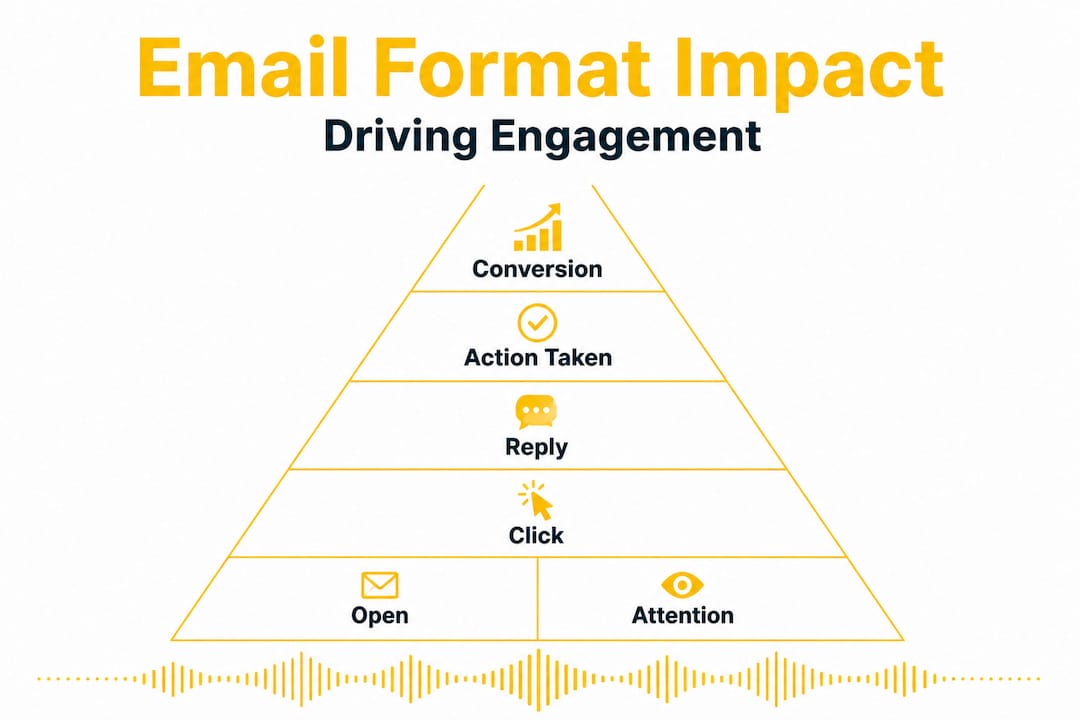
Once you know which creative formats to use, it’s essential to understand how these choices translate to measurable engagement benefits. Format decisions influence behavior at every stage of the email experience, from the preview pane to the post-click landing page.

Here is how format choices map to specific engagement outcomes:
Format choice | Primary engagement impact | Conversion goal supported |
Visual hierarchy with clear CTA | Increases click-through rate | Direct response |
Storytelling narrative structure | Increases time-on-email and brand affinity | Consideration and trust |
Interactive elements (polls, quizzes) | Boosts reply and click rates | Data capture, preference learning |
Personalization hooks in layout | Improves open-to-click ratio | Relevance and loyalty |
Sponsored native placement | Drives referral traffic with high intent | Awareness and acquisition |
The specific elements that consistently lift response rates include:
A/B tested design variations that isolate format variables like single-column vs. two-column layouts, image-heavy vs. text-forward structures, and button placement
Personalization hooks embedded in the format itself, such as dynamically populated sections based on past behavior or preferences
Interactive features that invite a micro-commitment before the main CTA, warming up the reader’s intent
Clear visual anchors that guide the reader’s eye predictably toward the action you want them to take
Consistent brand signals within the format that build recognition and trust over time
Creative email formats can shift an overall engagement model from simple broadcasts to two-way conversations and action-taking. That shift is not just philosophical. It shows up in your metrics. Brands that treat format as a strategic variable report stronger click-through rates, longer engagement times, and higher conversion rates compared to those running static, one-size-fits-all templates.
Personalized email strategies become far more effective when the format itself is designed to surface that personalization clearly. And storytelling in campaigns works best when the layout reinforces the narrative, not fights against it.
Practical frameworks for integrating creative formats
To move from theory to application, here are concrete frameworks for starting and scaling the use of creative formats in your email strategy. The goal is to build a repeatable process, not a one-time experiment.
Audit your current format library. List every email template your team currently uses. Categorize each by format type and map it to the campaign objective it was built for. Gaps in your library reveal where you are missing format options for specific goals or lifecycle stages.
Prioritize one new format to test per quarter. Trying to overhaul your entire format strategy at once creates confusion. Pick one underserved use case, build a new format for it, and run a controlled test against your existing approach.
Segment your test audience by lifecycle stage. Do not test a new format on your entire list. Isolate a segment where the format is most relevant, such as testing an interactive re-engagement format only on subscribers who have not clicked in 90 days.
Set clear success metrics before you launch. Define what a “win” looks like for each format test. Is it click-through rate, conversion rate, reply rate, or unsubscribe rate? Knowing this in advance prevents post-hoc rationalization of mixed results.
Document and share results across your team. Format learnings are institutional knowledge. A format that outperforms for one segment or campaign type should be codified and made available for future use.
Build a creative review cycle. Schedule quarterly reviews of your format performance data. Retire formats that consistently underperform. Invest in iterating formats that show strong signals.
Lifecycle automation and data-driven relevance are key in making creative formats part of triggered journey responses. This means your format decisions should be connected to your automation logic, not managed separately from it.
When you are working with sponsored content best practices, format integration becomes even more critical. The format needs to serve both the publisher’s editorial tone and the advertiser’s campaign goal simultaneously. And for publishers looking at monetizing specialized content, format choices directly affect how premium your inventory appears to potential sponsors.
Pro Tip: Build creative iteration into your regular campaign schedule, not just your quarterly planning cycles. Small, frequent format tests generate faster learning than large, infrequent overhauls. Even a single layout variable tested monthly compounds into significant performance improvements over a year.
Why creative format strategy is the missing link in modern email marketing
After digesting practical frameworks, let’s step back and challenge common wisdom with a candid industry perspective.
Here is what we see consistently across campaigns: brand teams spend 80% of their preparation time on copy and offer strategy, and maybe 20% on format. The copy gets reviewed in three rounds. The format gets approved in one. That imbalance is a performance problem, and most teams do not realize it until they look at the data.
We have seen campaigns where a format change, with zero changes to copy, produced a 30% lift in click-through rate. The message was identical. The offer was identical. The audience was identical. The only variable was switching from a multi-section newsletter layout to a single-focus email with one clear CTA. The format made the decision easier for the reader, and the reader responded accordingly.
The counterintuitive reality is that readers do not experience your email as copy first and format second. They experience it as a visual and structural whole. The format sets their expectations before they read a single word. A cluttered layout signals low priority. A clean, focused structure signals that something important is here. That signal happens in under two seconds.
Creative formats are underleveraged as tools for influencing customer action in journey-based email marketing. This is not a minor gap. It is a systematic blind spot that costs brands measurable performance every send.
The brands that get this right treat format as a first-class strategic decision, not a production task. They assign ownership of format strategy to someone on the team. They track format performance as a distinct variable in their reporting. They build format iteration into their roadmap. And they consistently outperform competitors who are still treating email design as a finishing step.
If you are running newsletter CPC strategies, format is directly tied to your cost efficiency. A format that drives higher click-through rates reduces your effective cost per click. That is a financial argument for format investment, not just a creative one.
Supercharge your email campaigns with proven creative solutions
You now have a clear picture of how creative formats drive real campaign performance. The next step is putting that knowledge into action with the right platform behind you.
Media Intercept connects brands and publishers through premium newsletter inventory and dedicated email campaigns built for performance. Whether you are looking to test new formats across targeted audiences or scale what is already working, our team helps you plan, execute, and optimize campaigns with speed and precision. For publishers ready to maximize revenue through format-forward placements, our newsletter monetization solutions handle demand, execution, and reporting without requiring exclusivity. And for brands ready to reach engaged, qualified audiences, explore our advertising opportunities and let’s plan your next campaign together.
Frequently asked questions
What is a creative format in email marketing?
A creative format is the unique structure or design chosen for an email, including layout, interactivity, and content arrangement tailored for campaign objectives. Formats become part of journey responses rather than functioning only as standalone campaigns.
How do creative formats impact email campaign performance?
They drive higher engagement and conversion by matching content structure to each recipient’s journey stage and communication goal. Creative formats shift engagement from one-way broadcasts to two-way conversations that prompt action.
When should different creative formats be used in email campaigns?
Select formats based on customer lifecycle stage: newsletters for nurture, single-message promos for activation, and interactive content for re-engagement. Trigger-based journeys require formats tailored to each stage, not uniform broadcasts across your entire list.
How do I test which creative format works best?
Use A/B testing and segment analysis to measure which formats deliver higher engagement at each touchpoint, isolating one format variable at a time to get clean, actionable data.
Can creative formats be automated based on customer behavior?
Yes, automation tools can trigger different formats for each customer segment based on behavioral signals and lifecycle data. Lifecycle automation and data-driven relevance make it possible to serve the right format to the right person at the right moment without manual intervention.
Recommended