Newsletter Marketplaces: Your Guide to Measurable Success
- Elise Harper

- May 5
- 10 min read
Newsletter advertising is having a moment, and the numbers back it up. Email outperforms display and social by 3 to 10 times on click-through rate, with an average ROI of $36 for every $1 spent. Yet many marketing managers still treat newsletters as a secondary channel, something you bolt on after social and search budgets are locked. This guide changes that perspective. You’ll learn exactly what newsletter marketplaces are, how to compare the top platforms, and what it takes to turn newsletter advertising into a repeatable, measurable performance channel.
Table of Contents
Key Takeaways
Point | Details |
High ROI channel | Newsletter marketplaces routinely outperform social and display ads for returns and click rates. |
Match goals to platforms | The right marketplace depends on your campaign type, audience, and measurement preferences. |
Platform features vary | Ad networks offer different targeting, analytics, and integration options—comparison is key. |
Execution drives outcomes | Creative approach, placement selection, and ongoing optimization determine campaign success. |
What are newsletter marketplaces?
A newsletter marketplace is a platform that connects advertisers with newsletter publishers in one centralized environment. Instead of hunting down individual publishers, negotiating rates one by one, and managing a patchwork of spreadsheets, you get a single interface to browse inventory, compare pricing, book placements, submit creative, and track performance.
For advertisers, that means faster campaign setup and more consistent reporting. For publishers, it means a reliable demand pipeline without the overhead of managing individual advertiser relationships. Both sides benefit from standardized workflows and shared data.
Here’s what a well-built newsletter marketplace typically offers:
Publisher discovery: Search and filter newsletters by niche, audience size, engagement rates, and demographics
Transparent pricing: Compare flat-fee, CPM, or CPC options across multiple publishers at once
Creative management: Upload and manage ad formats within the platform
Integrated analytics: Track opens, clicks, and conversions without relying on publisher-provided screenshots
Audience segmentation: Target by industry, geography, job function, or subscriber behavior
Well-known newsletter marketplaces include Paved, Beehiiv Ad Network, Dupple, Passionfroot, Lettergrowth, BuySellAds, and Liveintent. Each takes a different approach to inventory access, targeting depth, and pricing structure.
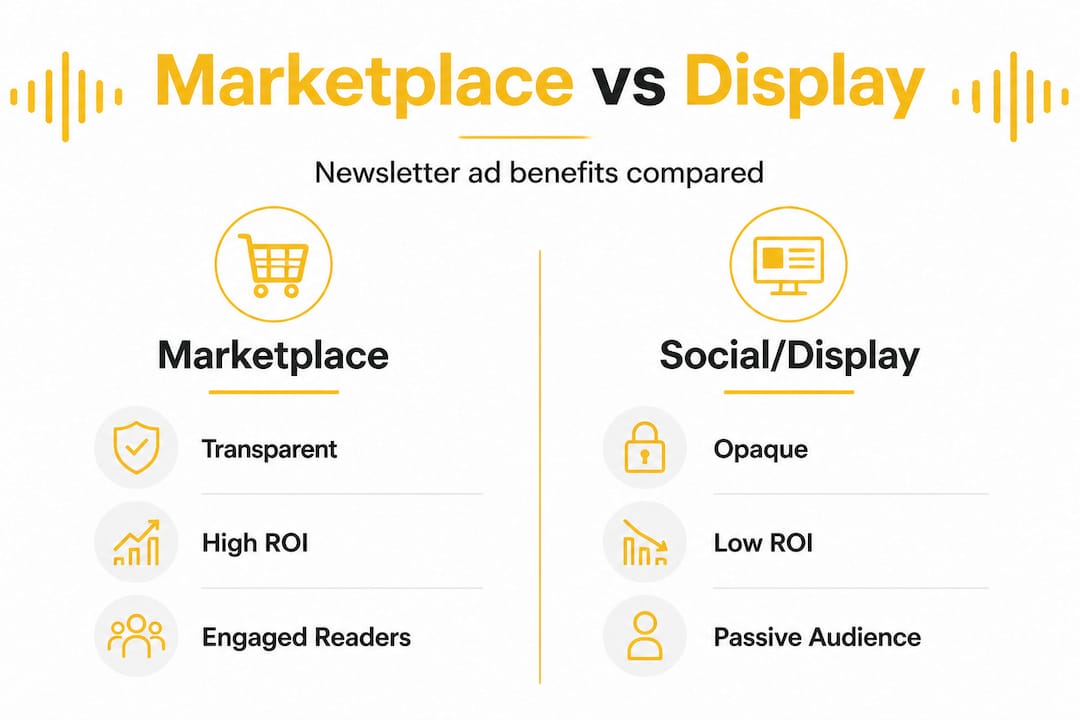
The core advantage over traditional channels is transparency. Display advertising often obscures where your ad actually appeared. Social platforms control targeting parameters and can change their algorithms overnight. Newsletter marketplaces put you in direct contact with specific, known audiences inside editorial environments where readers have actively opted in.
Understanding performance marketing basics helps you frame newsletter marketplaces correctly. They are not just awareness plays. When configured well, they function as full-funnel channels that drive both brand recognition and direct response.
Pro Tip: Before you evaluate any marketplace, write down your primary campaign goal. Are you driving leads, building brand awareness, or retargeting existing customers? That single decision will narrow your platform shortlist significantly.
Personalization at scale is another area where newsletter marketplaces outperform generic programmatic channels. Because publishers know their audiences deeply, you can align your message with highly specific reader interests in a way that broad-reach digital channels simply cannot replicate.
Key benefits for marketers
With an understanding of the marketplace model, explore why marketers are increasingly allocating serious budget to these platforms.
The engagement numbers are genuinely striking. Newsletter benchmarks for 2026 show open rates between 30% and 50% depending on niche, click-through rates of 2% to 5% on total sends, and click-to-open rates (CTOR) of 10% to 15%. Compare that to a typical display CTR of 0.1% and the performance gap becomes hard to ignore.
Here’s a summary of the core benefits marketers consistently report:
Higher engagement: Readers choose to subscribe and read newsletters, creating an opt-in environment that drives stronger attention and action
Audience trust: Editorial newsletters carry authority. When your brand appears alongside trusted content, that credibility transfers
Precise targeting: You can select publishers whose audiences match your ideal customer profile by industry, role, income level, or interest
Transparent ROI: Unlike programmatic display, you know exactly which newsletter your ad ran in and can track performance directly
Reduced dependency on platforms: Newsletter advertising does not rely on third-party cookies, algorithm changes, or social platform policy shifts
“Email marketing consistently delivers the highest ROI of any digital channel, and newsletter advertising inherits that advantage while adding the editorial trust and niche targeting that generic email blasts lack.”
The $36 return for every $1 spent in email is a widely cited benchmark, and newsletter ad performance metrics show that sponsored placements in high-quality newsletters can exceed even that average when audience fit is strong.
For agencies managing multiple brand accounts, the scalability argument is equally compelling. A single marketplace account can support campaigns across dozens of publishers, with standardized reporting that makes cross-client analysis straightforward. You can access detailed ROI analysis to benchmark your campaigns against industry performance data and identify where to increase investment.
Leading newsletter marketplaces compared
Given these benefits, marketers often ask: which platforms actually deliver? Let’s break down the top options side by side.
Major newsletter marketplace platforms each serve different advertiser needs. Paved, Beehiiv Ad Network, Dupple, Passionfroot, Lettergrowth, BuySellAds, and Liveintent represent the primary options available to marketers today. Understanding their differences saves you time and budget.
Platform | Best for | Pricing model | Targeting depth | Ease of use |
Paved | Quick testing, B2C brands | Flat-fee, CPC | Niche, audience size | High |
Beehiiv Ad Network | Publisher-integrated campaigns | CPM, flat-fee | Interest, demographics | High |
Dupple | B2B advertisers | Flat-fee | Industry, job function | Medium |
BuySellAds | Scale and volume | CPM, flat-fee | Category, geography | Medium |
Liveintent | Programmatic buyers | CPM, programmatic | Behavioral, contextual | Low to medium |
Passionfroot | Creator-focused brands | Flat-fee | Creator niche | High |
Lettergrowth | Growth-focused publishers | Referral and sponsorship | Niche | Medium |
Paved is ideal for quick testing and is free for advertisers to access, making it a natural starting point for teams new to newsletter advertising. Beehiiv’s native ad network integrates directly with publishers on its platform, which simplifies execution but limits your inventory to Beehiiv-hosted newsletters. Liveintent takes a programmatic approach, which suits buyers who want scale but may sacrifice some of the direct editorial alignment that makes newsletter advertising effective.
One important pitfall: overcrowded newsletter issues. Avoid newsletters with too many ads per send, as reader attention is finite and excessive ad density directly reduces CTR. A newsletter with one or two well-placed sponsorships will almost always outperform one running five or six competing placements.
For a broader perspective on how these platforms compare to other content-based advertising formats, podcast marketplace comparisons offer useful structural parallels. Both channels share the dynamic of audience trust, niche targeting, and direct creator relationships.
When comparing newsletter ad platforms for your specific use case, prioritize publishers with demonstrated audience engagement over raw subscriber counts. A newsletter with 20,000 highly engaged subscribers in your target vertical will outperform a 200,000-subscriber list with low open rates every time.
Pro Tip: Ask publishers for their last three months of average open and click rates before committing to a placement. Any reputable publisher will share this data willingly. If they hesitate, that tells you something important.
Choosing the right marketplace for your goals
Once you know what the main platforms offer, the next challenge is choosing the one aligned to your needs.
The selection process works best when you follow a structured approach rather than defaulting to the most well-known name. Here’s a practical sequence:
Define your primary objective. Lead generation, brand awareness, event promotion, and product launches each call for different placement types and pricing models.
Identify your target audience. Get specific: industry, job title, company size, geographic region, and content interests all matter.
Set your budget range. Some platforms have minimum campaign spends. Knowing your floor and ceiling eliminates options early.
Evaluate engagement benchmarks. Use 2026 newsletter benchmarks as your baseline: open rates of 30% to 50%, CTR of 2% to 5%, and CTOR of 10% to 15%.
Assess reporting capabilities. Can you track conversions, not just clicks? Does the platform integrate with your existing analytics stack?
The table below maps common campaign variables to marketplace strengths, helping you match your goals to the right environment.
Campaign variable | Best marketplace fit |
B2B lead generation | Dupple, Paved (B2B filters) |
Consumer brand awareness | Beehiiv, Passionfroot |
Programmatic scale | Liveintent, BuySellAds |
Quick campaign testing | Paved (free access) |
Creator audience alignment | Passionfroot, Lettergrowth |
Volume and reach | BuySellAds, Liveintent |
Choosing a sponsorship that aligns with your audience profile is more important than selecting the platform with the most publishers. A smaller, more focused marketplace with better audience data will outperform a large, unfocused one for most performance-driven campaigns.
Publication frequency also matters more than most marketers realize. A weekly newsletter with consistent readership delivers more predictable results than a daily newsletter where open rates fluctuate widely. Evaluate the cadence and consistency of any publisher before committing to a long-term placement.
Maximizing results: Tactics and pitfalls
With your marketplace chosen, what separates good from great outcomes? Tactical execution is the difference.

The most effective newsletter campaigns share a few consistent characteristics. They match the tone and format of the newsletter they appear in. They include a single, clear call to action. And they are measured at the CTOR level, not just raw opens, because CTOR tells you how many engaged readers actually clicked.
Here is a practical checklist for maximizing campaign ROI:
Match your creative to the newsletter’s editorial voice. Ads that feel native to the content perform significantly better than generic display-style copy.
Use a dedicated landing page. Sending newsletter traffic to your homepage dilutes attribution and reduces conversion rates.
Track CTOR, not just CTR. CTOR measures clicks among openers, giving you a cleaner signal of message relevance.
Split test subject line adjacent copy. The text immediately before and after your placement influences how readers engage with it.
Monitor placement position. Top-of-newsletter placements typically outperform mid-newsletter or footer placements, though this varies by audience.
Review performance after three sends. One send is rarely enough data. Three sends give you a reliable baseline.
“The biggest mistake we see is marketers treating newsletter advertising as a set-it-and-forget-it channel. Optimization is ongoing, and even small adjustments to timing, placement, or creative can produce meaningful performance lifts.”
Avoiding crowded newsletter issues is one of the simplest ways to protect your CTR. When a newsletter runs multiple competing sponsorships in a single issue, reader attention is split and your placement loses impact. Prioritize exclusive or limited-ad-count placements whenever your budget allows.
A CPC strategy for newsletters can also protect your budget during the testing phase. Paying per click rather than per send means you only pay when readers engage, which reduces risk while you identify which publishers and formats perform best for your brand.
Our perspective: What most marketers get wrong about newsletter marketplaces
After equipping you with tactics, it’s worth challenging some standard thinking in this space.
Most marketers approach newsletter marketplaces the same way they approach programmatic display: find the cheapest inventory, run the campaign, check the CTR, and move on. That approach misses the most valuable thing newsletter advertising actually offers.
Newsletters are relationship channels. Readers subscribe because they trust a specific voice or publication. When your brand appears consistently in that environment, you are not just buying impressions. You are borrowing trust over time. A single placement might generate a spike in clicks. But a consistent presence across multiple issues builds the kind of brand familiarity that converts readers into customers weeks or months later.
The industry’s obsession with one-off CTR metrics undervalues this dynamic entirely. We see brands pull out of newsletter campaigns after one or two sends because the immediate conversion numbers look modest. What they miss is that newsletter audiences often require multiple exposures before they act, just like any other channel. The difference is that each exposure in a newsletter happens inside a high-trust, low-distraction environment.
The smarter approach is to combine direct response and brand awareness objectives within your newsletter strategy. Use performance-focused placements to drive immediate action while simultaneously building brand recognition through consistent presence. That combination produces compounding returns that neither tactic achieves alone.
Marketplaces make this easier by giving you access to multiple publishers and formats under one roof. But the strategic thinking still has to come from you. Treat newsletter advertising as a relationship-building channel with measurable performance layers, and your results will consistently outperform teams chasing one-off CTR wins.
See how Media Intercept simplifies newsletter marketplace success
Ready to move from theory to results? Media Intercept is built specifically for brands and agencies that want newsletter advertising to work as a serious performance channel, not just an experiment.
Our platform connects you with premium newsletter publishers across a range of verticals, with flexible CPC and flat-fee pricing options that fit both performance and brand-building goals. You get standardized reporting, efficient campaign workflows, and a team that helps you plan, execute, and optimize every placement. Whether you’re exploring Media Intercept for the first time or ready to scale an existing newsletter strategy, our solutions for advertisers give you the tools to run campaigns with confidence. You can also download a whitepaper to go deeper on newsletter advertising strategy and benchmark data. Let’s plan your next campaign together.
Frequently asked questions
What is a newsletter marketplace and how does it work?
A newsletter marketplace connects advertisers and publishers in one platform, streamlining the buying and selling of newsletter ad placements with built-in targeting, creative management, and analytics. Platforms like Paved, Beehiiv, and Liveintent each offer distinct approaches to inventory access and pricing.
How do newsletter ad platforms compare to social or display ads?
Newsletter ad platforms typically deliver 3 to 10 times higher CTRs than display or social ads, with email averaging $36 in return for every $1 spent, making them a significantly more transparent and measurable channel.
Which newsletter marketplace is best for quick testing?
Paved offers free advertiser access and an intuitive interface, making it the most practical starting point for teams that want to test newsletter advertising without a large upfront commitment.
What are typical newsletter ad KPIs marketers should track?
Marketers should prioritize open rates (30% to 50%), CTR (2% to 5%), and CTOR of 10% to 15% as their core benchmarks, with CTOR being the most reliable indicator of message relevance among engaged readers.
How can I avoid performance pitfalls in newsletter advertising?
Select placements in newsletters with limited ad inventory per issue and avoid crowded sends where reader attention is split across multiple competing sponsors, which directly reduces your CTR and overall campaign effectiveness.
Recommended
Launch newsletter sponsorship campaigns with flexible pricing and transparent reporting. Get started with Media Intercept.